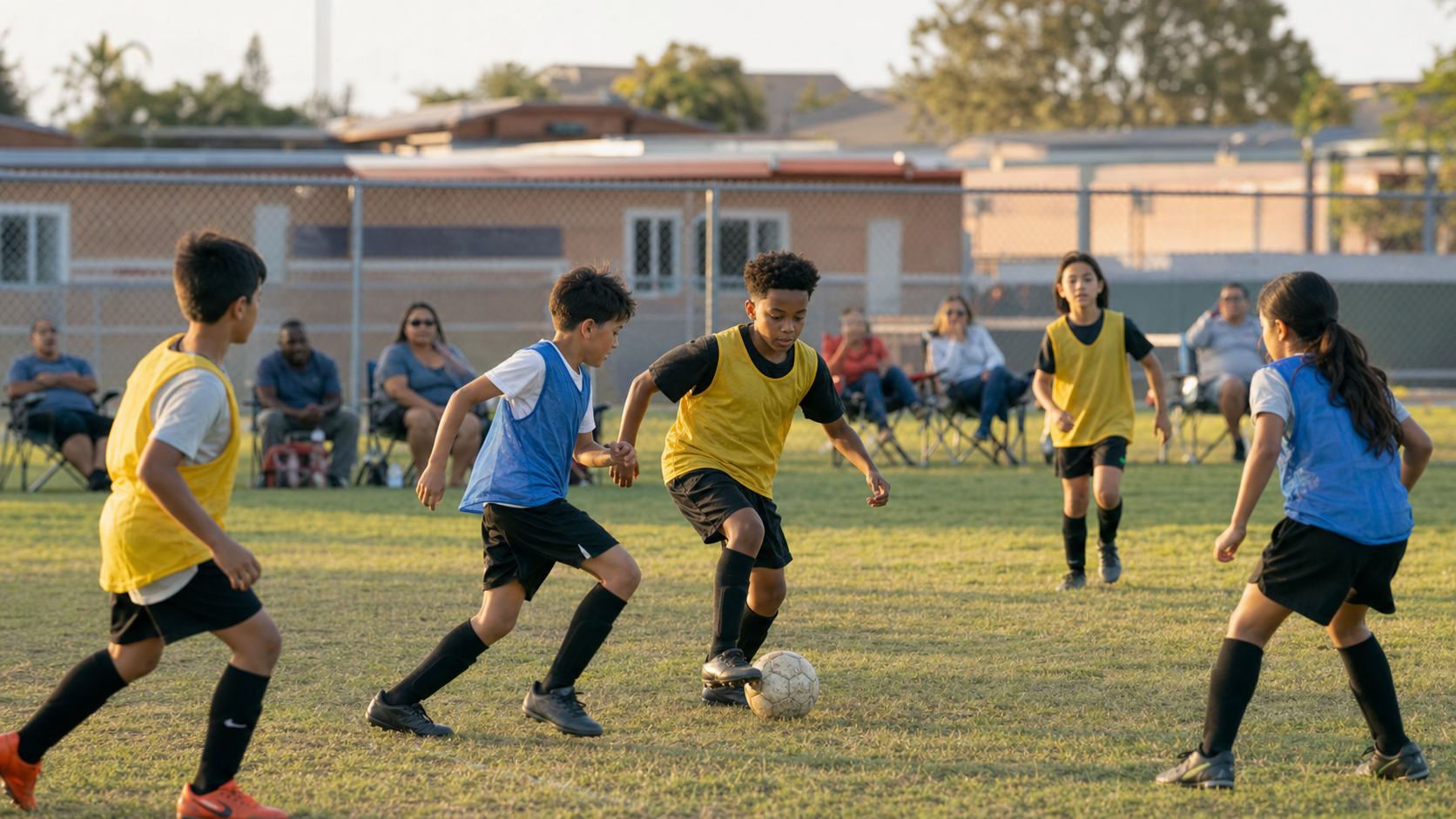
Community fields and local programming are central to the accessibility question raised by the AP-Ipsos poll. — Illustration generated with AI.
A new Associated Press-Ipsos poll reinforces what many soccer parents see every weekend: organized sports can be enormously valuable for children, but time demands and household costs can determine who gets to participate. The findings should add urgency to U.S. Soccer’s work on clearer, more accessible player pathways—especially as the federation seeks to widen the game rather than reserve its best development opportunities for families with the most money and flexibility.
The poll, conducted July 21-26 among 1,737 U.S. adults and including 510 parents of K-12 children who play youth sports, found that parents overwhelmingly believe youth sports’ benefits outweigh their drawbacks. Americans cited fitness, teamwork, friendships, resilience, reduced screen time, and lessons in hard work and commitment among the principal gains.
For soccer families, those results validate the core appeal of the sport: a child can build skills, confidence, community, and healthy habits without the experience needing to be defined by rankings, recruiting, or an elite roster at age 10.
But the survey also identifies a participation divide. Roughly half of parents with K-12 children said at least one child plays an organized sport; participation rises to about seven in 10 among households earning $100,000 or more, compared with about four in 10 among lower-income families.
That gap is highly relevant to the direction of youth soccer in the United States. Club fees, travel, tournament schedules, private training, uniforms, and the pressure to “keep up” can turn a sport that is globally accessible into one that is difficult for many American families to sustain. Nearly two-thirds of parents whose children play sports estimated annual spending of up to $2,000 for equipment, fees, training, and travel, the poll found – and of course, at higher levels costs can be much greater. Scheduling and time commitments were also among the biggest family challenges.
What This Means for Pathways
U.S. Soccer’s pathways strategy should be judged partly by whether it gives more players meaningful ways to develop close to home. A strong system does not require every promising player to join a costly travel program, change schools, or commit a family to near-constant weekend travel simply to remain visible.
For parents, practical pathway reform would mean:
- More quality local programming, including community clubs, school-based soccer, and affordable league options.
- Better coach education so player development is not limited to expensive “elite” environments.
- Clearer connections among grassroots soccer, local competitive clubs, academy environments, high school soccer, and college opportunities.
- Talent identification that reaches beyond the families able to pay for high-profile showcases and frequent travel.
- Age-appropriate competition that protects enjoyment, development, and family balance.
The survey also found that 44% of sports parents say potential future name, image, and likeness earnings play at least some role in enrolling a child in sports. That is a reminder that youth sports decisions are increasingly influenced by perceived future opportunity. Soccer leaders should respond by offering parents credible information—not hype—about development, scholarships, college soccer, and the relatively narrow path to professional play.
The main takeaway from the AP-Ipsos findings is that youth soccer has an opportunity to preserve what parents value most while reducing the barriers that exclude players. The healthiest U.S. Soccer pathway may be one that identifies and supports talent wherever it lives, while allowing more children to enjoy the game on terms their families can realistically sustain.
The full study is available for download here.

Ron Stitt
Co-Founder, U.S. Soccer Parent