Coaching Licenses in Youth Soccer: What the Levels Mean and What They Cost
Most parents meet their child’s coach long before they ever hear the word “license.” Then it starts coming up. Someone at the club mentions a C license. A coach disappears for a weekend course. A parent in the group chat says the whole system is a money grab, and that Europe sorted this out years ago.
Here is what the levels actually are, what soccer coaching licenses cost, which ones your child’s league requires, and how the American system really compares to Europe. Some of the common complaints hold up well. Others fall apart the moment you look at the published numbers.
What a coaching license actually is
A coaching license is a qualification issued by U.S. Soccer, the only body in the United States that FIFA recognizes to license coaches. It is not a background check, and it is not SafeSport training. Those are separate requirements that almost every club already enforces, and they are the ones that keep children safe. A license is about whether a coach has been assessed against a national standard for teaching the game.
The structure you see today dates from a rebuild in 2018. U.S. Soccer retired the old F and E licenses, made the introductory module free, and replaced the bottom of the ladder with courses matched to the game a child actually plays. A coach of six-year-olds playing 4v4 now takes a different course from a coach of thirteen-year-olds playing 11v11.
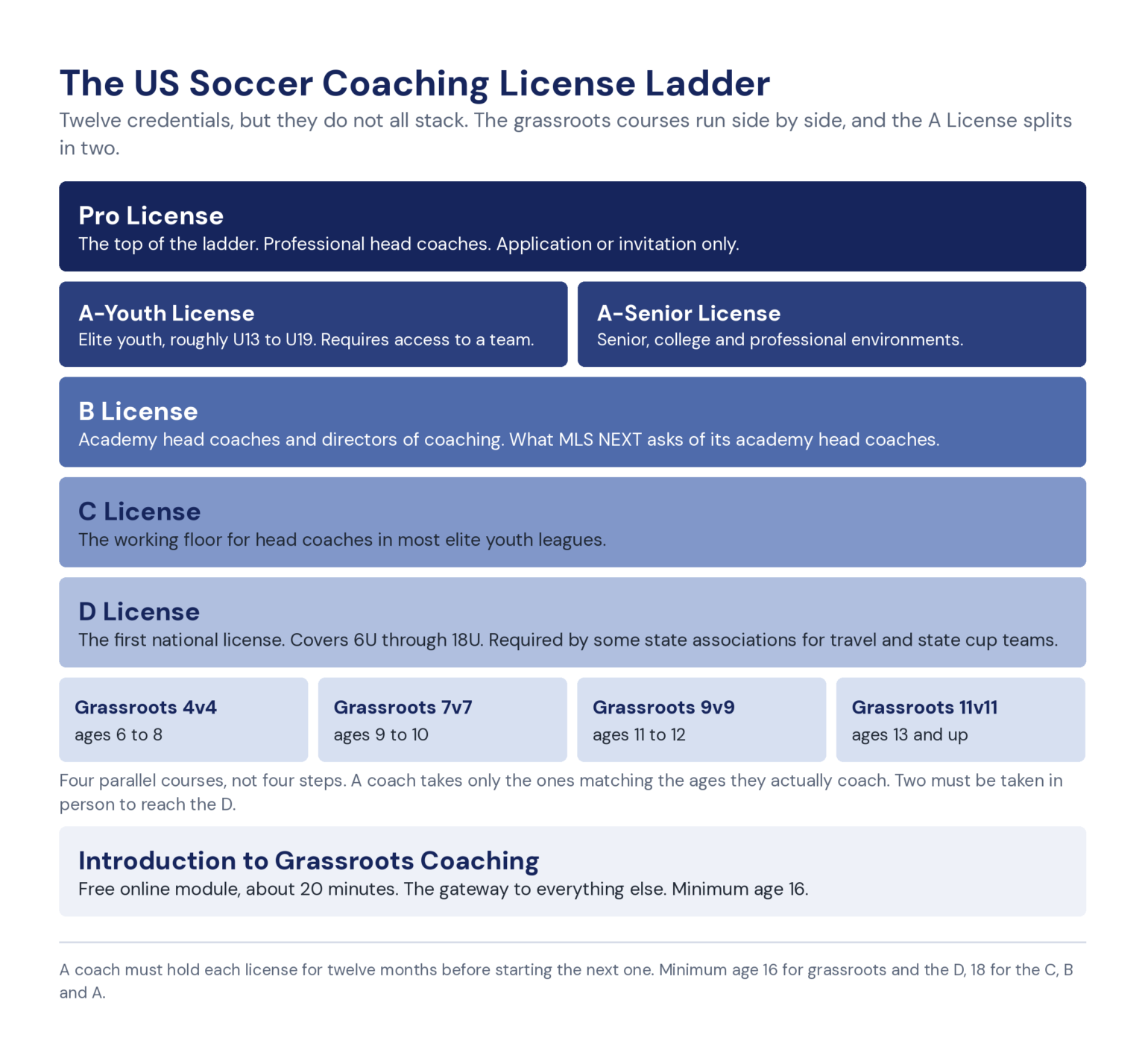
That detail matters for the most common complaint, which is that there are too many levels. Below the D license, the tiers are not stacked one above another. They run sideways. Four separate grassroots licenses cover four game formats, and a coach only needs the ones that match the ages they actually coach.
The license ladder, level by level
There are twelve credentials in the main pathway, but only a handful matter to most families. The grassroots licenses cover recreational and early travel soccer. The D is the first national license. The C and the B are the two that elite leagues actually ask for.
| Level | What it is for | Prerequisite | Minimum time |
|---|---|---|---|
| Introduction to Grassroots Coaching | Free online module. The gateway to everything else. | None. Minimum age 16. | About 20 minutes |
| Grassroots 4v4 | Coaching the 4v4 game, roughly ages 6 to 8 | Introduction module | 2 hrs online / 4 hrs in person |
| Grassroots 7v7 | Coaching the 7v7 game, roughly ages 9 to 10 | Introduction module | 2 hrs online / 4 hrs in person |
| Grassroots 9v9 | Coaching the 9v9 game, roughly ages 11 to 12 | Introduction module | 2 hrs online / 4 hrs in person |
| Grassroots 11v11 | Coaching the full 11v11 game, roughly 13 and up | Introduction module | 2 hrs online / 4 hrs in person |
| D License | The first national license. Covers 6U through 18U. Required by some state associations for travel and state cup teams. | Introduction module plus two in-person grassroots licenses. Minimum age 16. | 45 to 70 hours over 12 to 16 weeks, depending on the association |
| C License | The working floor for head coaches in most elite youth leagues. | D License held 12 months. Minimum age 18. | Five two-day meetings, blended with online work |
| B License | Academy head coaches and directors of coaching. Built around running a performance environment. | C License held 12 months, plus coaching experience. Minimum age 18. | About six months, including two four-day in-person meetings |
| A-Youth License | Elite youth, roughly U13 to U19. Requires access to a team. | B License held 6 to 12 months, and currently coaching. | Three in-person meetings across 10 months |
| A-Senior License | Senior, college and professional environments. | B License held 6 to 12 months. | Two in-person meetings across 11 months |
| Pro License | The top of the ladder. Professional head coaches. | A License plus a professional role. Application or invitation only. | About 12 months |
Two rules shape how long the whole climb takes. A coach must hold each license for twelve months before starting the next one, and two of the grassroots courses must be taken in person before the D is available. Waivers exist for former professionals: three years on a senior national team plus three years coaching allows entry at the C, and five years at national-team or professional level plus five years coaching allows entry at the B. A license from another FIFA-recognized federation can also be recognized.
Specialist tracks most parents never hear about
Goalkeeper B and Goalkeeper A licenses exist as a separate pathway. Costs and entry rules are not published publicly.
The Director of Coaching License, launched in 2019, requires a C license plus at least two years already serving as a club DOC. It is selection-based.
The Elite Formation Coaching License, run with the French Football Federation, is a parallel elite-youth credential rather than a US Soccer license. Participants must hold an A license before the final exam.
What soccer coaching licenses cost
This is where the complaints come from, and they are not baseless.
One thing to understand first: U.S. Soccer does not publish a national price list, and courses are hosted by state associations that set their own fees. So there is no single national number. The figures below are what named associations charged on the dates given, and prices where you live will differ.
- Introduction to Grassroots Coaching is free.
- Grassroots licenses run about $25 online. In person they ranged from $25 to $115 depending on the host, North Texas charged $25 for 4v4 rising to $100 for 11v11, while Ohio charged $75 to $85 in 2026.
- The D License ranged from about $300 to $550. Cal South charged $550 in July 2024; Ohio charged $400 in 2026.
- The C License ranged from about $1,300 to $1,950. Cal South charged $1,695 as a commuter and $1,950 residential; Ohio charged $1,300 and offered 50% reimbursement.
- The B License was listed at $2,875 in tuition through US Club Soccer Texas, spread over about six months with two four-day in-person meetings.
- A and Pro tuition is not published. The Pro License has been widely reported at around $10,000.
Look at the step from the D to the C. The cost roughly quadruples. That single jump is the real source of the “licenses are too expensive” frustration, and it lands exactly where it hurts most, because the C is the level most elite youth leagues expect of a head coach.
Travel is the cost nobody advertises. The higher licenses require multi-day in-person meetings, and courses are not offered everywhere, so flights and hotels sit on top of tuition.
There is help, though it is patchy. The Jill Ellis Scholarship Fund waives half the tuition for women taking the B and the A-Youth. Some state bodies subsidize directly, as Ohio does on the C. And many clubs reimburse coaches for grassroots and D licenses as a matter of policy.
What your child’s league actually requires
Requirements are set league by league, not nationally, and they vary more than most parents expect.
| League or body | Minimum coaching license | What that means in practice |
|---|---|---|
| MLS NEXT | Academy Head Coach: USSF B. Academy Director: USSF A, the USSF Academy Director course, or the Elite Formation Coaching License. | The highest published standard in US youth soccer. Applies across both the Allstate Homegrown and Academy Divisions, with exceptions approved case by case. |
| USL Academy | Head coach: USSF B within two years of appointment. Replacement coach: USSF C. | The only league found that fines clubs for non-compliance. A match cannot be played without a licensed coach on the bench, at a penalty of $500. |
| Girls Academy | Head and assistant coaches: USSF C, with a documented plan to reach the B. GA Director: USSF B, with a plan to reach A-Youth. Aspire coaches: USSF D. | GA publishes escalating minimums with deadlines running to the 2027 season. Failing to meet them can affect a club’s standing. |
| Elite Academy League | Head coach: USSF C. Academy Director: USSF A or B. | The league verifies licenses directly with US Soccer rather than trusting club paperwork. |
| National Academy League | Head coach: USSF C. Academy Director: USSF B, the Academy Director course, or the Elite Formation Coaching License. | Mirrors the MLS NEXT structure one rung lower. |
| ECNL and ECNL Boys | No minimum license level in the competition rules. | ECNL regulates continuing development instead. Every coach must complete set professional development hours each season through the ECNL Coach Education Center before coaching fall matches. |
| ECNL Regional League | Team coaches: USSF D. Director of Coaching: USSF B. (As applied through NorCal club applications.) | Requirements arrive through the club application process rather than the competition rulebook, so they can vary by conference. |
| National 1 League | No minimum level. Five hours of annual professional development before August 1, or a D License or above earned in the past five years. | A development-hours model rather than a license floor. Waivers exist for coaches actively working up the ladder. |
| UPSL Academy Division | USSF D or the United Soccer Coaches Advanced Regional diploma. | Raised to this floor from the 2025-26 season. |
| State associations | Varies widely. Roughly 36 states have some form of compulsory certification for competitive play. | Cal South requires the D for National Cup and California Regional League coaches. Utah requires competition-team coaches to pass at least two in-person grassroots courses. |
| Recreational and town leagues | Typically none. | A background check and SafeSport training are near universal. A coaching license usually is not required at all. |
Two things stand out. The first is that the C and the B are the licenses that carry real weight in the American club market. Below them, at travel and recreational level, the requirement is often a couple of grassroots modules or nothing at all.
The second will surprise people. ECNL, one of the largest elite platforms in the country, sets no minimum license level in its competition rules. It regulates continuing development instead, requiring every coach to complete set professional development hours each season before coaching fall matches. National 1 takes a similar approach, accepting five hours of annual development in place of a license floor. That is a genuine philosophical split: some leagues want the badge, others want proof the coach is still learning.
Is it really cheaper in Europe?
This is the claim that comes up most, usually in the form that the American system is a scam and Europe does it cheaper, faster and with less bureaucracy. It is worth testing properly, because the answer is genuinely split.
| England | Germany | United States | |
|---|---|---|---|
| First real license (C level) | £650, 16 to 20 weeks. Places described as extremely limited. | About €408 all-in for a compact course in Bavaria. | $1,300 to $1,950, depending on host association. |
| B level | £1,250 over 9 to 12 months. 2026/27 applications closed at time of writing. | Roughly €1,525 in Bavarian module fees. | About $2,875 in tuition, plus travel to in-person meetings. |
| A level | £4,150, six residential modules, with competitive priority given to professional clubs. | €6,000 course fee plus about €5,000 board. | Not published by US Soccer. |
| Top license (Pro) | £14,000 over 18 months. Mandatory for Premier League managers. | €19,000. Sixteen places available. | Widely reported at about $10,000. |
| Getting a place | Aptitude evaluation required by UEFA. Application windows close. | Points-based admission. Two windows a year. | Open enrollment if you hold the previous license. |
| Required to coach youth? | Yes. Every academy coach must hold a UEFA B plus youth awards. Accredited grassroots clubs need one qualified coach per youth team. | Yes. The C License is the compulsory entry step. | No federation-wide requirement. League by league only. |
England and Germany are used for the comparison because both federations publish their own prices. Spain is cheaper still at the entry levels, the Madrid federation charged €225 for a UEFA C license covering 210 hours of instruction, but published Spanish figures for the higher licenses come from secondary sources rather than the federation, so they are left out of the table rather than presented as equivalent.
Where the complaint is right
In the middle of the ladder, Europe really is cheaper, and it is not close. A compact C license in Bavaria came to about €408. England’s UEFA C is £650 and its B is £1,250. Set those against a US C license at $1,300 to $1,950 and a B at roughly $2,875, and the criticism is fair. American mid-tier licenses cost multiples of their European equivalents, and they are the exact licenses an ambitious youth coach has to buy.
Where it falls apart
At the top, Europe is more expensive, not less. England’s Pro License is £14,000 and its A is £4,150. Germany’s A license is €6,000 plus roughly €5,000 in board, and the Pro license is €19,000. The American Pro License, at a reported $10,000, sits below both.
One number is worth correcting directly. The claim that a German UEFA A license costs €600 circulates constantly. The DFB’s own page puts it at €6,000 plus board. The €600 figure is either badly out of date or a mix-up with a regional C license fee. If you have heard it, it is wrong by a factor of ten.
On time, Europe is not faster. UEFA sets minimum contact hours of 60 for the C, 120 for the B, 180 for the A and 360 for the Pro. Germany’s Pro license runs 700 units. Spain’s UEFA C is 210 hours. These are not shortcuts.
On access, the gap runs the other way, and it is wide. UEFA requires an aptitude evaluation set by the course organizer. England calls C license places “extremely limited” and had closed its 2026/27 B applications at the time of writing. Germany replaced first-come-first-served admission with a points-based process, admits sixteen people to the Pro course, and opens two application windows a year. Spain’s courses require an academic qualification, a medical certificate and language proficiency, and reserve at least half their places for local residents. In the United States, if you hold the previous license and can pay, you are in.
And Europe mandates what America merely suggests. Under English academy rules, every academy coach must hold a UEFA B plus the relevant youth awards, and lead coaches in the development phases need a UEFA A. To be an accredited grassroots club in England, every youth team must have at least one fully qualified coach. Germany makes the C license the compulsory entry step. In the United States there is no federation-wide requirement to hold any license at all.
The honest verdict
The complaint is half right, and the half that is right matters. American mid-tier licenses genuinely cost more than their European equivalents, and that is a fair thing to be annoyed about.
But Europe is not the cheap, fast, unregulated alternative it gets described as. It is more expensive at the top, no quicker in hours, considerably harder to get onto, and it legally requires credentials that the United States does not. If the American system had been designed purely to extract money and gatekeep, it would look more like Europe’s, not less.
Worth adding: the substance of the American courses is not what critics usually attack. Kevin Payne, who publicly pushed U.S. Soccer to cut its top-level prices, said in the same breath that the old A license had been “a little bit of a joke” compared with a top UEFA A, and that the reforms had made the licenses far more rigorous. The 2019 Youth Task Force also restructured the C and D into shorter meeting blocks to reduce time away from work, and added 3,800 coaches to the instructor pool to expand capacity.
Who actually pays for it
At the bottom of the ladder, clubs commonly pay. Reimbursement of grassroots and D licenses for head coaches is a published policy at many clubs. At the top, the coach usually pays unless a professional club employs them.
Parents should understand the loop here, because it is the substance of the pay-to-play criticism. Where a club pays for its coaches’ licenses, the money comes from club fees. Which means it comes from families. Coaching education costs do not disappear when a club absorbs them; they move into your invoice.
What this means when you are evaluating a coach
A license tells you a coach has been assessed against a national standard. It does not tell you whether they are any good with eleven-year-olds, whether they communicate well with quiet kids, or whether they will develop your child rather than chase results.
So use it as one input, not a verdict. Three questions are more useful than the badge alone:
- Which license do you hold, and when did you earn it? A B license earned twelve years ago with no development since may mean less than a D license held by someone doing continuing education every season.
- What continuing development have you done recently? The leagues that dropped license floors in favor of development hours did so for a reason.
- What license does our league or club actually require, and do all our coaches meet it? If a club is running below its league’s published standard, that is worth knowing.
For scale: the most recent usable figures, from 2018, suggested roughly one B-licensed coach for every 3,000 registered players and one A-licensed coach for every 6,000. Expecting one at every level of youth soccer is not realistic, and the licensing debate makes more sense once you know the supply.
Frequently asked questions
It depends entirely on the league. In recreational and town soccer, usually not. In elite leagues, usually yes, and often a C or a B. Check the table above against your child’s league.
The C is the working qualification for a head coach at a competitive club. The B moves into running a performance environment, and is the standard for academy head coaches and directors of coaching. The B costs roughly twice as much and takes about six months, including two four-day in-person meetings.
At least three years, and realistically longer. The waiting periods alone require twelve months holding the D before starting the C, and twelve months holding the C before starting the B. Add the courses themselves and the fact that they are not offered continuously in every region.
Not in the way UEFA licenses do. UEFA licenses are valid for three years and must be revalidated, and Germany charges a renewal fee plus continuing education every three years. No comparable federation-wide renewal requirement applies in the United States. But leagues are increasingly filling that gap with their own continuing development requirements.
Yes. A license from a FIFA-recognized federation can be recognized, and several leagues explicitly accept UEFA equivalents. The Elite Academy League, for example, accepts an accredited foreign equivalent of the C license.
The C is longer, more intensive and assessed more rigorously, and it is delivered through multiple multi-day in-person meetings rather than a compressed local course. Whether that justifies a fourfold price increase is exactly the argument that has been running for the better part of a decade.