National 1 League (Formerly NPL): Youth Soccer Parent Guide
Updated October 2026: The National 1 League handbook and rules of competition are published, and league operators are in place for all 34 districts. ECNL has announced 2027 postseason dates and sites; see the postseason section below. Schedules are published through each district operator, and spring plans vary by district. For spring deadlines by district, see what happens after National 1's first fall season.
The National 1 League (N1) is the joint team-based youth soccer competition created by US Club Soccer and US Youth Soccer for the 2026–27 season, bringing together the former National Premier Leagues (NPL) and USYS National League platforms. If your family previously played in NPL or National League, confirm your team’s acceptance and district placement with the local league operator rather than assuming an automatic rollover.
Beginning in summer 2027, qualifying National 1 teams will compete alongside selected ECNL Regional League teams in the ECNL Conference League Playoffs and Finals. This is an additional postseason pathway, not a replacement for the existing ECNL Regional League postseason.
This guide explains the transition from NPL, how National 1 is organized, and what families should ask about competition, travel, costs, and recruiting opportunities. Start with your specific team’s district, schedule, and commitments when evaluating whether it is the right fit.
League and competition logos are used for educational and informational purposes only to help parents understand different levels of play. All trademarks are the property of their respective owners. U.S. Soccer Parent is an independent media platform and is not affiliated with or endorsed by the organizations shown.
What Were the National Premier Leagues (NPL)?
The National Premier Leagues (NPL) was a youth soccer competition platform under US Club Soccer, connecting regional member leagues with a national championship pathway for U13–U19 boys and girls. Teams qualified for the NPL Finals through competition within their respective member leagues, combining regional league play with a national postseason opportunity.
The NPL operated for 15 seasons, concluding with its final championship event in July 2026 in the Denver area. For 2026–27, the NPL and US Youth Soccer’s National League combined to form the National 1 League.
The Structure of the National 1 League: Conferences, Districts, and Tiers
The National 1 League is organized into eight geographic conferences containing 34 districts. Conferences provide the broader regional framework, while districts organize more localized competition through designated league operators.
For the 2026–27 season, teams must apply through their district’s league operator. Previous participation in NPL or USYS National League does not guarantee acceptance, although prior performance is a consideration.
National 1 is primarily team-based, with merit-based promotion and relegation. Some districts may offer multiple competition tiers, so two teams playing in National 1 may compete at different levels. Ask your operator how team placement, movement between tiers, and qualification work in your district.
For families, the practical starting point is the specific team and district, not simply the conference name. Before committing, ask about regular-season opponents, expected travel, overnight stays, and any additional postseason commitments.
This National 1 League graphic shows the current conference map and many of the league operators selected by US Club Soccer and US Youth Soccer for the 2026–27 season.
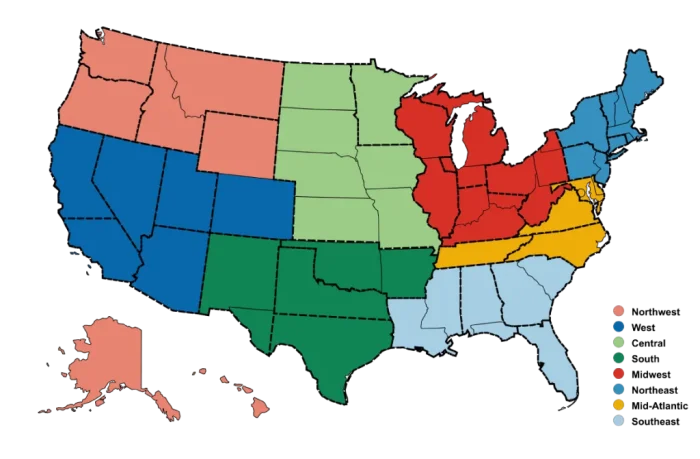
The National 1 League is divided into eight conferences containing 34 districts. Districts were drawn around population density, so a district may cover one state or several. Find your district and its league operator in the table below.
| Conference | States covered | Districts |
|---|---|---|
| Northeast | Maine, Vermont, New Hampshire, Massachusetts, Rhode Island, Connecticut, eastern New York, New Jersey, eastern Pennsylvania | 4 |
| Mid-Atlantic | Delaware, Maryland, Washington D.C., Virginia, North Carolina, Tennessee | 4 |
| Southeast | Georgia, South Carolina, Florida, Alabama, Louisiana, Mississippi | 4 |
| South | Oklahoma, Arkansas, Texas, New Mexico | 4 |
| Central | Minnesota, western Wisconsin, Missouri, Kansas, Nebraska, Iowa | 2 |
| Midwest | Ohio, western Pennsylvania, western New York, West Virginia, Indiana, Kentucky, Wisconsin, Illinois, Michigan | 5 |
| Northwest | Idaho, Montana, Oregon, Washington, Alaska, Hawaii | 5 |
| West | Colorado, Wyoming (Cheyenne), Arizona, California, Nevada (Las Vegas), Utah | 6 |
| Conference | District | Area covered | League operator |
|---|---|---|---|
| Northeast | NE 1 | Maine, Vermont, New Hampshire, Massachusetts, Rhode Island | EDP Soccer |
| Northeast | NE 2 | Eastern New York, Connecticut | EDP Soccer |
| Northeast | NE 3 | New Jersey, eastern Pennsylvania | EDP Soccer and Mid-Atlantic Premier League |
| Northeast | NE 4 | Upstate New York | EDP Soccer |
| Mid-Atlantic | MA 1 | Delaware, Maryland, Washington D.C. | EDP Soccer |
| Mid-Atlantic | MA 2 | Virginia | Virginia Premier Soccer League and National Capital Soccer League |
| Mid-Atlantic | MA 3 | North Carolina | Carolina Premier Soccer League |
| Mid-Atlantic | MA 4 | Tennessee | Tennessee State Soccer Association |
| Southeast | SE 1 | Georgia, South Carolina | Southeastern Clubs Champions League |
| Southeast | SE 2 | Florida | Florida Club Leagues |
| Southeast | SE 3 | Alabama, Florida Panhandle | Snap Soccer |
| Southeast | SE 4 | Louisiana, Mississippi | Snap Soccer |
| South | S 1 | Oklahoma, Arkansas | Frontier Premier League |
| South | S 2 | North Texas, Oklahoma | Texas Club Soccer League |
| South | S 3 | South Texas | South Texas Champions League |
| South | S 4 | West Texas, El Paso, New Mexico | El Paso Premier League |
| Central | C 1 | Minnesota, western Wisconsin | Twin Cities Soccer Leagues |
| Central | C 2 | Missouri, Kansas, Nebraska, Iowa | Missouri Youth Soccer Association |
| Midwest | MW 1 | Northern Ohio, western Pennsylvania, western New York, West Virginia | Great Lakes Alliance |
| Midwest | MW 2 | Southern Ohio, southern Indiana, Kentucky | Ohio River League with the Indiana, Ohio and Kentucky state associations |
| Midwest | MW 3 | Wisconsin, Illinois | Northern Illinois Soccer League |
| Midwest | MW 4 | Chicago | Northern Illinois Soccer League |
| Midwest | MW 5 | Michigan, northern Indiana | Michigan State Youth Soccer Association |
| Northwest | NW 1 | Idaho, Montana | Idaho Youth Soccer |
| Northwest | NW 2 | Oregon | Oregon Youth Soccer Association |
| Northwest | NW 3 | Washington | Regional Club League and Washington Premier League |
| Northwest | NW 4 | Alaska | Alaska Youth Soccer Association |
| Northwest | NW 5 | Hawaii | MISO Junior League |
| West | W 1 | Colorado, Cheyenne (Wyoming) | Colorado Soccer Association |
| West | W 2 | Arizona | Arizona Soccer Association |
| West | W 3 | Southern California | SOCAL Soccer League (team-based) and Arizona Soccer Association (club-based) |
| West | W 4 | Northern California | NorCal Premier Soccer |
| West | W 5 | Las Vegas, Nevada | Las Vegas Club Soccer League |
| West | W 6 | Utah | Utah Youth Soccer Association |
Age Groups and Development Pathways
The National 1 League offers six age groups: U13, U14, U15, U16, U17, and a combined U18/19. Its competition begins at U13; there are no National 1 divisions for U9–U12 players.
For 2026–27, National 1 uses an August 1–July 31 seasonal-year age matrix rather than the previous January–December birth-year calendar. This does not guarantee that every player will be grouped with their classmates. Before evaluating a roster spot, confirm your child’s age eligibility and proposed team placement with the club rather than assuming last season’s grouping carries forward.
Within those age groups, National 1 participation is one piece of a larger development picture that includes coaching quality, club culture, training volume, and the player’s own commitment. When evaluating a team, look beyond the league name to the day-to-day training environment, available playing opportunities, and communication between families, coaches, and clubs.
For U9–U12 players, focus on technical development, decision-making, enjoyment, and a healthy training environment rather than a future national league label. As players approach U13, add questions about competition level, travel expectations, and how the club’s teams fit their individual development needs.
Qualification pathways from state and local leagues are being developed, with on-field performance, organizational standing, and regional considerations among the factors. Ask your district operator which local competitions provide an entry pathway and what criteria apply; do not assume that winning a division automatically guarantees a National 1 place.
Join U.S. Soccer Parent
Free for every soccer parent.
Save articles, get the free newsletter, and find guidance tuned to your state, your kids' ages, and the pathway your family is on.
How Does the National 1 League Fit into U.S. Youth Soccer?
The National 1 League is the top team-based competition within US Club Soccer and US Youth Soccer. It brings together the former NPL and USYS National League platforms, connecting district competition with a national postseason pathway.
For parents, that description is more useful than treating youth soccer as one fixed ranking of leagues. When comparing National 1 with MLS NEXT, ECNL, ECNL Regional League, or Girls Academy, evaluate the specific team, its opponents, and the opportunities available to your child rather than assuming the league name alone establishes the best fit.
- The ECNL connection: Beginning in summer 2027, qualifying National 1 teams and selected ECNL Regional League teams will compete in the ECNL Conference League Playoffs and Finals. This is an additional postseason pathway; the existing ECNL and ECNL Regional League postseason structures remain in place.
- Competition level: Ask which district and division the team will enter, who its regular opponents will be, and how teams are placed. Compare the actual competitive environment rather than relying on a broad league ranking.
- Travel expectations: Request the team’s regular-season schedule and anticipated event commitments. Evaluate driving distances, overnight stays, and potential postseason travel separately.
- Player development: Ask about coaching, training quality, roster size, feedback, and the role your child could realistically earn. Consider whether the environment offers an appropriate balance of challenge and opportunity.
National 1 is worth considering when the specific team offers the right combination of development, competition, and manageable family commitments. Evaluate the environment your child will experience each week, not just the league’s national identity or postseason connection.
Benefits of the National 1 League Tier for Youth Soccer Parents
Balanced Competition and Travel
National 1’s district-based structure prioritizes regional, drivable competition while retaining opportunities for national exposure through showcases and postseason events. For families, the potential benefit is a competitive schedule with less unnecessary travel. Confirm your team’s actual opponents, event commitments, and overnight trips before assuming the season will be less expensive or easier to manage.
One League Instead of Two
National 1 brings the former NPL and USYS National League platforms into one national competition framework. (National 1 League) This can make the landscape easier to understand, but families should still confirm their team’s district, competition tier, and local operator requirements.
Player Development Focus
National 1’s stated standards emphasize long-term player development, safe playing environments, and coaching education. These standards provide a framework, not a guarantee of an identical experience at every club. Ask how your coach approaches player feedback, training, playing opportunities, and individual development.
College Recruiting Opportunities
National 1 includes showcases and postseason events intended to provide college-exposure opportunities. Participation alone does not guarantee recruitment, a roster offer, or a scholarship. Ask which events your team will attend and how the club supports player video, college outreach, and identifying suitable academic and soccer programs.
Inclusive Opportunities for Both Genders
National 1 provides competition for boys’ and girls’ teams within its district structure. (National 1 Schedules and Standings) Evaluate the specific age group and team available to your child, including coaching, roster size, competition level, and family commitments.
Local Administration and Support
District league operators manage day-to-day competition under National 1’s national framework. Know which organization operates your district and where to find its schedules, rules, and contact information. Your club should also explain whom to contact about team matters versus league-level questions.
High School Soccer Compatibility
National 1 allows players to participate in high school soccer, and its district scheduling is intended to consider local school seasons. Confirm how your club handles overlapping commitments, and check your school and state athletic association’s eligibility rules separately.

NPL Finals: The Final Chapter, July 2026
The 2026 NPL Finals marked the final national championship event of the National Premier Leagues. Held in July at DICK’S Sporting Goods Park in the Denver area, the event crowned 24 champions and closed the NPL’s final season before the transition to National 1.
Boys’ and girls’ teams from U13 through U19 earned their places through competition in NPL member leagues. The format connected regional league play with an opportunity to compete for a national championship.
National 1 continues the connection between district competition and a national postseason, with qualifying teams advancing to the ECNL Conference League Playoffs and Finals beginning in summer 2027. Families should confirm qualification requirements, event dates, locations, and potential travel costs rather than assume the new postseason involves only one trip.
The ECNL Conference League Playoffs: How the National 1 Postseason Works
National 1’s inaugural postseason takes place in summer 2027 at the ECNL Conference League Playoffs and Finals, bringing together qualifying National 1 teams and selected ECNL Regional League teams. This is an additional competition, not a replacement for the existing ECNL or ECNL Regional League postseason.
ECNL has announced the 2027 postseason structure, with four regional playoff events: Davis, California, and Frisco, Texas, June 11–15; St. Louis, Missouri, June 18–22; and Greensboro, North Carolina, June 25–29. U13–U17 teams play a group stage and knockout rounds, and those that advance qualify for the ECNL Conference League Finals in July. ECNL has not yet announced the Finals date or location. At U18/19, each regional event features eight National 1 teams, and champions are crowned on site. Expansion to six playoff venues has been announced for 2027–28.
Teams qualify through district competition, with league standings used to determine postseason qualification. Ask your operator how many places are available in your team’s age group and division, and confirm event dates, locations, and travel commitments before making plans.
One Postseason Pathway per Team
A team is eligible for only one league-based postseason pathway. If the same team competes in more than one competition within the pathway, such as National 1 and ECNL Regional League, it must declare its chosen pathway in writing to the commissioner and operator before its first scheduled match of the season. Failure to declare may result in postseason ineligibility.
Ask whether this rule applies to your child’s specific team and, if so, which pathway it has declared. Do not confuse a club having separate teams in both leagues with one team participating in both.
What Qualification Means
Qualifying gives a National 1 team access to the ECNL Conference League postseason; it does not automatically grant ECNL or ECNL Regional League membership. Club advancement is a separate evaluation involving performance and club standards. (National 1 FAQ)
For families, the opportunity is additional postseason competition and potential college exposure, not a guaranteed recruiting outcome. Evaluate the event alongside your player’s development, academic goals, and overall recruiting plan.
Player Identification and Development Pathways
National 1 League play can connect motivated players with identification and development opportunities beyond their club. One stated goal of bringing teams into a more unified competition structure is to make scouting for id², ODP, and U.S. Youth National Teams more efficient. This is a program goal, not a guarantee that every player will be evaluated or selected.
- id² Program
US Club Soccer’s national identification and development program provides opportunities for players to be identified, developed, and scouted for U.S. Soccer’s National Team programs, regardless of their league affiliation. There is no cost to be identified or participate, and training-camp lodging, meals, and training gear are provided. Players are evaluated through scouting and coach recommendations, including at club competitions, showcases, and regional identification events. US Club Soccer’s announced 2026–27 programming covers 2013- and 2012-born players while building a talent pool of 2014-born players. - Player Development Programs (PDPs)
PDPs are regional identification and development events within the id² program. Invitations are based on scouting and recommendations, and events include training and internal competition. id² staff evaluate participants for potential training-camp invitations; participation does not guarantee selection. Ask your club which events serve your area and how players are recommended
Treat these opportunities as additions to a strong daily development environment, not reasons to choose a league on their own. Ask your club how it supports player identification, who handles recommendations, and what opportunities are available for your child’s age group.
Costs and Budgeting for National 1 League–Level Play
When evaluating National 1 participation, request a full-season budget rather than comparing club dues alone. Separate required charges from optional expenses, and ask which costs could increase if the team qualifies for postseason competition.
- League and team fees: National 1 operators may charge team registration fees, subject to approval by the league commissioner. Ask your club whether league entry, player registration, referee fees, and team administration are included in its quote or billed separately.
- Club fees: Request an itemized breakdown of coaching, training, facilities, and other required charges. Do not assume the league’s position in the youth soccer landscape predicts its price; compare what each club actually includes.
- Travel costs: Build your budget around the team’s schedule, not just its conference or district name. Include transportation, lodging, meals, and any coach travel assessments. Budget separately for tournaments, showcases, and potential postseason trips.
- Equipment and gear: Ask for the complete required uniform and apparel package, including replacement-cycle expectations. Add footwear and other equipment your child may need during the season.
- Additional programs: Confirm whether camps, supplemental training, recruiting services, and additional events are required or optional. US Club Soccer states that there is no cost to be identified for or participate in its id² Program. For any other opportunity, ask the organizer what is included and whether travel or other expenses remain your responsibility.
Before committing, ask about payment plans, need-based assistance, deposit deadlines, and refund or withdrawal policies. Request the expected total for the season in writing, including known extras and potential postseason costs, so your family can make a realistic comparison.
How to Choose the Right National 1 League Club
When evaluating a National 1 club, look beyond the league name to the specific team your child would join. Use the following questions to clarify its confirmed placement, competition level, and commitments before accepting a roster spot.
- Has this specific team been accepted? All teams must apply for the 2026–27 season; previous NPL or USYS National League participation does not guarantee acceptance. (National 1 FAQ) Ask the club to confirm the status of your child’s age group and team, not simply the club’s overall involvement.
- Which district and operator will manage the team’s competition? Teams enter through district league operators, with some flexibility for teams near district boundaries. Ask for the operator’s name and a link to its official competition information.
- Which division or tier will the team play in? The availability of multiple tiers depends on the district. Ask about the team’s placement and expected opponents so you can evaluate the actual competition level.
- How does movement between levels work? National 1 uses merit-based promotion and relegation, but families should confirm the applicable process with their operator. Ask when placement is reviewed, what criteria apply, and whether a change would affect your family’s commitments.
- What schedule and costs are confirmed? Request the training schedule, available match dates, expected travel, and required events. If details remain pending, ask when they will be available and review deposit and refund terms before making a financial commitment.
Alongside those answers, meet the coach and discuss roster size, player feedback, development priorities, and how playing opportunities are earned. Choose the environment that fits your child’s needs and your family’s capacity, rather than treating league acceptance alone as proof of the right fit.
National 1 League vs. Other Elite Leagues: A Comparison
National 1 is the top team-based competition within US Club Soccer and US Youth Soccer, bringing the former NPL and USYS National League platforms into one structure. When comparing it with MLS NEXT, ECNL, ECNL Regional League, or Girls Academy, focus on the specific team’s coaching, opponents, playing opportunities, travel, and total cost rather than assuming one league label determines the best fit.
National 1’s connection to ECNL is specific: qualifying National 1 teams and selected ECNL Regional League teams compete in the additional ECNL Conference League Playoffs and Finals beginning in summer 2027. The existing ECNL and ECNL Regional League postseason structures remain separate. For your family, the most useful comparison is between the actual team environments available to your child and the commitments each requires.
How National 1 fits the ladder: National 1 isn't a rival to ECNL. It's the third tier of the same US Club Soccer pathway, below ECNL and ECNL Regional League, and the only one of the three that is team-based. The next step up is ECNL Regional League: high-performing National 1 clubs are eligible for promotion to ECNL RL, based on on-field performance and club standards. Clubs then earn promotion from ECNL RL into ECNL the same way. Because ECNL and ECNL RL are club-based, moving up depends on the club's results across age groups, not one team's season. Top National 1 teams can also be considered for ECNL RL events based on their results at the ECNL Conference League Playoffs.
National 1 League: Frequently Asked Questions
Quick answers for families navigating the transition from NPL and USYS National League to National 1.
What is the National 1 League, and does it replace NPL?
The National 1 League, also called National 1 or N1, brings together US Club Soccer’s National Premier Leagues (NPL) and US Youth Soccer’s National League beginning with the 2026–27 season. It is the top team-based competition within those two organizations. Previous NPL or National League participation does not guarantee acceptance; teams must apply through their district’s league operator. Read the official National 1 FAQ.
What age groups does National 1 offer for 2026–27?
National 1 offers U13, U14, U15, U16, U17, and a combined U18/19 age group. For 2026–27, it uses an August 1–July 31 seasonal-year age matrix. National 1 does not offer U9–U12 divisions. Confirm your child’s age eligibility and proposed team placement with the club; the cutoff does not guarantee placement with school classmates. Check the official age-group guidance.
Is National 1 the same as ECNL Regional League?
No. National 1 and ECNL Regional League are distinct competitions. Beginning in summer 2027, qualifying National 1 teams and selected ECNL Regional League teams will compete in the additional ECNL Conference League Playoffs and Finals. The existing ECNL and ECNL Regional League postseason structures remain in place. Qualifying through National 1 does not automatically grant ECNL Regional League membership. Read the postseason explanation.
When and where is the National 1 postseason?
National 1’s first postseason is the ECNL Conference League Playoffs in June 2027, at four regional events: Davis, California, and Frisco, Texas (June 11–15); St. Louis, Missouri (June 18–22); and Greensboro, North Carolina (June 25–29). U13–U17 teams play a group stage and knockout rounds, and those that advance qualify for the ECNL Conference League Finals in July; ECNL has not yet announced the Finals date or location. At U18/19, each regional event features eight National 1 teams, and champions are crowned on site. Qualification rules are set by district, so ask your operator how teams in your age group and division advance. Read ECNL’s 2026–27 postseason announcement.
Can National 1 players also play high school soccer?
Yes. National 1 allows players to participate in high school soccer, and district scheduling is intended to consider local school seasons. Ask your club how it handles overlapping training, matches, and events. Check your school and state athletic association’s eligibility rules separately; National 1 participation alone does not establish eligibility for a school team. Review National 1’s high school soccer guidance.
How much does it cost to play in National 1?
There is no single nationwide family price listed in the National 1 handbook. Operators may charge team registration fees subject to league approval, while families should request their club’s complete fee schedule. Ask whether league entry, player registration, referee fees, uniforms, events, and coach travel are included. Budget separately for family travel and potential postseason expenses. Review the National 1 handbook.
Can National 1 help players get recruited for college soccer?
National 1 includes showcases and postseason events intended to provide college-exposure opportunities. Participation does not guarantee recruitment, a roster offer, or a scholarship. Ask which events your team will attend and how the club supports player video, college outreach, and identifying suitable academic and soccer programs. Read National 1’s recruiting guidance.
Keep Going
Additional Resources
Where National 1 sits alongside the other pathways — and where to verify current-season details before you commit.
Related Guides
- Levels of Competition Every tier of U.S. youth soccer, explained in order
- The Layers of ECNL ECNL, ECNL Regional League, and where National 1 falls
- National 1 League Handbook Rules of competition and roster rules for 2026–27
- 2026–27 Age Group Change Why birth-year windows shifted, and who it affects
- Costs of Youth Soccer Real spending ranges by level, and the add-ons behind them
Official National 1 Sources
- National 1 League League home and current season information
- Schedules & Standings Central list of fall 2026 district schedules by operator
- The N1 App Free app for rosters, IDs, and match day — sign up with your GotSport email
District alignments, operators, and event dates change every year. Always confirm the current season’s details with your club and your district operator.