
Selecting the Right Cleats for Your Player
Choosing the right cleats is one of the most practical ways parents can protect their kids and help them play better, especially as they rotate between grass and turf. This condensed guide focuses on what actually matters—and how to steer kids away from pure marketing.
Step 1: Know the main cleat types
Get the surface match roughly right before worrying about brand or color.
Firm Ground (FG)
- Designed for: Natural grass that’s reasonably firm and compact (you leave stud marks but don’t sink deeply).
- Studs: Fewer, medium‑length molded studs, often bladed or conical, spaced to penetrate soil and then release.
- Good for: Most dry or slightly damp outdoor grass fields.
- Limitations: On hard artificial turf, long or aggressive FG blades can feel “grabby” and transmit more rotational force to the knee. On very soft or muddy grass they can clog and slip.
Artificial Grass (AG)
- Designed for: Modern 3G/4G rubber‑infill artificial turf.
- Studs: Many more, shorter, usually round and sometimes hollow studs spread across the plate to distribute pressure and reduce how deep any one stud bites.
- Plate: Often a bit stiffer and more abrasion‑resistant to handle turf friction and heat.
- Good for: Balanced traction and comfort on turf, with less “sticking” than long FG studs.
Multi‑Ground / Hybrid (MG, FG/AG)
- Designed for: Players who regularly move between decent natural grass and artificial turf.
- Studs: A compromise pattern—more studs than standard FG, generally shorter and rounder.
- Good for: A single‑pair solution when your child truly splits time between grass and turf.
- Limitations: Not as perfect as dedicated FG on top‑quality grass, or dedicated AG on very hard turf, but usually a smart all‑round choice for youth players.
Soft Ground (SG)
- Designed for: Very soft, loose, or muddy natural grass where players sink into the surface.
- Studs: Fewer but longer, often metal or metal‑tipped and sometimes replaceable, to cut through mud and grip deeper.
- Good for: High‑level play in consistently wet/muddy conditions.
- Limitations: Often banned on turf and many youth fields; overkill for typical US youth environments.
Step 2: Match cleats to where and how your child actually plays
Think in terms of hours per week on each surface and what those surfaces are like in reality.
Natural grass: firm vs loose/soft
- Firm, compact natural grass (most typical game fields in good weather)
- Primary choice: FG.
- The studs will penetrate enough to grip, then release as the player turns.
- Loose, soft, or muddy natural grass (you see pooling water, divots, players slipping)
- Ideal: SG, especially in higher‑level, older age groups and in leagues that allow metal studs.
- Real‑world youth compromise: FG will still be used most of the time, but expect more clogging and some loss of traction on very soft days. You may look for FG models with slightly deeper, conical studs if your child often plays in wet/muddy conditions.
Key idea: “Firm ground” is not meant for truly boggy or spongy fields.
Artificial turf: quality and age
Not all turf is the same, and stud choice interacts with that.
- Newer, well‑maintained 3G/4G turf with good rubber infill
- Best choice: AG.
- Acceptable: MG/FG‑AG hybrids if you can only have one pair.
- Caution with FG: Some “FG‑safe on AG” models exist, but long, sharp blades can still feel too sticky for some players; monitor comfort and knee/ankle feedback.
- Hard, older turf with compacted infill (feels thin and unforgiving underfoot)**
- Strongly consider: AG or MG over standard FG.
- Why: On these surfaces, long FG blades tend to bite and hold more, which can increase the “twist” going through the knee when the body turns but the foot doesn’t release as easily.
Indoor turf / carpet‑style surfaces (short pile, minimal infill)
- Often best: Turf “trainers” with lots of small rubber nubs, or whatever the facility specifically recommends.
- Cleats with long studs (FG or SG) are often banned on these fields.
Mixed environments
- Mostly grass with occasional turf**
- Start with FG.
- If turf usage grows (e.g., winter training block on turf), consider adding AG or MG as a second pair.
- Mostly turf with occasional grass**
- Start with AG.
- If your child also plays important matches on grass, MG or a separate FG pair can be worth it.
- True 50/50 split between decent grass and turf**
- MG/FG‑AG hybrids are often the most practical single‑pair answer.
- If budget and bag space allow, the best combo is a dedicated FG + a dedicated AG, chosen according to the day’s field.
Join U.S. Soccer Parent
Free for every soccer parent.
Save articles, get the free newsletter, and find guidance tuned to your state, your kids' ages, and the pathway your family is on.
Step 3: Fit and comfort – the non‑negotiables
The “right” stud pattern won’t help if the shoe hurts or doesn’t hold the foot securely.
- Length
- Aim for roughly a thumb’s width of space from the longest toe to the end of the shoe for growing kids.
- Too small: blisters, nail issues, and general discomfort.
- Too big: foot slides inside the boot, reducing stability and touch.
- Width and foot shape
- Brands and models fit differently: some are narrow and snug, others more accommodating.
- Have your child jog, cut, and stop in them; ask specifically where they feel tightness or rubbing.
- Lockdown (heel and midfoot)
- The heel should not lift with each step; the midfoot should feel supported, not pinched.
- Use proper lacing (including a “runner’s loop” if needed) to secure the heel.
- Upper material and stiffness
- Softer uppers tend to be more comfortable for youth players and help with first touch.
- Break new boots in during lighter training sessions before tournaments or big games.
Step 4: Turf, stud choice, and ACL/knee considerations
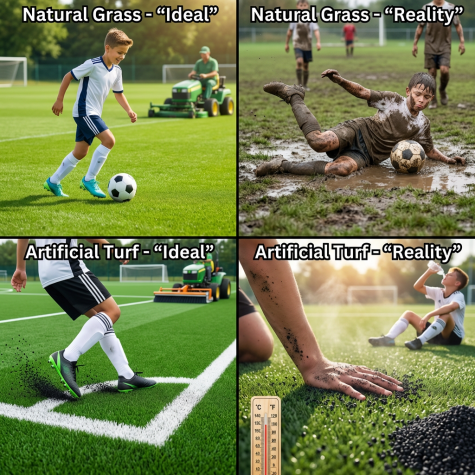
- Artificial turf typically offers more consistent and sometimes higher friction than natural grass.
- On grass, the ground can shear, divot, or tear away under load, helping the foot release when the body rotates. On turf, the surface tends to hold together, so more of that rotational force can be transmitted through the shoe, up the leg, and into the knee.
- Long, widely spaced FG studs can “bite” deeper into turf, increasing rotational traction—making it harder for the foot to pivot freely when the body twists.
- AG layouts, with more, shorter, rounder studs, are designed to spread load and moderate that rotational grip, aiming for a safer balance between traction and release.
(We wrote about the various surfaces (pros & cons); you can read it at the link below.)
What this means for ACL‑injured or higher‑risk players
No stud pattern can guarantee injury prevention, but you can avoid avoidable risks. Players with a history of ACL injury, strong family history of knee injuries, or known risk factors (for example, some female athletes) may want to be particularly cautious about using long, aggressive FG studs on hard turf. For these athletes, using AG or MG on artificial turf is a reasonable, low‑cost way to avoid adding extra “stickiness” at the shoe–surface interface on an already high‑friction surface.
This does not replace strength training, neuromuscular control work, good landing mechanics, and sensible workload, but it’s one controllable part of the overall risk picture. Wearing AG or MG patterns on turf is a best‑practice recommendation—especially for players with prior knee issues—but remember this is about risk‑management, not a guarantee.
Step 5: Age, level, and rules
- Younger players (U9 and below)
- Prioritize comfort, correct surface match, and price.
- They don’t generate the same cutting forces as older players, but good habits (AG on turf, FG on grass) can start early.
- Tweens and teens at competitive levels
- Training multiple times per week and playing on mixed surfaces increases the importance of appropriate studs.
- If possible, consider two main pairs (FG for grass, AG or MG for turf) and rotate to keep boots dry and fresh.
- Rules and facility policies
- Some fields ban metal studs or restrict certain cleats on turf or indoor surfaces.
- Always check league and facility rules so you’re not buying something your child can’t use.
Step 6: Marketing, brands, and star players
This is where parents feel pressure and kids get pulled toward what their heroes wear.
What the marketing doesn’t tell you
- Top pros often wear ultra‑light, highly specialized versions of boots tuned for:
- Perfect pitches.
- Fully grown bodies with elite strength and control.
- Very specific playing styles.
- Kids playing on mixed or lower‑quality surfaces don’t benefit from those trade‑offs in the same way—and sometimes those “pro” boots are less forgiving, less protective, or mismatched to turf.
How to talk about it with your child
You can acknowledge the appeal while still guiding the decision:
- Start by validating:
- “I get why you want that model—your favorite player wears it and it looks amazing.”
- Shift to their needs:
- “Our job is to find what helps *you* play your best on *your* fields. Your hero plays on perfect grass; you’re on turf a lot, so you need a different tool.”
- Use simple examples:
- “If your cleats hurt your feet or make your knees sore, it doesn’t matter whose name is on them.”
- “We’d rather choose a pair that fits great and matches your field, and put the extra money into tournaments or training.”
- Offer controlled choice:
- Pre‑select 2–3 surface‑appropriate, budget‑reasonable options, then let your child choose color and brand within that group.
The lesson you’re reinforcing: smart players choose equipment that fits their body, field, and game—not just what’s in the latest ad.
A simple decision checklist for busy parents
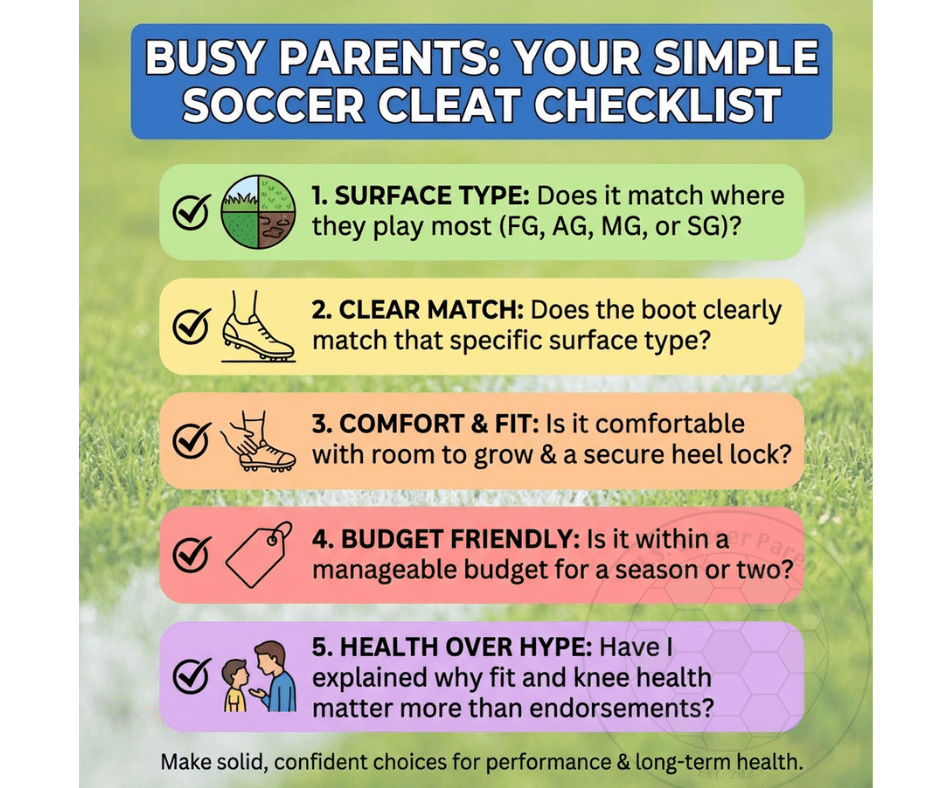
When you’re staring at the options, run through this:
- Where does my child play most—firm grass, soft/loose grass, turf, or a mix?
- Does this boot clearly match that surface type (FG, AG, MG, or SG in special muddy cases)?
- Does it fit comfortably now, with a bit of room to grow, and lock the heel and midfoot in place?
- Is it within a budget I can live with, knowing we’ll replace it in a season or two?
- Have I explained to my child why fit, surface match, and knee health—especially on turf—matter more than which star is in the commercial?
If you can say “yes” to those, you’ve made a solid, repeatable cleat choice that respects both performance and long‑term health.