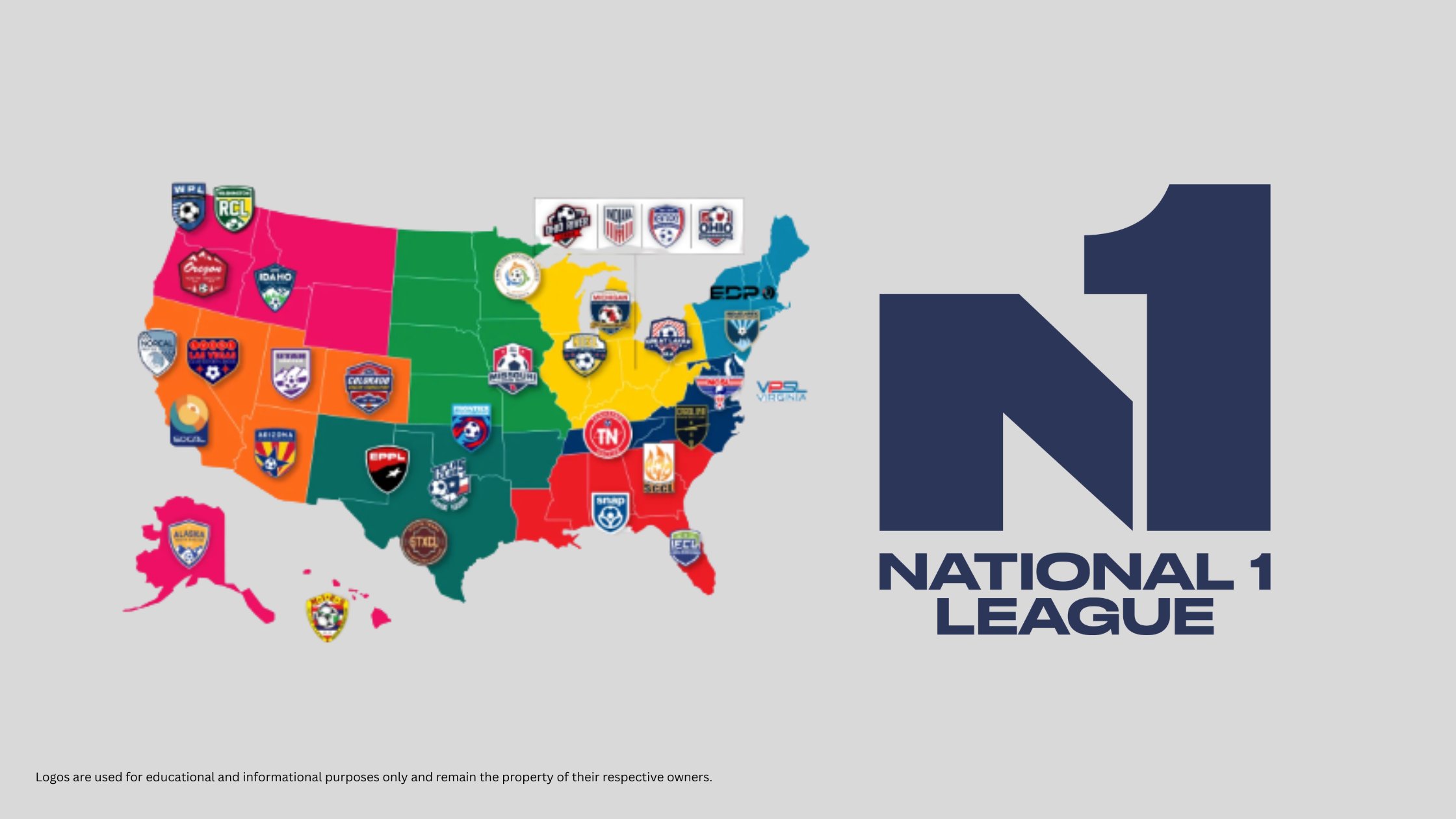
The National 1 League is moving from announcement mode into a more defined part of the youth soccer landscape, and the biggest reason is that its handbook and rules are now public. For families trying to understand what National 1 actually is, how it works, and where it fits with ECNL, NPL, and the USYS National League, this is one of the most meaningful updates in the rollout so far. The operator map helped explain who would run the league, but the National 1 League handbook gives parents a clearer picture of how the competition is supposed to function heading into the 2026–27 season.
This update picks up where earlier National 1 coverage left off. The biggest recent developments are the release of the National 1 League handbook, stronger public language about how National 1 fits with ECNL and ECNL Regional League, and growing district-level detail from operators.
What the National 1 League handbook and rules clarify
The most important development in this phase of the rollout is that National 1 now has a formal handbook and published rules of competition. That matters because families are no longer looking at only a concept, a name, or an operator map; they now have a clearer picture of how the competition is supposed to function.
What the handbook clarifies
The handbook lays out the league framework for the 2026–27 season, including competition governance, team-based structure, and how National 1 connects back to broader US Club Soccer policies and rules. It also gives families more clarity on the operational side of the league, including how a standardized competition is supposed to work across different operators and regions.
For parents, the practical takeaway is simple: National 1 is no longer just a rollout announcement. It now has a defined rule structure behind it, which helps explain how clubs, teams, and operators are expected to function inside the platform.
How the National 1 League fits with ECNL, NPL, and youth soccer pathways
Another important shift is how National 1 is now being described publicly within the larger youth soccer pathway. US Club Soccer describes National 1 as the top team-based competition in US Club Soccer and US Youth Soccer, integrated with the ECNL pathway.
Where National 1 fits
In plain terms, National 1 is being positioned below the club-based ECNL and ECNL Regional League structure, while serving as a higher-level team-based platform above more localized league play. US Club Soccer has also tied the new competition to postseason integration with ECNL Regional League through the new playoff structure beginning in 2027, which helps make the pathway more visible for families.
This matters because many parents are trying to understand whether National 1 is simply a rebrand or a meaningful step in the broader competition pyramid. The newer public language suggests it is meant to be a real pathway layer, especially for strong teams outside full ECNL club membership.
Team-based still matters
One key distinction remains important for families: National 1 is a team-based platform, while ECNL is club-based. That means a team may move into National 1 through its operator and competitive level even if the club itself is not part of a full ECNL structure.
For many families, that makes National 1 easier to compare with existing NPL and National League experiences than with ECNL membership itself. It also helps explain why clubs may talk about National 1 as an opportunity without presenting it as the same thing as joining ECNL.
What the National 1 League rollout means for NPL and National League families
National 1 was introduced as the unified team-based competition bringing together US Club Soccer’s NPL and US Youth Soccer’s National League beginning with the 2026–27 season. Even so, the transition is likely to feel gradual in many parts of the country rather than immediate or identical everywhere.
What this may look like in practice
For some clubs and leagues, the first visible changes may be updated naming, new division labels, or revised pathway language rather than a completely different weekly experience. Operators are expected to manage the league within districts and conferences, which means many teams may still see familiar opponents and manageable travel patterns even as the national structure changes.
For parents already in NPL or National League environments, the most useful question is not whether everything disappears at once. The better question is how a child’s current team, division, and operator fit into the new structure over the next one to two seasons.
How local operators are implementing the National 1 League
The national framework is clearer now, but local implementation is still where many families will get their most relevant answers. National 1 schedules for operators are expected closer to the start of the 2026–27 season, and participants will be able to access schedules and results during the season through the official National 1 app.
What families are likely to notice first
In many regions, the first signs of National 1 may be practical rather than dramatic. Families may start seeing National 1 branding in club communication, operator websites, division names, or postseason language before they see major changes to weekly routines.
That is part of why the rollout can still feel uneven. Some operators are further along in publishing local details, while others are still moving toward the point where schedules, standings, and team placements become public.
What parents should watch next in the National 1 League rollout
At this stage, families do not need to memorize every structural detail. What matters most is watching for the points where National 1 starts affecting the child’s actual team experience.
Questions worth asking your club
Parents may want to ask whether their club or team is pursuing National 1 placement, what that would change about league play, and whether travel, cost, or postseason opportunities would shift as a result. Those are often more useful questions than trying to decode national announcements in the abstract.
Signs National 1 is becoming relevant to your family
The clearest signs will likely be club emails, updated league branding, revised division names, and postseason references tied to the new pathway. As those changes start to appear, families can look at National 1 alongside ECNL, NPL, and USYS National League resources on US Soccer Parent to better understand where their team fits in the bigger picture.
Why the National 1 League handbook is the latest meaningful update
At the start of the rollout, the big story was who the operators were and how the country would be divided. Now, the more meaningful update is that National 1 has moved from announcement mode into implementation mode, with published rules, clearer pathway messaging, and more signs of how the league will function in real life.
That does not mean every detail is finalized in every district yet. It does mean families now have a much clearer sense of what the National 1 League is, where it fits, and what to watch for as the 2026–27 season approaches.

Gloria Cid-Stitt
Founder, U.S. Soccer Parent
2 Responses
Thank you
You are very welcome!