History of U.S. Youth Soccer: How We Got Here
The U.S. youth soccer system has evolved from scattered immigrant clubs and volunteer-led town leagues into a sprawling, fragmented ecosystem that now touches millions of kids each year. Understanding how we got here helps explain both the system’s strengths and its persistent structural problems.
Early roots and pre-boom era
Soccer arrived in the United States in the late 19th and early 20th centuries, largely through immigrant communities that formed local ethnic clubs and social teams. For decades, these clubs focused on adult play, with youth involvement informal and limited to community or school pick-up games rather than organized, age-group leagues.
Through the mid‑20th century, American youth sports culture revolved far more around baseball, American football, and basketball than soccer. Where organized youth soccer did exist, it was usually run by local recreation departments, YMCAs, or church groups, often using homegrown rules and modest fields. There was no unified national structure, no clear development pathway, and very little connection between youth play and the U.S. Soccer Federation (USSF), which primarily focused on adult amateur and occasional national team efforts.
The first national youth organizations
The modern era of U.S. youth soccer began in the 1960s, when the first national-scale youth organizations were founded. In 1964, American Youth Soccer Organization (AYSO) was created in a garage in Torrance, California, specifically to provide organized soccer opportunities for children. AYSO grew rapidly on the strength of a simple model—volunteer coaches, local community teams, and an emphasis on participation and enjoyment over elite selection.
A decade later, in 1974, the United States Youth Soccer Association (now known as US Youth Soccer, or USYS) was founded with around 100,000 registered players. USYS became the largest youth affiliate of U.S. Soccer and began to give youth soccer a more formal structure, organizing state associations, regional competitions, and national championship pathways. This provided the basic architecture of a pyramid: local recreational play at the base, select and travel teams in the middle, and regional and national competition at the top.
The 1970s and early 1980s saw a substantial “soccer boom” in suburban America, driven by demographic shifts, the spread of youth leagues, and growing cultural exposure to the sport. Suburban middle‑class families, in particular, embraced soccer as a safer, inclusive alternative to collision sports, fueling rapid growth in registrations.
The participation boom and the pro game
By the 1980s and early 1990s, youth soccer had become a mainstream activity in many communities, even as the professional game struggled. The North American Soccer League (NASL) collapsed in 1984, leaving the U.S. without a top‑tier outdoor professional league for several years. In this period, youth development was largely club‑driven, with limited coordination from U.S. Soccer and few direct pathways from youth clubs to professional opportunities.
The turning point came when the United States hosted the 1994 FIFA World Cup. The tournament generated unprecedented attention and helped normalize soccer as part of the American sports landscape. In 1996, Major League Soccer (MLS) launched as a new Division I professional league, backed by a commitment made as part of the World Cup hosting bid. The combination of a home World Cup and a permanent pro league reinforced the value proposition of youth soccer for families, who could now see a clearer cultural and aspirational pathway from youth fields to professional stadiums.
During this period, USYS continued to expand, with registration rising from its initial 100,000 in 1974 to nearly 3 million players by the 2010s. It remained the largest youth affiliate under the U.S. Soccer Federation umbrella, supported by hundreds of thousands of volunteers and coaches nationwide.
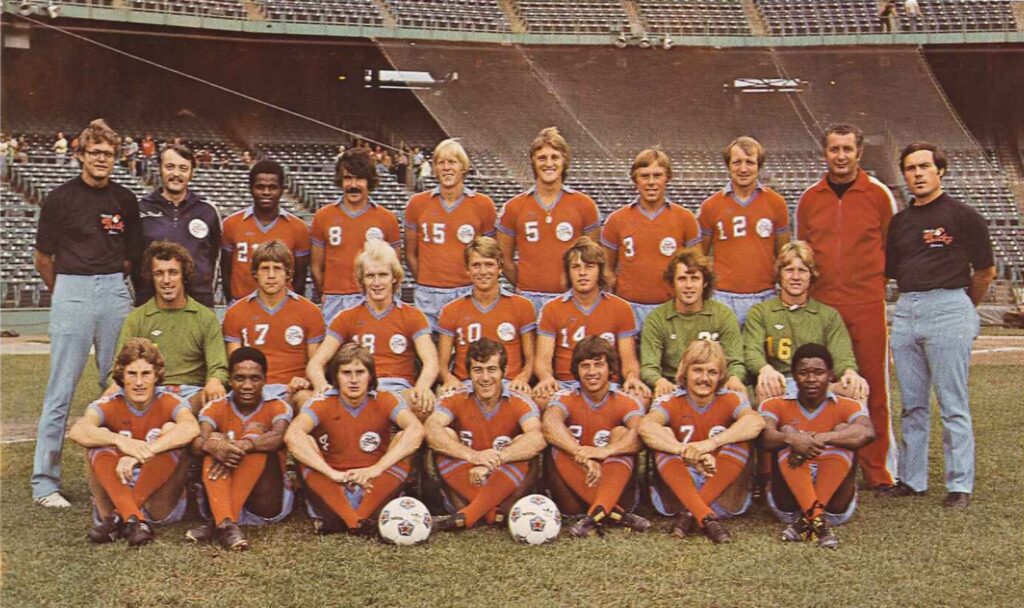
Image of the Minnesota Kicks who played played the 1st game in franchise history, in April, 1976.
From recreation to elite club pathways
As youth numbers grew, the system became more stratified between recreational and “travel” or “competitive” soccer. In the 1970s and 1980s, the distinctions were simpler—many communities had intramural teams and a limited number of travel teams drawn from the same local school district. Over time, however, the rise of club soccer created regional and then national-level programs that recruited players across wide geographic areas, often requiring significant financial and time commitments from families.
The 2000s and 2010s brought a wave of elite platform creation and consolidation:
- In 2009, the Elite Clubs National League (ECNL) launched as a high-level competition platform for girls, emphasizing a unified national schedule and college recruiting visibility.
- ECNL’s success led to the addition of a boys’ league in 2017, positioning it as a premier pathway for both genders into college soccer and, for a small subset, professional opportunities.
- U.S. Soccer launched its own Development Academy (DA) for boys in 2007 to centralize elite development, later adding girls, though this was eventually shuttered in 2020.
The acceleration of elite club pathways shifted the development emphasis from state association all‑star programs and Olympic Development Program (ODP) events toward year‑round, club‑centered training and competition. National youth teams increasingly scouted through these club networks, with U.S. Soccer officials noting that the vast majority of actual player development occurs at the club level rather than in occasional national team camps.
MLS and the professionalized youth pathway
On the professional side, MLS gradually moved from simply operating first teams to building integrated academies and youth pipelines. This culminated in MLS NEXT, launched in 2020, which became the top level of boys’ youth soccer within the MLS structure. MLS NEXT is designed to connect elite youth talent directly to professional clubs, offering a more European-style pathway in which academy players can sign homegrown contracts and move into first-team environments.
This professionalization has created a dual-track system: one pathway centered on MLS academies and national elite platforms like MLS NEXT (boys) or top ECNL/NPL programs, and another centered on more traditional club and state association structures feeding primarily into high school and college soccer. At the same time, leagues such as the USL have begun building their own youth and pre-professional structures, adding further complexity to the landscape.
Governance shifts and age‑group debates
Overlaying these competitive platforms is a complex web of governing bodies and administrative decisions that shape the youth experience. U.S. Soccer, USYS, US Club Soccer, AYSO, and others share influence over rules, registration systems, and competition formats.
One of the most consequential—and controversial—administrative changes in recent years has been age‑group alignment. For many years, youth soccer in the U.S. largely used an August‑based cutoff, grouping players roughly by school grade and making it easier for friends and classmates to play together. In 2016, the Federation mandated a shift to calendar‑year (January 1–December 31) age groups nationwide, affecting roughly 3.2 million players. The change disrupted team compositions and drew criticism from families and clubs who favored school‑year alignment.
In response to continued feedback and data, US Youth Soccer, AYSO, and US Club Soccer announced in 2025 that they would move back to an August 1–July 31 age‑group formation cycle starting with the 2026‑27 season. The stated goal was to realign youth soccer with school‑grade cohorts, increase inclusion, and help stem participation drops by making the youth experience more socially coherent for kids. This shift underscores how administrative choices—sometimes seen as minor calendar issues—can, in fact, represent some of the most significant structural changes in the youth game.

Access, participation, and equity
While aggregate participation has grown dramatically over the past several decades, access has not been evenly distributed. Pay‑to‑play club models, travel costs, and facility constraints have made high‑level youth soccer expensive, particularly for families in underserved or high‑poverty communities. At the same time, programs targeted at these communities have demonstrated strong demand when barriers are lowered.
The U.S. Soccer Foundation’s “Soccer for Success” after‑school initiative, for example, reported an average year‑over‑year participation growth rate of 39 percent over three years, despite a broader reported 14 percent decline in soccer participation among 6‑ to 12‑year‑olds during the same period. In one recent year, the program grew participation by 64 percent and projected reaching 100,000 children nationwide in the subsequent school year. These figures highlight both the systemic challenges of pay‑to‑play and the opportunity latent in lower‑cost, community‑embedded programming.
Where the system stands today
Today’s U.S. youth soccer system is vast, decentralized, and highly varied by region. On one end of the spectrum, millions of children participate in recreational leagues run by local clubs, park districts, and national organizations like AYSO and USYS, often with volunteer coaches and a focus on fun and basic skills. On the other, a smaller but influential elite segment operates within professionalized club structures, national leagues like ECNL and MLS NEXT, and increasingly integrated professional pathways.
Compared with its origins, the system is far more sophisticated in coaching education, sports science integration, and scouting, yet also more fragmented, with multiple overlapping leagues and governing bodies competing for players and influence. Strategic initiatives such as U.S. Soccer’s emerging “U.S. Way” framework aim to provide clearer developmental guidance and better coordination across this landscape, acknowledging that most meaningful development still happens in daily club training environments rather than in national team or federation-run settings.
From a historical perspective, the story of U.S. youth soccer is one of rapid expansion, institutional layering, and evolving aspirations—from local recreation to college scholarships and professional contracts. The system’s future will likely turn on how effectively it can reconcile broad participation with accessible, merit-based pathways, and how well its many stakeholders can align around coherent developmental principles while preserving the diversity that has defined the American game from the outset.
Keep Reading
Six guides that pick up where this history leaves off.
| Glossary of Terms & Definitions | ECNL, MLS NEXT, USYS, NPL — the acronyms decoded. |
| Levels of Competition | How recreational, travel, and elite tiers rank against each other. |
| Costs of Youth Soccer | Real numbers on fees, travel, and equipment at every level. |
| Player Development Pathways | The routes from first practice to college or pro. |
| The 2026/27 Age Group Change | The shift to an Aug 1–Jul 31 year and who it affects. |
| National 1 League: Parent Guide | The new top league launching for 2026–27. |