
U14-U18 Travel Soccer: Youth Soccer Rules for Parents
Understanding full-sided competitive soccer and the transition to adult rules.
Game Format
At U14 and above, teams play 11v11 (11 players per side including goalkeeper) on a full-sized field, approximately 110–120 yards long by 70–80 yards wide. Games consist of two halves:
- U14–U15: Two 35-minute halves
- U16–U18: Two 40-minute halves
High school soccer (typically played in spring for boys, fall for girls) follows NFHS rules, which differ from FIFA/US Youth Soccer rules in several ways, including substitution patterns, clock management, and some technical interpretations.
No Hands Rules
- Field players cannot deliberately handle the ball with their hands or arms. The referee judges whether contact was deliberate based on hand/arm position, movement toward the ball, and distance from which the ball was played.
- The goalkeeper may use hands only inside their own penalty area; outside that area they play with their feet like everyone else.
- The goalkeeper cannot pick up a deliberate pass played with the foot by a teammate (the “back-pass rule”); doing so results in an indirect free kick for the opposing team from the spot of the handling.
Starting and Restarting
- The game begins with a kickoff from the center circle. After each goal, the team that conceded kicks off to restart.
- All players must be in their own half at kickoff; opponents must remain outside the center circle (10 yards from the ball) until the ball is played.
- The kicker may not touch the ball a second time until another player has touched it.
Ball Out of Bounds
- Throw-in: When the ball completely crosses the sideline, the team that didn’t touch it last restarts with a throw-in from that spot. Both hands must deliver the ball from behind and over the head, with both feet on or behind the line at the moment of release.
- Goal kick: When the attacking team sends the ball over the goal line without scoring, the defending team restarts from anywhere inside their goal area. The ball is in play when it is kicked and clearly moves, and opponents must be outside the penalty area until then. Players on the kicking team may play the ball again inside the penalty area once it is in play, but the kicker cannot touch it again before another player does.
- Corner kick: When the defending team sends the ball over their own goal line, the attacking team takes a kick from the corner arc nearest to where the ball went out.
Fouls, Free Kicks, and Penalties
Common fouls include kicking or attempting to kick an opponent, tripping, jumping at, charging recklessly, pushing, holding, striking, or deliberate handball.
- Direct free kick: Awarded for physical fouls. The ball can be shot directly into the goal.
- Indirect free kick: Awarded for technical violations such as dangerous play, obstruction, goalkeeper violations (holding the ball more than 6 seconds, handling a back-pass), or offside. The ball must touch another player before a goal can count; the referee signals by raising one arm straight up.
- Penalty kick: When a direct-free-kick foul is committed by the defending team inside their own penalty area, the attacking team is awarded a penalty kick from the penalty spot (12 yards from goal). Only the kicker and goalkeeper are involved; all other players must remain outside the penalty area and arc until the ball is kicked.
Offside
The offside rule is fully enforced at this level and is a frequent source of confusion:
- A player is in an offside position if they are in the opponent’s half of the field and closer to the opponent’s goal line than both the ball and the second-to-last opponent (typically the last defender, since the goalkeeper is usually the last player).
- Being in an offside position is only an offense if the player is actively involved in play when a teammate plays the ball—by receiving the ball, interfering with an opponent, or gaining an advantage from being in that position.
- You cannot be offside** on a throw-in, corner kick, or goal kick.
- If offside is called, the defending team receives an indirect free kick from the position where the offside player was when the ball was played.
Key concept: Offside is judged at the moment the ball is played by a teammate, not when the offside player receives it. A player can be in an onside position when the pass is made and then run into an offside position to receive the ball—this is legal.
Heading and Safety
- Heading is fully permitted at U14 and above. There are no restrictions on deliberate headers in games or practice.
- Slide tackles are legal if executed safely and the tackler plays the ball first. Sliding “through” an opponent, from behind, or in a reckless manner is a foul and may result in a yellow or red card depending on severity.
- Dangerous play (high kicks near an opponent’s head, reckless challenges) is called as an indirect free kick offense.
Yellow and Red Cards
Referees use the disciplinary card system consistently at this level:
- Yellow card (caution): Issued for unsporting behavior, dissent by word or action, persistent fouling, delaying the restart of play, failing to respect required distance on corner kicks or free kicks, or entering/leaving the field without permission. Two yellow cards in one game result in a red card (ejection).
- Red card (ejection): Issued for serious foul play, violent conduct, spitting at an opponent or any other person, denying an obvious goal-scoring opportunity with a deliberate foul or handball, or using offensive/insulting/abusive language or gestures. The player is sent off and cannot be replaced; the team plays with one fewer player for the remainder of the match.
Players receiving red cards typically face additional suspension from subsequent matches, determined by league policy.
Substitutions
- Club/travel soccer (US Youth Soccer, ECNL, MLS NEXT): Most leagues allow unlimited substitutions at designated stoppages—goal kicks, throw-ins for the team in possession (opponents may then also substitute), after goals, and between halves. There is typically no guaranteed minimum playing time.
- High school soccer (NFHS rules): Substitutions are permitted after a goal by either team, on any goal kick, on a throw-in or corner kick by the team in possession (if the attacking team substitutes, the defending team may also substitute), for an injury, or when a cautioned player must leave the field. NFHS rules allow unlimited re-entry in many states, meaning a player can be substituted out and later return to the game.
♦ High School vs Club Soccer Rule Differences
If your player participates in high school soccer, be aware of key differences from club rules:
- Clock management: In high school, the game clock is official and is often stopped for injuries, goals, and other situations. In club soccer, the referee keeps time and adds stoppage time at their discretion.
- Substitution rules: High school allows more liberal substitution (often unlimited re-entry); club soccer typically does not allow re-entry once substituted.
- Overtime format: High school often uses two full overtime periods and may proceed to penalty kicks. Club soccer may use “golden goal” or no overtime in regular season.
- Bench location: High school rules require benches on the same side of the field; club soccer typically places them on opposite sides.
Many referees are certified in both systems, but mistakes can happen when switching between rule sets. Understanding these differences helps you follow the game and avoid confusion.
Key Mindset for Parents
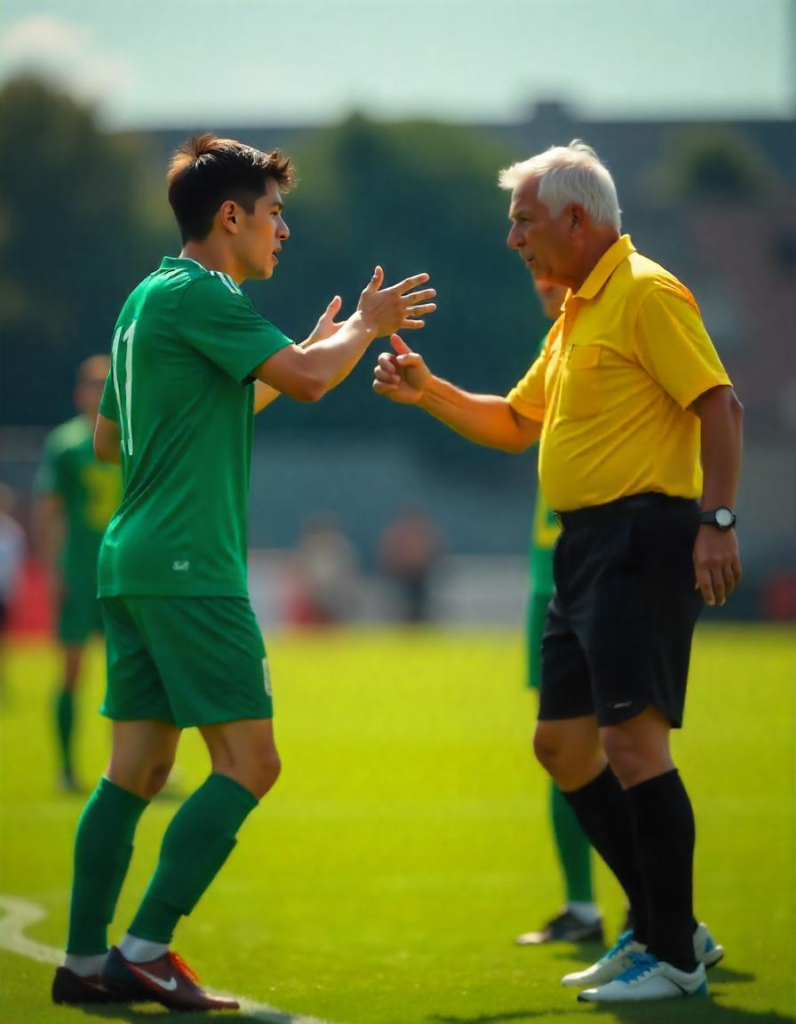
At this age, soccer becomes tactically and physically demanding. Players are learning to read the game, make split-second decisions, and execute at competitive speed. Referees are human and positioning/judgment calls will sometimes be missed or debatable—this is part of the game at every level, including professional soccer.
Your role is to support your player’s development, model good sportsmanship, and trust the coaching staff to manage playing time and tactics. Let referees referee, coaches coach, and players play. The best gift you can give your player is a parent who cheers effort, handles disappointment with grace, and keeps the experience positive.