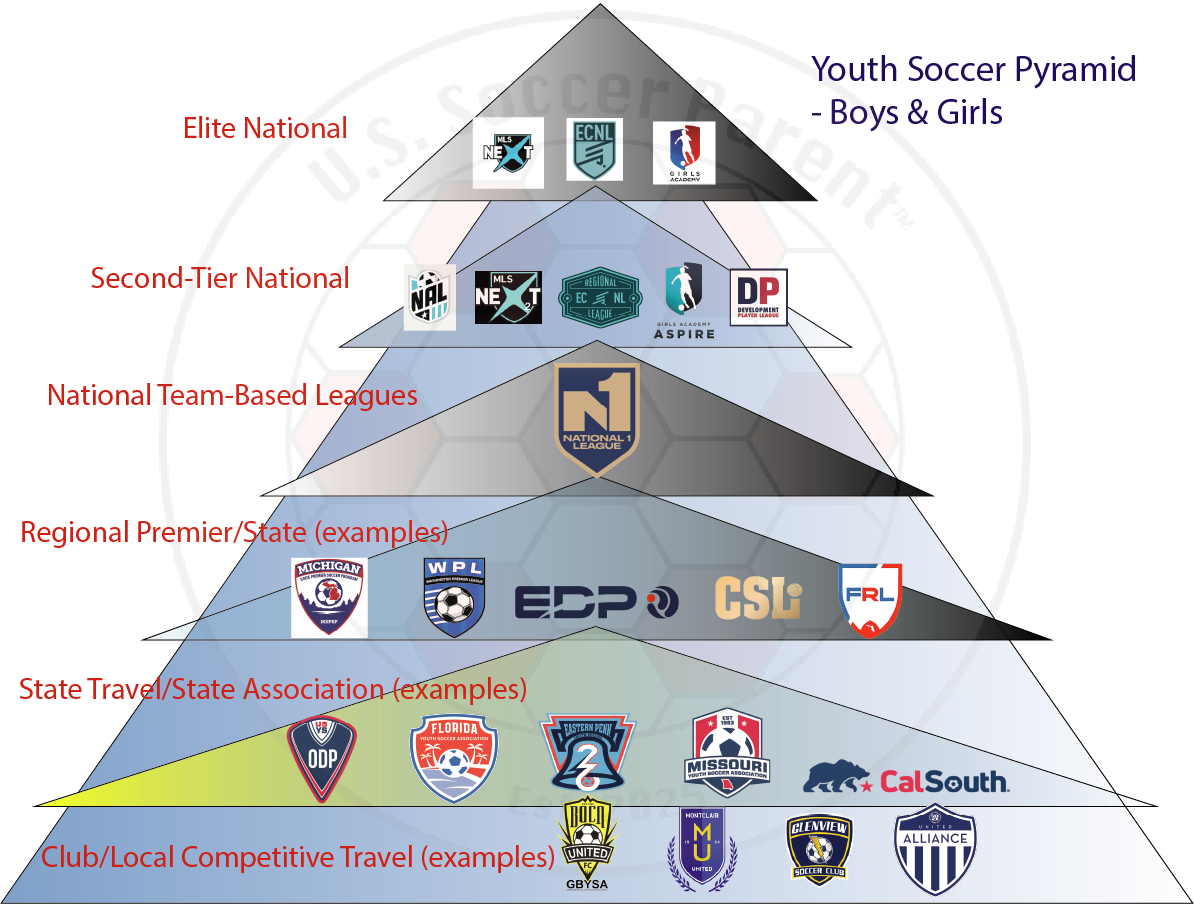
The competitive and travel levels of U.S. youth soccer, 2026–27 season. Rec play is the entry point for most players and is covered further down this page. Graphic: U.S. Soccer Parent™View full-size pyramid ↗ (opens in a new tab)
If you’ve ever tried to figure out where MLS NEXT sits versus ECNL, whether Girls Academy is “above” National 1 League, or why the club down the road claims to be “elite” when it doesn’t appear on any pyramid — this guide is for you. We walk through all six tiers of U.S. youth soccer for the 2026–27 season, explain what actually separates them, and show you how most families end up choosing.
A quick note before the pyramid: this is a map of how youth soccer is “organized”, not a ranking of soccer quality. A tier tells you who runs a competition and how teams qualify. It does not tell you how strong the soccer is in your specific market, and it does not tell you what your player is capable of. We’ll come back to that — it matters more than the pyramid itself.
Updated September 2026 for the 2026–27 season. The National Premier Leagues (NPL) and the USYS National League team-based platform have been replaced by the National 1 League. Every league guide below reflects that change.
Compare the six levels in detail
The six levels of U.S. youth soccer for the 2026–27 season, matching the pyramid above. Levels vary by region, club, age group and by boys’ vs. girls’ platforms. Always confirm current details with your club and the official league.
Tier
Level
Leagues at this level
What it means for your player
Tier 1
Elite National
MLS NEXT (boys) ECNL (boys & girls) Girls Academy (girls)
The most competitive national platforms. Expect a full-year commitment, national travel, the heaviest college-recruiting presence and the highest cost. Clubs buy in as members, so your child’s access depends on which platform their club belongs to.
Tier 2
Second-Tier National
MLS NEXT Academy Division, often called MLS NEXT 2 (boys) NAL (boys & girls) ECNL Regional League (boys & girls) GA Aspire (girls) DPL (girls)
National-brand leagues one step below the top. Strong competition and real showcase access, usually with less travel and lower cost than Tier 1. Unlike the MLS NEXT top tier, Academy Division players are permitted to play high school soccer. In many markets this is the highest level actually available locally.
Tier 3
National Team-Based Leagues
National 1 League (boys & girls)
Individual teams qualify on merit rather than the whole club buying a membership. This matters if your club is strong in one age group but not across the board. National 1 replaces NPL and the USYS National League team-based platform from 2026–27.
Tier 4
Regional Premier / State
Regional leagues such as MSPSP, WPL, EDP, CSL and FRL
Serious competition with travel measured in hours rather than flights. The level varies widely by market, so judge the specific league in your region rather than the category.
Tier 5
State Travel / State Association
State association leagues in each state. ODP sits alongside these as an identification program, not a league.
Competitive travel within your own state. This is where the majority of committed travel players actually play, and it is a realistic, affordable level to develop in.
Tier 6
Club / Local Competitive Travel
Local club travel programs and community-based competitive leagues
The entry point into competitive travel soccer. Local schedules, lower cost and a wide range of ability. Many players start here and move up as they develop.
MLS NEXT is widely viewed as the top boys’ platform in U.S. youth soccer, and it runs as two divisions. The Allstate Homegrown Division is the elite tier, where players do not play high school soccer. The Academy Division, often called MLS NEXT 2, sits a level below and does allow high school play.
Best for: Boys at a club that holds an MLS NEXT place, and families ready for a full-year, national-travel commitment.
ECNL is one of the most recognized youth soccer platforms in the U.S., known for strong competition, player development, and college recruiting visibility. ECNL Regional League sits just below ECNL and can be a strong pathway or competitive home depending on the club and market.
Best for: Players seeking a serious, development-focused environment with strong competition and recruiting opportunities.
The Girls Academy (GA) is one of the top national platforms in U.S. girls’ youth soccer, offering high-level competition, professionalized training environments, and strong college recruiting exposure. Aspire is a connected tier that provides a competitive, development-focused option for players and clubs that may sit just below full GA but still want access to structured schedules, showcases, and a clear pathway upward.
Best for: Girls seeking a serious, development-first environment with meaningful college recruiting opportunities, where GA is the top tier and Aspire offers a strong, connected competitive level.
NAL is a national platform for academy-style clubs sitting just below the very top tiers, with quality competition, structured schedules and a real place for players to be seen. It runs its own league and national championship for boys and girls U13–U19, and separately operates nine conferences of the MLS NEXT Academy Division. That means “we play NAL” can mean two different things depending on the club — worth asking which.
Best for: Players wanting serious regional competition without national travel, and one of the few second-tier national options that serves girls as well as boys.
The Elite Academy League is an all-boys national platform of more than 100 clubs across nine conferences, running U11 through U19 with its own national championship each June. It sits below the very top tiers but offers quality opponents, structured schedules and a serious training environment. EA also operates three MLS NEXT Academy Division conferences — Pacific Northwest, Southern California and Mountain — so the same organization runs both its own league and part of MLS NEXT’s second tier.
Best for: Boys seeking strong regional competition with a national championship to play for, particularly where EA is one of the top options their club offers.
The Development Player League (DPL) is a national girls’ platform that offers strong competition and a structured environment in the U13–U19 age groups. It provides meaningful games and development opportunities for clubs and players that may sit just below the very top girls’ leagues in some markets.
Best for: Girls seeking a competitive, development-focused league with solid showcase and college-exposure opportunities.
National 1 League (Formerly NPL & USYS National League)
The National 1 League is the top team-based competition in US Club Soccer and US Youth Soccer, replacing both the National Premier Leagues (NPL) and the USYS National League team-based platform from 2026–27. Individual teams qualify on merit rather than clubs buying a membership. Play runs through eight conferences divided into districts to keep travel manageable, and the league is integrated with the ECNL — districts advance teams into the ECNL Conference League Playoffs, and high-performing clubs are eligible for promotion to the ECNL Regional League.
Best for: Teams and players who want high-level competition without national travel, and a real chance to earn postseason and college-exposure opportunities through results rather than club membership.
EDP is a league and tournament platform that focuses on providing competitive, development-oriented play for clubs across multiple states. It often serves as a strong regional option for teams that want consistent, organized competition and access to showcases without necessarily being in the very top national leagues.
Best for: Players and teams looking for solid regional competition, structured league play, and tournament/showcase opportunities that can support long‑term development and, in some cases, college visibility.
USL Academy and USL Youth are part of the United Soccer League’s broader youth-to-pro development model. They offer competitive environments and, in some markets, a clearer connection between local youth players and higher-level pre-professional or professional opportunities.
Best for: Players looking for a competitive pathway tied to the USL ecosystem, especially where local clubs have strong academy or pro-club connections.
The United Soccer League (USL) is building a connected ecosystem of professional and pre-professional leagues in the U.S., and has announced plans to introduce a promotion and relegation system across parts of that structure. For youth soccer families, these changes could gradually reshape how local clubs, communities, and ambitious young players connect to higher levels of the game.
Best for: Parents who want to understand how USL’s evolving league system and promotion/relegation plans might impact their child’s long-term pathway and local soccer landscape.
The Olympic Development Program (ODP) is a supplemental identification and training program that sits alongside a player’s main club team, not in place of it. It focuses on selecting players for additional coaching and higher-level events, often through state and regional pools.
Best for: Players who are already performing well in their club environment and are looking for extra training, competition, and visibility—while still understanding that ODP is an add‑on, not the primary pathway for most families.
AYSO is one of the most common starting points for youth soccer in the U.S. offering local, affordable, and volunteer-driven programs focused on fun, learning, and participation. It emphasizes playing time, sportsmanship, and skill development .
Best for: Younger or newer players, and families looking for a low-pressure, community-based introduction to soccer before deciding on more competitive pathways.
The Soccer Forward Foundation is part of a broader effort to make youth soccer in the United States more accessible, inclusive, and affordable for families. It focuses on reducing barriers to play and supporting communities and clubs that want to open more doors for young players.
Best for: Families and clubs interested in financial-access programs, community initiatives, and new ways to keep youth soccer within reach for more players.
The pyramid and table above show where each league sits. This is the same landscape in everyday language — the four stages most families move through, starting well before any of the leagues above come into it.
Recreational Leagues
Recreational leagues are the entry point for many young players and families. They focus on participation, skill development, fun, and local play rather than high-level competition.
Town Travel Leagues
Town travel leagues usually sit above rec and introduce a higher level of competition, stronger teams, and more travel within the local region. They can be a good next step for players who want more challenge without jumping immediately into elite club soccer.
Competitive Club Soccer
Competitive club soccer includes local and regional teams that offer stronger coaching, more training, and a more demanding environment than rec or town travel. The level can vary widely by club, region, and age group.
Elite National Platforms
Elite national platforms include leagues such as MLS NEXT, ECNL, Girls Academy, and other top-tier environments. These leagues are designed for highly committed players seeking the strongest competition, exposure, and long-term pathway opportunities.
Frequently Asked Questions About Youth Soccer Levels
The questions parents ask us most often about the U.S. youth soccer pyramid, updated for the 2026–27 season.
What is the youth soccer pyramid?
The youth soccer pyramid is a visual map of how competitive youth soccer leagues in the U.S. are organized into tiers, from local recreational play at the base to national elite platforms at the top. For 2026–27, the main tiers are MLS NEXT, ECNL, and Girls Academy at the elite level; National 1 League and USL Academy in the tier below; regional leagues like ECRL and MLS NEXT 2 in the middle; and state-based competitive and recreational leagues at the base. The pyramid shows structure and qualification, not soccer quality in a given market.
What are the levels of youth soccer explained simply?
Youth soccer in the U.S. has six main levels of competition for the 2026–27 season: (1) elite national leagues (MLS NEXT for boys, ECNL and Girls Academy for girls), (2) second-tier national platforms (National 1 League, USL Academy), (3) regional competitive leagues (ECRL, MLS NEXT 2, GA regional), (4) state premier and top-flight state leagues, (5) state competitive and travel club leagues, and (6) local recreational leagues. Which level makes sense for your child depends on age, development stage, family logistics, and what leagues actually operate in your area.
What is the highest level of youth soccer?
The highest level of youth soccer for boys is MLS NEXT, launched in 2020 and operated by Major League Soccer. For girls, the top level is a two-league split between the ECNL (Elite Clubs National League) and the Girls Academy (GA) — both operate as elite national platforms, and top clubs sometimes participate in both. All three are showcase-heavy leagues designed to be seen by college and pro scouts, and clubs must meet significant staffing, facility, and player-pool requirements to be admitted.
What is the National 1 League in youth soccer?
The National 1 League is the new national team-based competition platform for the 2026–27 season, replacing the National Premier Leagues (NPL) and the USYS National League team-based platform. It operates below MLS NEXT and ECNL/GA in the pyramid but represents the top tier of the USYS competition structure, with regional qualifying leading to national championships. If your child was in an NPL team last season, they are almost certainly in National 1 League this season under the new name.
How do club soccer levels work?
Club soccer levels work through a combination of league affiliation and internal team ranking within a club. A club joins specific leagues (e.g., ECNL, MLS NEXT, National 1, state premier), and within each league the club fields multiple teams by age group. Most clubs also rank their teams internally — often labeled by number (e.g., 07 Boys ECNL, 07 Boys ECRL, 07 Boys State Premier) — with the top team in each age group competing at the highest level the club offers. Your child's actual level is a combination of which league their team plays in and which team within that league they're on.
How is the girls youth soccer pyramid different from the boys?
The girls youth soccer pyramid has two co-elite national leagues at the top (ECNL and Girls Academy), while the boys pyramid has a clearer single top league (MLS NEXT). This means girls families often face a real choice between ECNL and GA that has no exact equivalent on the boys side. Below the top tier, the structures are similar: both have regional divisions (ECRL for girls, MLS NEXT 2 for boys), National 1 League participation, and state premier layers. Girls Academy is generally smaller in overall club count than ECNL, which changes availability by region.
Keep Going
Additional Resources
Understanding the leagues is one part of choosing a soccer
environment. These guides can help with the practical decisions
about clubs, commitments, coaching, and costs.
Changing Clubs Mid-Season
Explore what to consider before moving clubs during a season,
including release requirements and existing commitments.
What to Know Before You Sign
Review registration rules and questions to ask before
accepting a roster spot and committing to a club.
Governing Bodies
Understand the organizations behind U.S. youth soccer
and how they connect to different playing pathways.
Playing Up
Consider whether an older age group is the right fit
for your child’s development and readiness.
Coaching Licenses & Costs
Learn about coaching qualifications and the questions
parents can ask about a coach’s training and experience.
Costs of Youth Soccer
Look beyond registration fees when comparing the
financial commitment of different soccer options.