
USL Promotion/Relegation & Youth Soccer
What the New 2028 USL Promotion and Relegation System Means for Youth Soccer
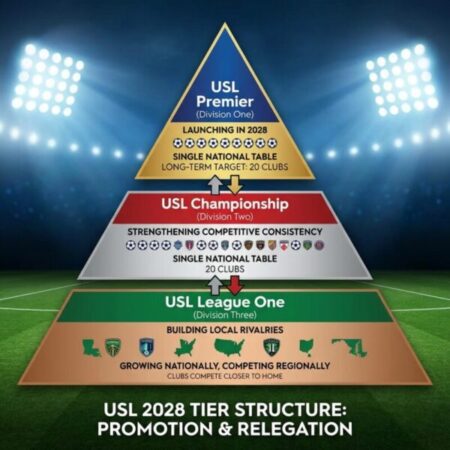
The United Soccer League (USL) plans to introduce promotion and relegation across its men’s professional leagues in 2028, alongside the launch of USL Premier. The planned system would connect USL Premier, USL Championship, and USL League One, allowing clubs to move between divisions based on their performance.
For youth soccer families, the immediate distinction is that this change concerns professional clubs, not automatic promotion of youth teams into professional leagues. The broader question is how a connected professional system could influence youth development, local opportunities, and the relationship between clubs and their communities.
This guide explains how promotion and relegation works, what USL has announced, and the potential implications for young players. It also separates the planned professional structure from youth-development benefits that will depend on how individual clubs respond.
A New Era: What Is Promotion and Relegation?
Promotion and relegation is a system in which clubs move between divisions based on their results. Promotion moves a club into a higher division, while relegation moves it into a lower one. This creates a connection between competition levels rather than keeping every club permanently in the same division (USL promotion and relegation overview).
USL plans to introduce this model in 2028 across three men’s professional divisions: USL Premier at Division One, USL Championship at Division Two, and USL League One at Division Three. The addition of USL Premier would complete that three-division structure (USL’s September 2026 announcement).
The intended effect is to give clubs something to compete for at both ends of the standings: an opportunity to move up or a need to avoid moving down. USL has announced the overall framework, but its promotion-and-relegation overview says further implementation details will be shared as the system develops.
How Does This Affect Youth Soccer?
USL’s promotion-and-relegation plan applies to its men’s professional divisions, so its potential influence on youth soccer is indirect. The question is how professional clubs respond to the opportunity to move up and the risk of moving down, including whether they strengthen their youth-development programs.
Connections Between Youth and Senior Soccer
USL already has development programs linking youth soccer with its broader club network. USL Youth provides complementary summer competition, while USL Academy connects selected players with professional and pre-professional environments. Those programs exist independently of the planned promotion-and-relegation system.
Promotion and relegation could give clubs another reason to develop local players who may eventually contribute to their senior teams. However, a professional club moving into a higher division would not automatically move its youth players onto the senior roster; Academy and senior-team opportunities still involve individual identification and selection (USL Academy player-development model).
Potential Investment in Player Development
USL presents promotion and relegation as an incentive for clubs to invest in players, facilities, and infrastructure. Separately, its Academy model already establishes development standards covering areas such as coaching, facilities, and individual player plans.
Those incentives could support stronger youth programs, but that outcome is not automatic. A club could prioritize long-term development, immediate senior-team recruitment, or a combination of both. Increased spending at the professional level should not be treated as proof of better coaching, lower fees, or more playing opportunities for every youth player.
Opportunities for Local Soccer Communities
A central part of USL’s stated vision is allowing clubs and their communities to aspire to higher levels of professional competition through results on the field. The league sees that connection as a way to strengthen local support and engagement.
For young players, the potential benefit is a stronger relationship between local youth soccer and a nearby senior club. Whether that produces more scouting, training access, or development opportunities will depend on the partnerships and programs each club actually builds.
Join U.S. Soccer Parent
Free for every soccer parent.
Save articles, get the free newsletter, and find guidance tuned to your state, your kids' ages, and the pathway your family is on.
What Should Parents Consider?
For parents, USL’s promotion-and-relegation plans are worth understanding, but they should not be confused with an immediate change to a child’s youth team. The announced system concerns movement between men’s professional divisions, while USL Academy has its own player-development and selection structure.
Distinguish announcements from local changes: A professional-league announcement is different from a confirmed change to your child’s coaching, schedule, fees, or playing opportunities. Look for specific information from the local program before drawing conclusions about its impact.
Understand what a club connection means: USL Academy’s model requires a league-approved youth network and a connection to a senior team. That provides a development structure, but families should understand what the relationship offers in practice rather than treating affiliation as a promise of advancement.


Keep development in perspective: Promotion and relegation creates stakes for professional teams. Those stakes should not become the measure of a child’s progress; coaching, appropriate competition, meaningful playing time, and enjoyment remain useful priorities.
Stay connected to local soccer: Following a nearby USL club can help families understand the professional game and feel part of their soccer community. Supporting that club does not require treating professional soccer as the destination for every young player.
The useful takeaway is awareness, not urgency. Follow how USL’s plans develop, while basing youth soccer decisions on the experience and support available to your child today.
A Time of Opportunity and Change
USL’s planned introduction of promotion and relegation in 2028 would change how clubs move through its men’s professional divisions. Alongside the launch of USL Premier, it would connect three professional levels through a system that rewards results on the field (USL announcement).
The potential significance for youth soccer lies in how clubs respond: whether they strengthen development programs, deepen local partnerships, and create meaningful opportunities for young players. Those are possibilities to follow, not benefits that every family should assume will arrive automatically.
For now, the distinction is straightforward: USL has announced a new professional structure, while its effects on youth development will depend on implementation and individual club decisions. Understanding that difference allows families to follow an important change in American soccer without confusing future possibilities with current opportunities.
For more context, explore our United Soccer League overview and our guide to USL Youth and USL Academy.
USL Promotion and Relegation: Frequently Asked Questions
What USL has announced, how the planned system works, and what it could mean for youth soccer.
What is promotion and relegation in soccer?
Promotion and relegation is a system in which clubs move between divisions based on their results. Promotion moves a club into a higher division, while relegation moves it into a lower one. USL plans to use this model to connect its three men’s professional divisions.
When does USL plan to introduce promotion and relegation?
USL plans to introduce promotion and relegation in 2028 alongside the launch of USL Premier, according to its September 2026 announcement. This is a planned implementation, not a system already operating across the three divisions. Follow USL’s official announcements for implementation details and any changes to the timetable.
Which leagues are included in USL’s promotion-and-relegation plans?
The announced structure connects three men’s professional leagues: USL Premier at Division One, USL Championship at Division Two, and USL League One at Division Three. USL Premier is the planned new top division within that system. The framework is described in USL’s promotion and relegation overview.
Does promotion and relegation apply to USL Youth or USL Academy?
The announced promotion-and-relegation system concerns men’s professional clubs, not automatic movement of USL Youth or USL Academy teams into professional divisions. Youth and Academy development opportunities involve their own participation, identification, and selection processes. Individual player progression is different from a professional club earning promotion.
Does a club’s promotion guarantee professional opportunities for its youth players?
No. Team promotion changes the division in which the professional club competes; it does not automatically give youth players senior-team roster places or professional contracts. USL Academy opportunities depend on individual identification and selection. A club’s results and a young player’s development are related considerations, but they are not the same process.
What could USL promotion and relegation mean for youth development?
USL presents promotion and relegation as an incentive for clubs to invest in players, facilities, and infrastructure. That could support youth development if clubs strengthen coaching, local partnerships, and opportunities for young players. Those benefits are not guaranteed, and increased professional investment should not be assumed to mean lower youth fees, more playing time, or easier access to professional soccer.
Keep Going
Additional Resources
Explore USL’s structure, its youth-development programs, and where they fit within American soccer.
Related Guides
- United Soccer League Overview Understand USL’s youth, pre-professional, and professional leagues and how the platforms connect.
- USL Youth vs. USL Academy Compare age groups, schedules, participation requirements, and development opportunities for young players.
- The U.S. Soccer Pyramid See where MLS, USL, and amateur leagues fit within the men’s soccer structure.
- Youth Soccer Levels of Competition Understand the youth league landscape and compare competition levels with your child’s needs in mind.