
(EAL) Elite Academy League
Elite Academy League (EAL)
The Complete Guide for Youth Soccer Parents
Updated August 2026: three things changed for the 2026–27 season. EA is now an official operator of the MLS NEXT Academy Division, MLS NEXT split into two different age-group systems, and EA launched a new U11–U12 platform called EA Pre National. All three are covered below.
Navigating the world of competitive youth soccer can feel overwhelming—especially with new expansions and shifting league structures every year. For families considering the Elite Academy League (EAL) as the next step or simply wanting to understand where it fits, this detailed guide clarifies EAL’s role, benefits, and differences from other major platforms like ECNL, NAL, and MLS NEXT.

EAL in the Youth Soccer Pyramid
To understand EAL’s significance, you first need to see the big picture. The “youth soccer pyramid” in the U.S. is a layered structure that starts with recreational leagues at the base (think local AYSO and town clubs), then moves up to travel leagues and regional competitions. NOTE: There are nuances depending on regions, boys, girls, etc. Generally, at the top sit the national platforms:
- MLS NEXT: The highest boys’ youth league, run by Major League Soccer—exclusive and highly competitive, with strict development standards.
- Girls Academy (GA): Top national league for girls.
- ECNL (Elite Clubs National League): Nationally recognized for both boys and girls, providing deep competition and college recruiting exposure.
- EAL (Elite Academy League): The Elite Academy League runs its own competition and also serves as an operator of conferences within the MLS NEXT Academy Division. These are separate competition roles: an EA league roster spot is not automatically an MLS NEXT roster spot. Ask the club which competition your child’s specific team will enter.
- NAL (National Academy League): Similar mission to EAL, focusing on national and regional competition, some overlap in club participation.
- NPL/DPL/USL/USYS National League: Strong regional platforms that provide additional competitive opportunities.
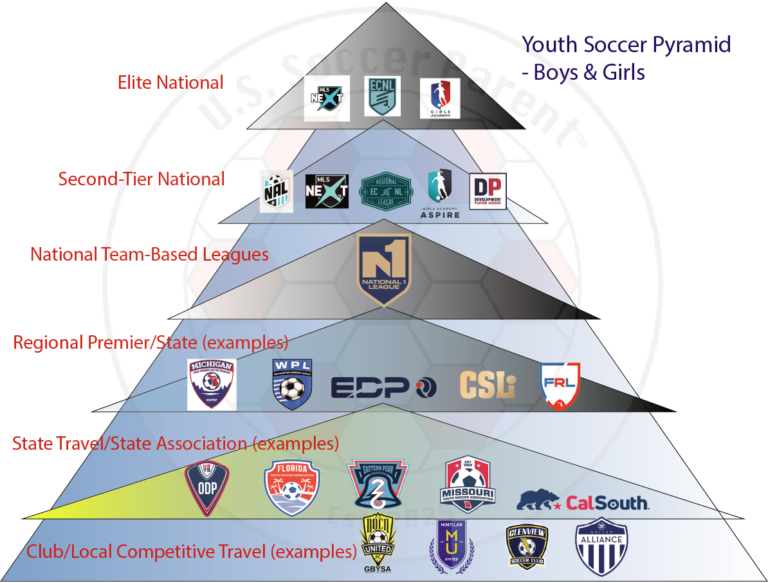
Note: This placement in the ‘youth soccer pyramid’ is a general guide, not an official ranking. The level of EAL (and its peers) can look slightly different by region, club, and age group, so families should always consider local context when comparing options.
Key Takeaway:
Compare the specific team offer, not just the club’s league affiliations. Confirm whether the roster is for EA, EA2, or an MLS NEXT division, then ask about coaching, playing opportunities, travel, and how movement between teams is considered.
Two Divisions, Two Age Systems for 2026–27
If your son plays in an EA or MLS NEXT environment, this is the detail to get right before registration.
Beginning with the 2026–27 season, MLS NEXT registers players two different ways depending on the division. The Allstate Homegrown Division continues to use birth-year age groups, January 1 – December 31. The Academy Division changes to school-year age groups, August 1 – July 31.
MLS NEXT explains the reasoning directly: birth-year “remains the optimal structure for the Allstate Homegrown Division, as it aligns with FIFA standards, the global professional pathway and greatly benefits our youth national teams,” while the school-year system “is the most suitable structure for the Academy Division, as it aligns with the broader youth soccer landscape across the United States.”
These two age-group systems apply to MLS NEXT’s divisions. Do not assume that EA’s role as an Academy Division operator determines the registration rules for every EA or EA2 team. Confirm the competition and its current age-group requirements with your club before registering.
2026–27 Registration
MLS NEXT Now Has Two Age Systems
This is the detail most families will get wrong. Beginning with the 2026–27 season, the two MLS NEXT divisions no longer use the same age-group calendar.
Allstate Homegrown Division
Birth-Year
January 1 – December 31
Unchanged. MLS NEXT cites alignment with FIFA standards, the global professional pathway and the youth national teams.
Academy Division
School-Year
August 1 – July 31
Changing. MLS NEXT cites alignment with the broader U.S. youth soccer landscape. This is the division EA helps operate.
What this means for your son: the same player can fall into two different age groups depending on which division he registers in. For example, a player born in September 2012 falls into U14 in the Academy Division for 2026–27, but U15 in the Homegrown Division. If he is moving between divisions, or trialing with clubs in both, confirm his age group for each one separately.
Source: MLS NEXT age group update. Confirm your son’s registration age group with his club before the season starts.
Who Sanctions the Elite Academy League?
EA’s published 2026–27 rules identify USSSA as the sanctioning body that insures EA teams, players, and staff. The rules specify registration through USSSA using LeagueApps, with players approved through the EA league registration process. USSSA should not be confused with USYS (US Youth Soccer). eliteacademyleague
If your club also fields teams in other competitions, ask which registration and insurance arrangements apply to your child’s specific team. Do not assume that every team within the same club uses the same sanctioning organization or competition rules.
What Makes EAL Different?
Developmental Philosophy
- EAL is built around the standards of the former U.S. Development Academy (DA), with additional flexibility gained from working within and alongside the MLS NEXT framework.
- Clubs joining EAL are selected for proven competitive quality, focus on development, and alignment with modern coaching and organizational standards.
- EAL clubs often have a “player-first” ethos—prioritizing individual growth, technical skill, and mental toughness.
Unique Flexibility
- High School Soccer Participation: Unlike MLS NEXT’s traditional restrictions, EAL players are allowed and even encouraged to compete for their high school teams. This gives student-athletes a balance between elite club exposure and the pride of local school representation.
- Revised Substitution Rules: Designed to maximize showcase opportunities, better utilize player pools, and help athletes be seen by college coaches.
Integrated Pathways
- EAL clubs generally also participate in MLS NEXT or have close ties to the league, giving families more options.
- Provides a structured player development pathway from foundation (U13-U15) through performance phase (U16-U19), focusing on both skill mastery and advancement to college or professional opportunities.
Showcase & Exposure Events
- EAL organizes national showcases and talent ID events attracting top college coaches and scouts—crucial for players aiming for NCAA soccer or pro ambitions.
High Standards, Broad Reach
- Member clubs are committed to coaching excellence, transparency, ethical soccer education, and long-term player support.
EA is ideal for advanced players who want elite competition without giving up high school soccer. EA’s operator role does not mean every EA player participates in MLS NEXT. Confirm whether the offer is for EA’s own league or an MLS NEXT Academy Division team, then check the rules and calendar for that specific competition.
College recruiting exposure in EA is strong, especially through national showcases and club coaching networks.
ECNL remains more prominent for girls and has deeper established pathways, but EA and NAL provide important alternatives for boys.
2026–27 Season
Where EA Fits Compared to Other Boys’ Platforms
Ratings below are our editorial read, not an official ranking. Standards and exposure vary by club, conference and region. League participation does not guarantee college recruitment, a professional opportunity or movement to another platform.
| League | Boys/Girls | College Exposure | HS Soccer Allowed? | Club Standards | Pathway to MLS/Pro |
|---|---|---|---|---|---|
|
MLS NEXT
Allstate Homegrown Division |
Boys | Highest |
Approved waiver required
Subject to MLS NEXT’s high school waiver rules |
Elite only | Yes |
|
MLS NEXT
Academy Division |
Boys | High | Yes | High |
Individual opportunities
Movement depends on selection, not automatic promotion to Homegrown. |
|
ECNL
ECNL & ECNL RL |
Both | Excellent | Yes | High |
Yes
College and pro |
|
EA
Elite Academy League |
Boys | Excellent | Yes | High |
Individual opportunities
EA league participation is separate from an MLS NEXT roster spot; movement requires selection. |
|
NAL
National Academy League |
Both | Good | Yes | Medium–High |
Individual opportunities
NAL league participation is separate from an MLS NEXT roster spot; movement requires selection. |
|
National 1 League
Formerly NPL · with DPL & USYS NL |
Both | Good | Yes | Medium | College and local |
On smaller screens, swipe horizontally to view all columns.
Confirm the specific team’s competition and current-season rules with your club before committing. EA and NAL also serve as MLS NEXT Academy Division operators, but their own league teams are separate from MLS NEXT teams. NAL’s published standards permit high school soccer for all players.
Player Pathway in the Elite Academy League (EAL & EAL 2)
U11–U12 (EA Pre National) — New for 2026/27
EA added a U11–U12 platform for the 2026/27 season, branded EA Pre National. In the league’s own words: “Starting in 2026/27, U11 & U12 teams will officially compete in the EA Pre National, expanding the Elite Academy pathway and creating more opportunities for player development.”
One important nuance for planning: under EA’s published standards, U13 through U19 are mandatory age groups for EA clubs, while U11 and U12 remain optional and are “determined by individual conferences if desired.” So a Pre National team may or may not exist at your club depending on your conference. Ask before you assume.
EAL 2 continues to expand geographically. EA launched EA2 Oregon in April 2026, extending the second-tier platform beyond its original Southwest base.
U13–U15 (Foundation Phase):
- Athletes focus on mastering technical skills, building core habits, and developing a positive mindset toward growth and training.
- Players are introduced to advanced tactical concepts, with special attention to individual improvement and versatility.
- Ask whether your club offers both EA and EA2 teams in your child’s age group. Compare the coaching, likely playing time, and competition schedule for the specific team being offered rather than assuming the two programs provide the same experience.
U16–U19 (Performance Phase):
- The training intensity and competition level rises as players enter key recruiting years.
- Ask which showcases your specific EA or EA2 team will attend and what recruiting support the club provides. Evaluate the actual event schedule and support available rather than assuming the league name guarantees exposure.
- EA’s published rules allow limited cross-roster participation between EA and EA2, subject to eligibility and match-minute restrictions. This is not the same as a permanent promotion or a guaranteed roster spot. Ask how your club evaluates players for these opportunities.
- The environment balances team success, personal progress, and individual visibility, preparing athletes for college recruiting or professional pathways.
How Can Players Progress From EA or EA2?
Think of EA or EA2 as a development opportunity, not a guaranteed sequence of promotions. Families can use these three steps to evaluate the next move:
Confirm the starting point: Identify the specific team, competition, coach, and expected role before accepting an offer.
Review development opportunities: Ask how player feedback, training opportunities with other teams, and roster decisions are handled.
Evaluate the next opportunity: Treat an EA, MLS NEXT, ECNL, or college roster opportunity as a separate selection decision, not an automatic next stage.
Why EAL & EAL 2 Matter
EA and EA2 can provide additional development opportunities, but families should evaluate the specific team rather than assume a fixed progression between leagues. Ask about coaching, meaningful playing time, competition, and how the club considers players for opportunities with other teams.
For current member clubs, divisions, and competition information, visit the official Elite Academy League website. Confirm which team and league your child’s offer covers before committing.
Is EAL the Right Choice for Your Family?
Only you can really answer this question. It starts with having an open, honest dialogue with your athlete first. Understand the commitment for them and your family. Seek the advice of coaches, your club and other EAL families. EAL may be a good fit if the specific team’s coaching, competition, playing opportunities, and schedule align with your child’s goals. Before committing, confirm the full cost, travel expectations, high school soccer arrangements, and how the club supports development and recruiting. The best choice is the environment where your child can learn, contribute, and stay motivated, not simply the league name on the jersey.
League and competition logos are used for educational and informational purposes only to help parents understand different levels of play. All trademarks are the property of their respective owners. U.S. Soccer Parent is an independent media platform and is not affiliated with or endorsed by the organizations shown.
Frequently Asked Questions About the Elite Academy League
Common parent questions about EA, EA2, MLS NEXT, and choosing the right team.
What is the Elite Academy League in youth soccer?
The Elite Academy League, commonly called EA or EAL, is a national youth soccer competition organized into regional conferences, with national events and a national championship. Its published standards cover club requirements, coaching, competition, and player eligibility. Families should evaluate the specific team’s coaching, playing opportunities, travel, and cost before accepting an offer.
Is the Elite Academy League the same as MLS NEXT?
No. EA runs its own league and also serves as an operator within the MLS NEXT Academy Division. These are different competition roles. An EA league roster spot is not automatically an MLS NEXT roster spot. Ask the club whether your child’s specific team will compete in EA, EA2, or an MLS NEXT division.
What is the difference between EA and EA2?
EA2 is a development platform within the broader Elite Academy structure, with its own competition and playoff format. According to the official EA2 overview, the top-performing EA2 club across U13–U19 age groups, measured by points per game, is considered for promotion into EA for the following season. That is club-level consideration, not guaranteed promotion for an individual player. Ask your club how team selection and player movement work locally.
What age groups does the Elite Academy League offer?
EA’s published 2026–27 standards list U13, U14, U15, U16, U17, and U19 as required age groups for EA clubs. U11 and U12 are optional and depend on the conference. Confirm which teams your club offers and which birth-date eligibility rules apply to your child’s specific competition before registering.
Can Elite Academy League players play high school soccer?
Yes. EA accommodates high school soccer through conference-based breaks in its league schedule. The timing depends on the conference, so ask your club how training, matches, and events align with your school season. Families should also confirm any applicable state high school eligibility rules.
Can the Elite Academy League help with college recruiting?
Yes. EA provides college-exposure opportunities, including National Talent ID Centers where selected players train with college coaches. Participation in EA does not guarantee selection for those programs, recruitment, or a scholarship. Ask which events your team will attend and how the club helps players with video, college outreach, and identifying suitable programs.
Keep Going
Additional Resources
Compare related youth soccer platforms and use official resources to confirm the competition, age groups, and requirements that apply to your child’s team.
Related Guides
- MLS NEXT Homegrown Division Explore the Allstate Homegrown Division and the participation rules families should understand.
- MLS NEXT & the Academy Division Understand MLS NEXT’s division structure and the distinctions to clarify when evaluating a roster offer.
- National Academy League Explore NAL’s own competition and its separate role within the MLS NEXT Academy Division.
- Youth Soccer Age Group Change Review the August 1–July 31 framework and why families should confirm their team’s age-group rules.
Official Resources
- Elite Academy League Consult the league’s official website for competition information, member clubs, and resources.
- MLS NEXT Academy Division Check official Academy Division information and its regional operators.