Development Player League (DPL): A Complete Guide for Soccer Parents
If you’re a parent navigating elite girls’ youth soccer, you’ve likely heard about the Development Player League (DPL). This guide explains what the DPL is, where it fits in the youth soccer pyramid, and what it means for your daughter’s development, college pathway, and overall experience as a player.
What Is the Development Player League (DPL)?
The Development Player League (DPL) is a national, elite-level girls’ youth soccer league in the United States for primarily U13–U19 girls. Its mission is to “develop the player and empower the person in a purposeful and memorable environment,” with an emphasis on both athletic and personal growth. The DPL operates across 10 regional conferences with more than 16,000 players nationwide, combining conference play with national showcase events that give players high-level competition and college exposure. Member clubs must meet strict competitive and operational standards, helping ensure a consistently professional environment for families. Beginning with the 2026/27 season, the DPL competes under The Girls Academy (GA) sanctioning structure, which formally connects it to the GA pathway.
Where Does the DPL Fit in the Girls’ Youth Soccer Pyramid?
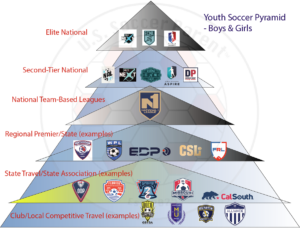
The girls’ youth soccer pyramid is topped by the Girls Academy (GA) and ECNL. The DPL sits below GA Tier 1 and GA ASPIRE as a high-level, standards-driven league — and, as of the 2026/27 season, as the official entry point into the Girls Academy ecosystem.
The DPL operates within a four-tier, merit-based competition pathway: DPL Open → DPL → GA ASPIRE → Girls Academy (GA Tier 1). Players and clubs move up based on performance, standards, and development rather than automatic placement. GA ASPIRE, launched in February 2025, is Tier 2 of the Girls Academy: it is owned and sanctioned by GA, while the DPL serves as the exclusive management partner handling day-to-day operations, scheduling, and staffing. Clubs accepted into GA ASPIRE must meet full Girls Academy standards, including fielding teams in all six age groups (U13–U19). For families, the practical takeaway is that DPL, GA ASPIRE, and GA now share registration, health and safety protocols, and league standards, so movement between levels is more structured than it used to be.
League and competition logos are used for educational and informational purposes only to help parents understand different levels of play. All trademarks are the property of their respective owners. U.S. Soccer Parent is an independent media platform and is not affiliated with or endorsed by the organizations shown.
What Makes the DPL Unique?
Player Development Focus
- The DPL prioritizes development over winning, fostering a professional training environment with high-level coaching and meaningful games. Its structure is designed to maximize playing time and skill growth for all rostered players, rather than focusing solely on results.
College Exposure
- College recruiting is a major component at this level. The DPL hosts college showcase events attended by NCAA, NAIA, and junior college coaches, making it a strong platform for players with collegiate ambitions.
Flexible Participation & High School Soccer
- DPL players can also play high school soccer, especially in the U15 and older age groups, and that has not changed with the move under Girls Academy sanctioning — GA requires its member clubs to give players permission to play for their school. Schedules at the older age groups are built around the fall high school season. This flexibility is highly valued by families who want their daughters to experience both elite club soccer and representing their school. Always confirm the specific calendar with your club, and check your state athletic association’s rules on overlapping club and school seasons.
Community and Player Empowerment
- The DPL emphasizes building a supportive community and empowering young women as both athletes and people, on and off the field. Leadership, teamwork and character development are central to the league’s philosophy.
Coaching &Training Standards
- At this level, parents should expect a rigorous but supportive environment. DPL clubs are expected to provide licensed, experienced coaches who follow best practices in youth development, with multiple training sessions each week that focus on technical skills, tactical understanding, and physical conditioning.
- Coaches are encouraged to provide regular feedback and individualized development plans, and parents and players should feel comfortable asking for feedback and maintaining open communication to support growth.
Player Well-Being and Support
Recognizing the demands of elite youth sports, the DPL and its clubs place a strong emphasis on player well-being and holistic development. Many clubs offer resources for injury prevention, nutrition, and mental health, and they encourage a healthy balance between soccer, academics, and personal life. Above all, the DPL strives to foster a positive, inclusive, and supportive team culture, helping young players thrive while pursuing their athletic goals.
Who Can Play in the DPL?
The DPL is designed for ambitious female soccer players, primarily serving the U13 through U19 age groups. In 2026 the league also launched NINES, a standalone 9v9 platform for U11 and U12 teams, giving younger players a structured entry point below the 11v11 age groups. Participation is selective: clubs must apply and meet rigorous standards to join, so if your local club offers a DPL program, it has demonstrated a commitment to development and excellence. The league operates through regional conferences to limit weekly travel, while still hosting national showcase events that offer exposure to college coaches and scouts.
If your daughter is interested in joining a DPL team, the process typically begins with club tryouts, usually in late spring or early summer.
Coaches evaluate players on:
- Technical skills (first touch, passing, dribbling, finishing)
- Tactical understanding (positioning, decision-making, awareness)
- Athleticism (speed, strength, endurance)
- Attitude and mentality (coachability, work rate, resilience)
- Fit with the team’s culture and goals.

The commitment is significant: multiple training sessions each week, weekend games, and travel to regional and national events. Once selected, players are generally expected to honor their commitment for the full season, and most clubs require tryouts each year to maintain roster spots.
Key DPL Benefits for Players and Families
Key benefits include:
- High-level competition: Players face top regional and national opponents, which prepares them for college soccer and potentially higher levels.
- College pathway: The league is designed with college recruitment in mind, offering exposure at showcases and through league play.
- Balanced experience: Players can pursue both elite club soccer and high school soccer, supporting academic, social, and athletic development.
- Clear advancement: Strong DPL players and clubs can move up through GA ASPIRE and into Girls Academy teams — a defined, merit-based route to the top of the GA structure rather than an informal one.
DPL, GA ASPIRE, and the Girls Academy Pathway
In February 2025, the Girls Academy introduced ASPIRE — now GA ASPIRE — as its Tier 2 league, managed operationally by the DPL. In July 2026, the two organizations went a step further: GA and the DPL executed a formal management services agreement for GA ASPIRE, and the DPL moved its sanctioning under the Girls Academy beginning with the 2026/27 season. DPL leadership describes the league as the “Premier Pathway” into GA ASPIRE and the Girls Academy.
For parents, this alignment means three things: a club can enter the ecosystem at the level it currently fits, players and clubs can advance on merit through DPL → GA ASPIRE → GA, and registration, health and safety protocols, and competitive standards are now consistent across all three levels. There are no automatic promotions — clubs apply and are evaluated.
You can read the GA and DPL alignment announcement here.
What this means for your daughter. Promotion happens at the club level, but individual players move too — through club roster decisions, showcase performance, and in some cases a move to a club at a higher tier. Practically, that means:
Movement is annual. Most clubs re-tryout every year, so a roster spot is earned each season, not held.
Showcase events matter more than league results. National showcases are where GA and ASPIRE staff and college coaches actually see players.
If your club is DPL-only, ask directly whether it has applied for GA ASPIRE and on what timeline — that determines whether your daughter can advance without changing clubs.
Ask your club how it handles players who are ready for a higher level than the club currently offers. A good answer is a real answer, not a deflection.
DPL Age Groups Are Now Seasonal-Year (August 1 – July 31)
As of the 2026/27 season, the DPL forms age groups by seasonal year (August 1 – July 31) rather than by birth year (January 1 – December 31). The Girls Academy, GA ASPIRE, and most other national platforms made the same move for 2026/27, so the pathway is now aligned. In practice, age groups follow the school year, which means some players shifted age groups compared with where they played in 2025/26 — most often girls born between August and December. If your daughter changed age groups in this transition, that is expected and is happening league-wide, not a reflection of her ability. Seasonal-year age groups do not affect high school eligibility, which is set by your state athletic association.
Bottom Line for Parents: How to Support Your DPL Player
The DPL offers a high-level, standards-driven environment for girls who want to challenge themselves, develop as players and people, and keep doors open for both high school and college soccer. For families seeking a balance between elite competition and flexibility, with a clear path to the top of the youth soccer pyramid, the DPL is a compelling option.
As a parent, your support is crucial in helping your daughter make the most of her DPL experience. Stay informed by attending parent meetings, reading club communications, and asking questions about schedules and expectations. Encourage your daughter to maintain a healthy balance between soccer, academics, and social life, and focus on celebrating her effort and improvement rather than just results. Planning ahead for travel, especially for regional and national showcases, can help your family manage the logistics and costs involved.
The youth soccer landscape is always evolving, but the DPL’s commitment to player development, exposure, and empowerment makes it a strong choice for many aspiring young soccer players. By staying engaged and supportive, you can help your daughter thrive both on and off the field.
DPL FAQs for Parents
Yes. The DPL offers college showcases and competitive league play attended by NCAA, NAIA, and junior college coaches, making it a strong platform for players pursuing college soccer.
ECNL and Girls Academy are generally viewed as the top national platforms. Within the GA structure, GA Tier 1 sits at the top, GA ASPIRE is Tier 2, and the DPL sits below both as the entry point into the pathway — closely connected to GA and, as of 2026/27, sanctioned by it.
The DPL is ideal for motivated, coachable players who want strong training, meaningful games, and college exposure, but who may also want to balance club soccer with high school and other commitments.
Travel varies by club and conference, but regular-season play is typically regional, with additional travel for select showcases and national events.
Beginning with the 2026/27 season, the DPL competes under The Girls Academy sanctioning structure. The league was previously sanctioned by USSSA. The change centralizes player registration, health and safety protocols, and league standards across DPL, GA ASPIRE, and the Girls Academy.
No. Players can still play high school soccer. Girls Academy policy requires member clubs to give players permission to play for their school, and older age-group schedules are built around the fall high school season.
NINES is a standalone 9v9 DPL platform for U11 and U12 teams, launched in 2026. It runs in two windows — a fall "Front 9" season and a spring "Back 9" season — and conferences may offer one or both. It gives younger players a development-first entry point before the jump to 11v11.
Keep Going
Additional Resources
Where the DPL sits alongside the other girls’ pathways — and where to verify current-season details before you commit.
Related Guides
- Levels of Competition Every tier of U.S. youth soccer, explained in order
- GA vs. ASPIRE vs. ECNL How the tiers above the DPL compare on cost, travel, and exposure
- The Layers of ECNL ECNL, ECNL Regional League, and how they differ from the GA pathway
- The Women’s Soccer Pyramid What the levels above youth soccer actually look like, college through pro
Official DPL Source
- The DPL League home — conferences, schedules, standings, and current-season news
Conference alignments, sanctioning, and event dates change from season to season. Always confirm the current season’s details with your club and the league.