The U.S. Women's Soccer Pyramid, Explained
Last verified August 6, 2026.
For the men’s side of the pyramid — including MLS, USL’s tiered structure, and its planned move to promotion and relegation — see our U.S. Soccer Pyramid guide.
The women’s side of American soccer is organized differently from the men’s side, and it has changed a great deal in just the last few years. For parents, understanding it comes down to one practical question: after a girl finishes youth soccer, where does she actually keep playing – in college, in summer leagues, or as a professional – and what does each of those paths require?
This page walks through the current structure, tier by tier. Some of it is settled and well documented. Some of it is still being built in real time, and we have tried to be clear about which is which.
How U.S. women's soccer is structured right now
- There are two Division I leagues, not one. The NWSL and the USL Super League are both sanctioned at the top tier. The men's game has only one.
- No Division II league is sanctioned. Two applications are pending — NWSL Division 2 and WPSL Pro — and both now target 2027. Neither exists yet.
- There is no promotion or relegation. Nowhere in U.S. women's professional soccer. Teams join by expansion, not by earning their way up.
- College soccer is the main development tier. This is the biggest difference from the men's side, where pro academies increasingly bypass the NCAA.
Division II sanctioning status last verified August 6, 2026. This is the fastest-moving part of the women's pyramid.
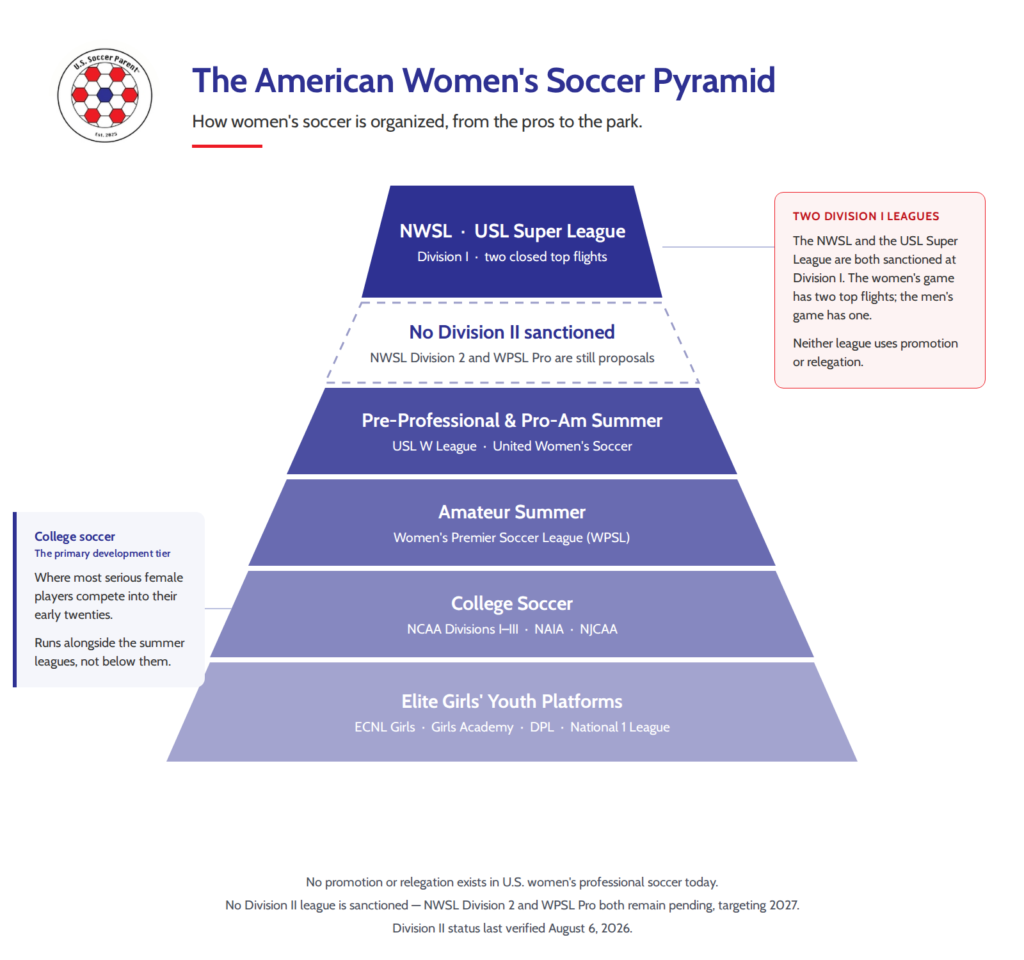
Table of Contents
Two Division I Leagues, No Sanctioned Division II
Unlike the men’s pyramid, where U.S. Soccer sanctions a single Division I league with lower divisions stacked underneath it, the women’s professional game currently has two separate Division I leagues operating side by side: the National Women’s Soccer League (NWSL) and the USL Super League.
Below that top tier, there is no U.S. Soccer–sanctioned Division II women’s professional league. Two groups have applied and both are still waiting (Wikipedia, United States soccer league system).
There is also no promotion or relegation anywhere in U.S. women’s professional soccer. Teams don’t move up or down between divisions based on results, and none of the current sanctioning documents describe a plan to introduce it.
The Top Tier: NWSL and USL Super League
National Women's Soccer League
Founded in 2013, the NWSL is the older and larger of the two top-flight leagues. It grew to 16 teams for the 2026 season with the addition of Boston Legacy FC and Denver Summit FC. Expansion franchises in Atlanta and Columbus are both set to join in 2028, bringing the league to 18 clubs — which means 2027 will be the final 16-team season (Yahoo Sports).
It is a closed league. No team is relegated out of it, and new teams join by paying an expansion fee and being approved by existing owners, not by earning promotion.
One structural change worth knowing: after its 2024 collective bargaining agreement, the NWSL eliminated its college draft entirely. Players leaving college programs now sign with teams as free agents (ESPN, NCAA.com). For families, this mostly means there is no longer a single predictable “draft day” — a college player’s move to the NWSL now happens through recruitment and negotiation, on a timeline that varies player to player.
A calendar note for 2027: the NWSL has announced the earliest start in its history. The Challenge Cup begins February 6 and the regular season opens February 11, 2027, with a 30-match schedule built around a seven-week pause for the 2027 FIFA Women’s World Cup in Brazil (June 24–July 25). Decision Day is October 31, playoffs run November 5–14, and the championship is November 20 (CBS Sports, Reuters). If you are planning to take your daughter to a match, the season now starts in the dead of winter rather than spring.
USL Super League
Marketed as the Gainbridge Super League, this is the newer of the two top flights, launching in August 2024. U.S. Soccer granted it Division I sanctioning in February 2024 – the first time two leagues have shared the top tier of the U.S. women’s pyramid (Wikipedia). It plays in cities not currently served by the NWSL, including Jacksonville, Fort Lauderdale, Lexington, and Brooklyn.
The league is mid-transition in two ways at once. It originally ran on an August-to-May calendar aligned with the international soccer season, but in June 2026 announced a shift to a spring-to-fall schedule starting in 2027 to align with the NWSL (ESPN). As a bridge, it is playing an abbreviated 14-match 2026 Fall Season that kicks off August 15, 2026 and runs through November 28, with the championship on December 12. That season features eight clubs, down from nine after Spokane Zephyr FC folded in May 2026 (Wikipedia, 2026 USL Super League season).
Separately, in July 2026 the league and its players reached a tentative agreement on their first-ever collective bargaining agreement, including minimum salaries starting at $37,200, housing benefits, and fully covered insurance premiums, with terms running through the end of 2031. As of August 6, 2026 that agreement is still pending final ratification (ESPN, The Athletic).
What This Means for Your Family
The NWSL and USL Super League are both legitimate top-division professional options, but they are separate businesses with separate rosters, calendars, and pay structures. A player does not move between them through promotion — only by being signed.
Which one you can actually watch depends heavily on where you live, since neither league yet covers the whole country. In Florida, the Super League is far more visible, with clubs in Jacksonville, Fort Lauderdale, and Tampa Bay.
The two Division I leagues, side by side
| NWSL | USL Super League | |
|---|---|---|
| Founded | 2013 | 2024 |
| Sanctioning | Division I | Division I (granted February 2024) |
| Clubs in 2026 | 16 18 in 2028 with Atlanta and Columbus | 8 down from 9 after Spokane folded in May 2026 |
| Season calendar | Spring–fall 2027 opens Feb 11, the earliest ever | Moving to spring–fall in 2027 14-match bridge season from Aug 15, 2026 |
| Minimum salary | $50,500 rising to $82,500 by 2030 | $37,200 under a CBA not yet ratified |
| Salary cap | $3.5M team cap, plus revenue share | No cap on salaries or squad size |
| Players' contract | CBA ratified 2024, runs through 2030 | Pending Tentative deal reached July 2026 |
| College draft | Eliminated — players sign as free agents | None — direct signings only |
| Promotion / relegation | None. Closed league. | None. Closed league. |
| Where you'll find it | Mostly larger metros — Portland, Kansas City, Orlando, Seattle, Denver, Boston | Markets without an NWSL club — Jacksonville, Fort Lauderdale, Tampa Bay, Lexington, Dallas, Carolina, Brooklyn |
Both leagues sit at Division I, so a player does not move between them by promotion — only by being signed. Figures verified August 6, 2026.
Why There's No Division II Yet
This is the area where it matters most not to get ahead of the facts. As of August 6, 2026, U.S. Soccer has not sanctioned any Division II women’s professional league. Two organizations have applied, both are pending, and both have already pushed their launch targets back at least once.
NWSL Division 2
In April 2025 the NWSL applied to U.S. Soccer for Division II sanctioning for a proposed reserve-team league, intended to give clubs a development tier for players coming off the college pipeline and returning from injury — roughly a minor-league system.
The plan calls for eight NWSL-affiliated reserve teams in year one: Bay FC, Gotham FC, Kansas City Current, North Carolina Courage, Orlando Pride, Racing Louisville, Seattle Reign, and the Washington Spirit, with a goal of all 16 NWSL clubs fielding one by 2029. Commissioner Jessica Berman confirmed in September 2025 that the league would not launch in 2026, shifting the focus to 2027. As of early 2026 it still had not been formally announced by the league, and sanctioning remains pending (Wikipedia, ESPN).
WPSL Pro
Originally planned as a Division III league, WPSL Pro announced in April 2025 that it would instead seek Division II sanctioning, backed by new investment including the Cleveland Soccer Group (ESPN).
Its own materials now describe a 2027 launch as a lower-division professional league, with roughly 15 to 18 franchises announced and a Connecticut club named as the 18th, slated for 2028 (WPSL Pro media kit, Yahoo Finance). Sanctioning is still pending.
One naming trap worth flagging: the amateur WPSL runs its own internal lower division, which is also called “Division II.” That is a completely separate thing from the proposed professional Division II discussed here.
What U.S. Soccer Requires
Part of why both timelines have slipped is that the bar is real. U.S. Soccer’s Pro League Standards require a Division II women’s league to field at least six teams in year one and eight by year three, place more than half its teams in metro markets above 500,000 people, use stadiums seating at least 2,000, and have a principal owner with a net worth of at least $7.5 million (Wikipedia, U.S. league system).
Summer Leagues: Where College Players Play
Below the professional tiers sits a group of summer leagues that matter enormously to families with older youth and college-aged daughters, because this is where a lot of real, structured soccer happens outside the school year. None of these are sanctioned by U.S. Soccer as professional divisions — they sit outside the numbered pyramid entirely.
USL W League
Launched in 2022 and run by the United Soccer League, the W League describes itself as the nation’s premier pre-professional platform. It grew to roughly 96 teams across 16 divisions for the 2026 season (Indy Eleven). It is not sanctioned as a pro league and players are not paid — that is deliberate, because it lets current college players compete over the summer without risking NCAA eligibility (Wikipedia).
Women’s Premier Soccer League
Founded in 1998, the WPSL is the longest-running and largest amateur women’s league in the country, spanning roughly 150 cities across 40 states (WPSL). It is explicitly amateur, sanctioned as a Tier 1 league by the United States Adult Soccer Association rather than as a professional division by U.S. Soccer. Its own talent-pool data shows about 70% of registered players are current student-athletes across NCAA Divisions I, II, and III, NAIA, and NJCAA programs (WPSL).
United Women’s Soccer
Founded in 2015, UWS is a national “pro-am” league. Most players are amateurs preserving NCAA eligibility, but the structure allows some paid, non-collegiate players — so check a specific team’s status rather than assuming the whole league works one way (Wikipedia).
What This Means for Your Family
If your daughter is playing club or high school soccer now and is a strong player heading toward college, these summer leagues are likely where she would play between college seasons. They are not a replacement for college soccer.
The single most important practical fact: none of these leagues pay players who want to keep NCAA eligibility. Accepting payment for play is what puts eligibility at risk — not the level of competition. Always confirm a specific team’s compensation status directly rather than assuming from the league name.
College Soccer: The Real Development Tier
This is the biggest structural difference between the men’s and women’s sides of American soccer, and it is worth stating plainly: college soccer is the primary development pathway for women in the U.S., in a way it no longer is for men.
On the men’s side, MLS academies and MLS NEXT Pro have increasingly pulled top prospects away from the NCAA, with some players turning professional as teenagers without playing college soccer at all. On the women’s side there is no equivalent professional academy pipeline at scale — which is precisely the gap the two proposed Division II leagues are trying to fill.
With more than 300 NCAA Division I women’s programs plus Division II, Division III, NAIA, and NJCAA, college soccer remains where the overwhelming majority of serious female players spend their late teens and early twenties. It is still described by outlets covering the sport as the prime pathway toward a possible professional opportunity, while also standing on its own as a meaningful athletic and academic experience for the large majority who never play professionally (Goal.com).
The elimination of the NWSL draft reinforces this rather than working against it. Teams still recruit heavily out of college programs — they simply do it through direct signings instead of a draft.
We want to be careful here: playing college soccer, even at a high level, does not guarantee a path to professional soccer. Only a small fraction of college players sign professional contracts. For most families, college soccer is valuable primarily as a college experience – scholarship opportunities, competition, and years of development – and any professional opportunity that follows is a possibility, not an expectation.
How Girls' Youth Leagues Connect Upward
Families often ask how the elite girls’ leagues connect to everything above. The honest answer is: indirectly, and almost entirely through college recruiting rather than any formal promotion ladder.
ECNL Girls and Girls Academy (GA) are the two national top-tier platforms. Both draw significant college-coach attendance at showcases and are generally treated as roughly equivalent depending on region and club affiliation (ECNL).
DPL and GA Aspire sit a level below GA as feeder platforms. DPL was named GA’s official second-tier competition platform in 2021 (SoccerWire).
Beginning in 2026–27, US Club Soccer’s NPL and US Youth Soccer’s National League merge into a single platform, the National 1 League (SoccerWire).
What these platforms actually provide is exposure — showcases, national playoffs, college-coach attendance — that can lead to a college roster spot. From there, college soccer is the bridge to any summer or professional opportunity. Treat “elite youth league” and “path to the pros” as two loosely connected ideas rather than one continuous ladder.
For a full breakdown of how these youth leagues stack up against each other, see our guide to the levels of competition in youth soccer.
What's Still Changing for 2026–27
The USL Super League switches from an August–May calendar to spring–fall in 2027, after an eight-club, 14-match bridge season starting August 15, 2026. Its first CBA is agreed in principle but not yet ratified.
NWSL Division 2 and WPSL Pro remain unsanctioned Division II applications. Both now point to 2027, and it is not clear which — if either — will be approved first, or whether both will coexist.
The NWSL’s 2027 season starts February 11, the earliest ever, with a seven-week break for the Women’s World Cup in Brazil. Atlanta and Columbus arrive in 2028 to make it an 18-team league.
Girls’ youth soccer is mid-reorganization, with the NPL and USYS National League merger into National 1 League taking effect in 2026–27.
On the men’s side, for contrast, USL plans to introduce promotion and relegation across a three-tier structure — a new top-flight USL Premier, the USL Championship, and USL League One — with USL Premier targeted for 2028 and its Division I sanctioning still pending (USL Expansion). MLS has continued to rule it out.
Given how much is still in motion, treat any specific claim about a new professional league’s launch date as provisional until the league or U.S. Soccer confirms it directly.
Additional Resources
Official league sites, sanctioning references, and pathway resources. The professional landscape on the women's side is moving quickly, so we've noted which of these are the best places to check for changes.
Division I Professional
Proposed Division II Not yet sanctioned
The NWSL's proposed reserve-team Division II league has not been formally announced by the league and has no public site yet. Both Division II applications remain pending as of August 6, 2026.
Summer Pre-Professional & Amateur
College Soccer
Elite Girls' Youth Platforms
More From U.S. Soccer Parent
Division II sanctioning status last verified August 6, 2026. This is the fastest-moving part of the women's pyramid — check U.S. Soccer or the league directly before relying on it.