Understanding The National Academy League (NAL)
Last updated: August 2026 — Reflects the 2026–2027 seasonal year, including new conference alignment and the August 1–July 31 age-group change.
NAL Soccer: What Parents Need to Know
The National Academy League (NAL) is a national youth soccer league offering regional club competition for boys and girls, with its main league serving U13–U19 players. For the 2026–27 season, NAL has announced 15 boys conferences, while its age-group registration cycle has changed to August 1–July 31.nationalacademyleague+1
One distinction matters before you compare teams: NAL runs its own league and also serves as an operator of conferences in the separate MLS NEXT Academy Division. A team playing in the NAL league is not automatically an MLS NEXT team simply because NAL is involved in both competitions.mlssoccer+1
For families, the starting question is: “Which competition will my child’s specific team play in?” This guide explains the NAL’s structure, age groups, high school participation, recruiting opportunities, and family commitments so you can evaluate the actual team offer, not just the league name.
League and competition logos are used for educational and informational purposes only to help parents understand different levels of play. All trademarks are the property of their respective owners. U.S. Soccer Parent is an independent media platform and is not affiliated with or endorsed by the organizations shown.
What Is the NAL?
NAL’s Own League
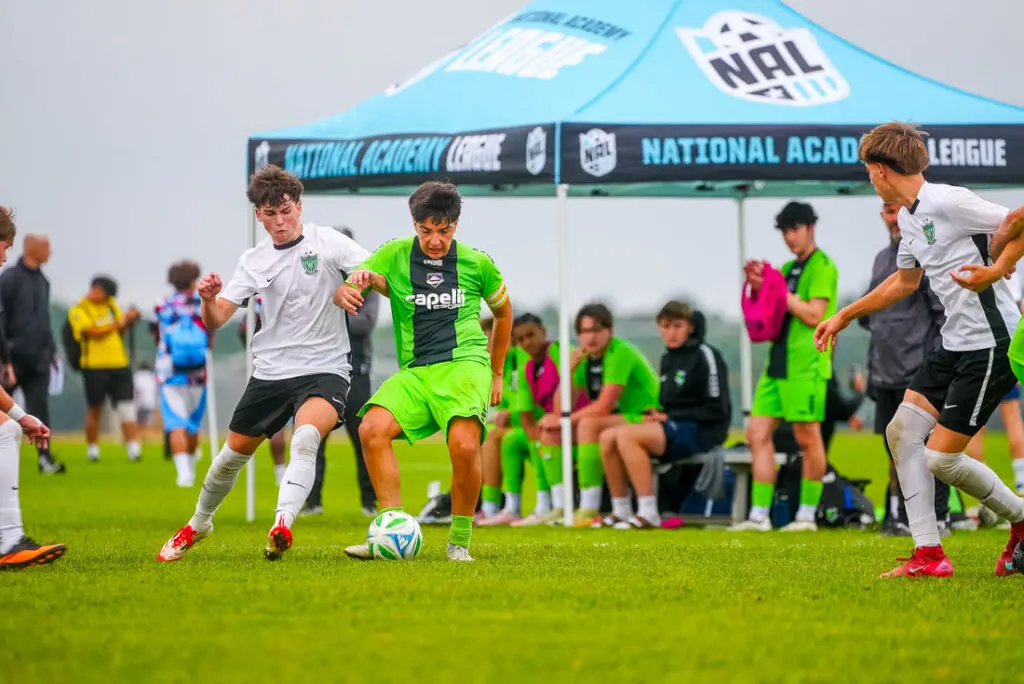
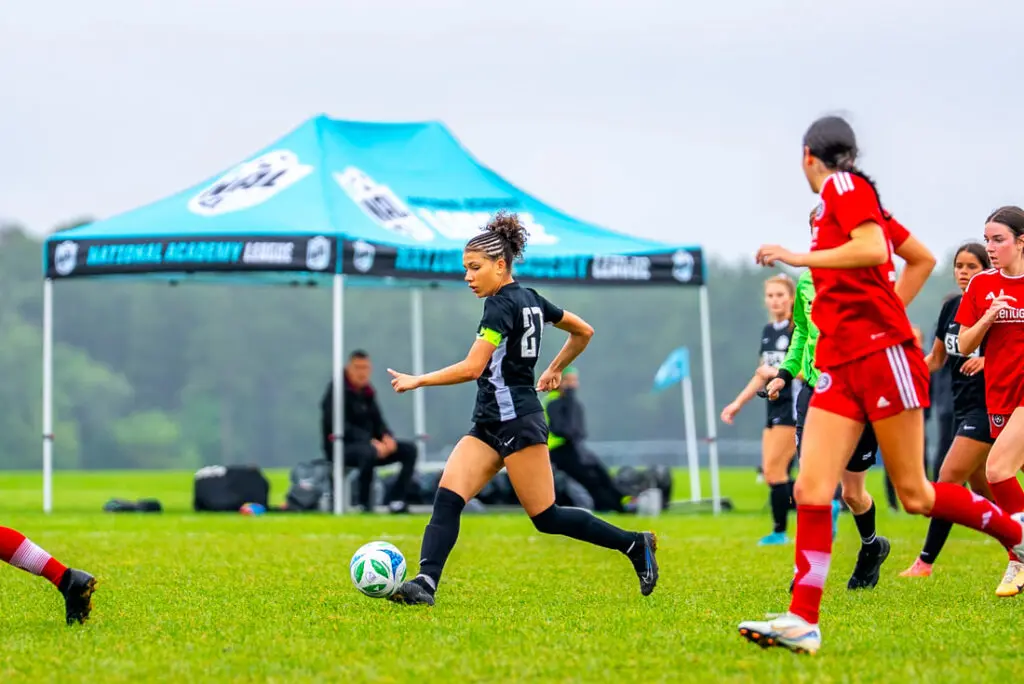
The National Academy League brings clubs together in a club-versus-club competition structure for boys and girls, with its main league serving U13–U19 players. Teams compete in regional conferences, with league events and postseason opportunities extending competition beyond their regular opponents. (Official NAL overview)
For parents, evaluate the specific team rather than assuming every NAL program offers the same experience. Ask where that team sits within the club, who coaches it, how playing time is managed, and which events are included in the season.
How NAL Connects to MLS NEXT
NAL also operates conferences within the MLS NEXT Academy Division, which follows MLS NEXT’s program guidelines and technical standards. That operator role is separate from the competition offered through NAL’s own league.
Before accepting a roster spot, ask the club to identify the team’s exact competition: the NAL league, MLS NEXT Academy Division, or MLS NEXT Homegrown Division. Do not assume that a club’s involvement in multiple competitions means your child’s team participates in all of them or that movement between teams is guaranteed.
What Changed for 2026–27?
NAL announced 15 boys conferences for 2026–27, including partnerships bringing boys clubs from the Texas Academy League and Desert Academy League into NAL regular-season competition, postseason play, and league events. Both partner leagues are operated by Cobalt Sports. (NAL partnership announcement)
NAL also adopted an August 1–July 31 age-group formation cycle beginning with the 2026–27 registration year. Families should confirm their player’s eligible age group and actual team placement with the club rather than relying on the previous season’s birth-year label. (NAL player registration)
For girls teams, confirm the current conference, opponents, and event schedule directly with the club. The expansion announcement specifies the new boys conference count but does not provide an updated 2026–27 girls conference total.
NAL Age Groups for 2026–27
Beginning with the 2026–27 season, NAL uses an August 1–July 31 age-group formation cycle rather than January 1–December 31 birth years. Use the registration windows below to identify your player’s age category, then confirm team placement with your club.
| Age category | Player’s date of birth |
|---|---|
| U11 | August 1, 2015 – July 31, 2016 |
| U12 | August 1, 2014 – July 31, 2015 |
| U13 | August 1, 2013 – July 31, 2014 |
| U14 | August 1, 2012 – July 31, 2013 |
| U15 | August 1, 2011 – July 31, 2012 |
| U16 | August 1, 2010 – July 31, 2011 |
| U17 | August 1, 2009 – July 31, 2010 |
| U18 | August 1, 2008 – July 31, 2009 |
| U19 | August 1, 2007 – July 31, 2008 |
Registration category does not guarantee a separate team. NAL’s published technical standards list league competition at U13, U14, U15, U16, U17, and U19. Its registration chart also includes U11, U12, and U18 categories. Ask your club which age groups it fields, whether younger teams participate through a partner league, and how U18-age players are placed.
Official references: NAL player registration and age groups and NAL technical standards.
Where Does the NAL Fit in the Youth Soccer Landscape?
NAL is best understood as a separate competition option, not a universal ranking immediately below every MLS NEXT, ECNL, or Girls Academy team. NAL runs its own league, while also operating conferences within the separate MLS NEXT Academy Division; those are different competition settings. (NAL league overview, MLS NEXT Academy Division)
For parents, compare the specific teams available to your child rather than treating league names as a complete measure of quality. A useful comparison looks at coaching, appropriate competition, meaningful playing opportunities, development support, and the demands on your family.
A Club Connection Is Not Guaranteed Advancement
If a club offers NAL alongside other programs, ask where the NAL team fits within that club’s structure. Do not assume it is always the second team, that players regularly train across rosters, or that accepting a NAL offer guarantees a later place in MLS NEXT, ECNL, or Girls Academy.
Ask the director to explain how players are evaluated, when movement is considered, and which registration rules apply. Recent examples involving players in your child’s age group are more useful than a general promise of a “pathway.”
How to Compare a NAL Team With Other Options
Whether your alternative is an MLS NEXT, ECNL, Girls Academy, or another competitive team, ask the same questions:
Exact competition: Which league and division will this specific team play in, and who are its regular opponents?
Coaching and development: Who will coach the team, how often will it train, and how will your child receive individual feedback?
Roster and playing opportunities: How many players will be rostered, how are match-day selections made, and what role does the coach envision for your child?
Movement between teams: Is there a defined evaluation process, and what conditions must a player meet to change rosters?
Family commitment: What are the full costs, travel expectations, school conflicts, and required events?
Recruiting support: For older players, what help does the club provide with video, college communication, and identifying suitable programs?
Use the answers to judge the offer in front of you. The goal is an environment where your player can develop and your family can sustain the commitment, rather than choosing on the league label alone.
Join U.S. Soccer Parent
Free for every soccer parent.
Save articles, get the free newsletter, and find guidance tuned to your state, your kids' ages, and the pathway your family is on.
Playing Time and Player Development
NAL publishes standards for training, rosters, and player participation, but its playing-time recommendations are not guaranteed minutes for every player. Understanding that distinction helps families ask more specific questions before accepting a roster spot.
Playing Time: Recommendations, Not Guarantees
NAL’s published participation recommendations are:
All age groups: Players should start in 25% of official matches.
U13, U14, and U15: Players should participate in 50% of minutes per week.
The league explicitly labels these as recommendations, not mandatory playing-time guarantees. Ask the coach how the team applies them, how participation is tracked, and how players receive feedback when their minutes are limited.
Team Rosters and Match-Day Selection
NAL permits up to 28 players on a team roster, but match-day rosters have a maximum of 18 players. A place on the season roster therefore does not necessarily mean selection for every match.
Before committing, ask how many players the team actually intends to carry, how match-day selections are communicated, and what opportunities are available to players who are not selected. For goalkeepers, ask specifically how training, starts, and match minutes are shared.
Training, Playing Up, and Recovery
NAL’s published standards require U13–U19 teams to train at least three times per week and individual players to receive at least one day off per week. Confirm how the club organizes that schedule around matches, travel, and school commitments.
Field players may play in an older age group while remaining rostered in their younger age group, provided they meet competition standards and stay within a maximum of 90 minutes per day across no more than two matches. The standards provide a separate goalkeeper exception allowing participation in more than one game and more than 90 minutes in a day.
Playing up is an option, not a promise attached to a NAL roster spot. Ask who makes that decision and how the club coordinates a player’s total workload across teams.
High School Soccer
NAL permits high school soccer participation for all players. That permission is part of NAL’s own technical standards, rather than a guarantee that club and school schedules will never conflict.
Ask the club how it handles the high school season, overlapping commitments, and recovery time. Also confirm your school’s and state athletic association’s eligibility requirements before combining school and club participation.
| Time of Year | Typical NAL Event Type | Recruiting Focus |
|---|---|---|
| Late Summer / Early Fall | Season kickoff, early league games, club-hosted friendlies | Laying the foundation for the year, early identification by local and regional college programs |
| Fall | Conference league play, occasional local showcases | Ongoing evaluation, building game film, first touch points with college coaches |
| Winter | NAL crossover festivals and showcase-style events; select external showcases (e.g., IMG Cup) | Major recruiting window for many classes, concentrated college coach presence |
| Spring | Final conference matches, additional crossover events or showcases | Continued evaluation, follow-up conversations, refinement of college target lists |
| Early Summer | NAL Championship events and select post-season tournaments | Final impressions and offers for older players; early identification for younger age groups |
College Exposure and Recruiting
NAL’s event calendar offers opportunities for competition beyond regular conference play, with college-coach registration listed for several 2026–27 crossover events. However, an event listing does not establish which coaches will attend or guarantee that a particular player will be evaluated.
For families with college goals, ask how the team’s actual schedule connects to the player’s age, academic interests, and potential college fit. Treat events as one part of a recruiting plan rather than the plan itself.
Understand the Team’s Actual Event Schedule
NAL’s 2026–27 calendar includes crossover events with different age and gender offerings. Participation is subject to event capacity and limits on the number of clubs from each conference, so league membership should not be treated as confirmation that a team will attend every event.
Ask the club to distinguish between confirmed events, planned applications, and postseason opportunities that depend on qualification. For each trip, ask what the event is intended to provide: appropriate competition, development experience, recruiting opportunities, or a combination.
Ask What Recruiting Support Includes
NAL’s technical standards require the home club to upload U15–U19 match video to the Taka League Exchange within 24 hours of the final whistle. That requirement does not, by itself, explain what footage families can access or what individual recruiting assistance a club provides. (NAL technical standards)
Before accepting general promises of “exposure,” ask about:
Video access: Can players obtain full-match footage and create clips, and are there additional fees?
College guidance: Who helps players identify programs that fit their academic interests and playing level?
Coach communication: What help is available with introductions, outreach, and follow-up?
Event preparation: How does the club help players share schedules and relevant information with appropriate college programs?
Recent examples: What college placements has this specific team or program supported, rather than the club as a whole?
Request concrete examples of the support available. A useful recruiting conversation should explain what the club will do and what the player will be responsible for.
Travel, Costs, and Family Commitment
NAL’s published 2026–27 crossover calendar includes events in multiple states, with hotel-information listings for those events. Your family’s actual travel commitment depends on the team’s conference schedule and the events it attends, not simply the NAL label.
Request a written season budget covering:
Club charges: Tuition, registration, uniforms, and any separate event fees.
Travel expenses: Transportation, hotels, meals, and any shared coach-travel costs.
Required attendance: Which trips are mandatory and whether hotel-booking requirements apply.
Additional costs: Video services, recruiting services, and potential postseason expenses.
Financial assistance: What aid is available, what it covers, and when applications are due.
Compare the full commitment, not just the advertised club fee. Ask how schedule changes and additional event costs are communicated before making a decision.
When Is NAL a Good Fit for a Player?
NAL can be worth considering when the specific team offers an appropriate challenge, a clear development plan, and a commitment your family can sustain. Evaluate those features directly rather than assuming they come automatically with league membership.
An appropriate playing environment: The coach can explain how the level of competition matches your child’s current ability, what role they envision, and which skills the player needs to develop.
Meaningful opportunities to improve: The team offers a credible plan for training, feedback, and match involvement. Ask how that plan works for players across the roster, not just the strongest starters.
Room for high school soccer: NAL permits high school participation, which may appeal to players who want both school and club experiences. Confirm how the club manages overlapping schedules and expectations.
A sustainable family commitment: The full costs, travel, training schedule, and required events fit your circumstances. Consider whether the arrangement leaves sufficient room for school, recovery, and life outside soccer.
Be cautious if the main selling point is a promised future move to another team or league, while the current coaching, roster role, or costs remain unclear. A useful final question is: “Would this still be a good environment for my child if that future move never happened?”
The Bottom Line for Parents
A NAL offer is worth evaluating on the strength of the team your child would actually join, not simply its league affiliation or a possible future move. Look for clear answers about coaching, roster size, playing opportunities, development feedback, and the full family commitment.
Before accepting, confirm the team’s exact competition and ask for its season schedule, costs, and player-development expectations in writing. Choose an environment that supports your child’s progress and enjoyment now, while keeping future goals in perspective.
Frequently Asked Questions About NAL
Answers to common parent questions about the National Academy League, its relationship to MLS NEXT, and the 2026–27 season.
What is NAL in youth soccer?
The National Academy League (NAL) is a national youth soccer league offering regional club-versus-club competition for boys and girls, with its main league serving U13–U19 players. It provides regular-season competition, league events, and postseason opportunities. Families should confirm the specific team’s conference, age group, and schedule directly with their club.
Is NAL part of MLS NEXT?
NAL’s own league is separate from MLS NEXT. NAL also serves as an operator of conferences within the MLS NEXT Academy Division, which follows MLS NEXT’s program guidelines and technical standards. A place on a NAL league team is therefore not automatically a place on an MLS NEXT team. Ask the club to identify the exact competition attached to your player’s roster offer.
Is NAL better than ECNL for my child?
There is no one-size-fits-all answer for an individual player. Compare the specific NAL team with the specific ECNL or ECNL Regional League team available to your child. Consider coaching, competition, likely playing opportunities, development feedback, recruiting support, travel, and total costs. Neither league label alone tells you which team will be the better fit.
Can NAL players play high school soccer?
Yes. NAL’s technical standards permit high school soccer participation for all players. Families should still confirm how their club handles overlapping schedules and check school and state athletic association eligibility requirements. League permission does not guarantee that club and school commitments will never conflict.
What age-group cutoff does NAL use for 2026–27?
Beginning with the 2026–27 season, NAL uses an August 1–July 31 age-group formation cycle instead of January 1–December 31 birth years. Check your player’s full date of birth against the official NAL registration chart, then confirm team placement with your club. A registration age category does not guarantee that a separate team is offered at that age.
Does NAL offer college recruiting opportunities?
NAL’s 2026–27 event calendar includes crossover events with college-coach registration. That creates potential evaluation opportunities, but it does not guarantee attendance by particular coaches, individual exposure, or a college offer. Ask which events your team will attend and what support the club provides with match video, college outreach, and identifying suitable programs.
Keep Going
Additional Resources
Where the NAL fits alongside the other pathways — and where to verify current-season details before you commit.
Related Guides
- Levels of Competition Every tier of U.S. youth soccer, explained in order
- The U.S. Soccer Pyramid How the whole structure fits together, youth through pro
- National 1 League Formerly the NPL — the confirmed 2026–27 structure and operators
- The Layers of ECNL ECNL, ECNL Regional League, and how they differ
- Girls Academy vs. Aspire vs. ECNL The elite girls’ platforms compared side by side
- MLS NEXT The tier directly above the NAL on the boys’ side
- 2026–27 Age Group Change Why birth-year windows shifted, and who it affects
Official NAL Sources
- National Academy League League home and current season information
- Player Registration & Age Groups Official birth-year windows for 2026–2027
- Partnerships & Conferences Conference count, member clubs, and new league partners
Conference alignments, event dates, and showcase locations change every year. Always confirm the current season’s details with your club and the league.