
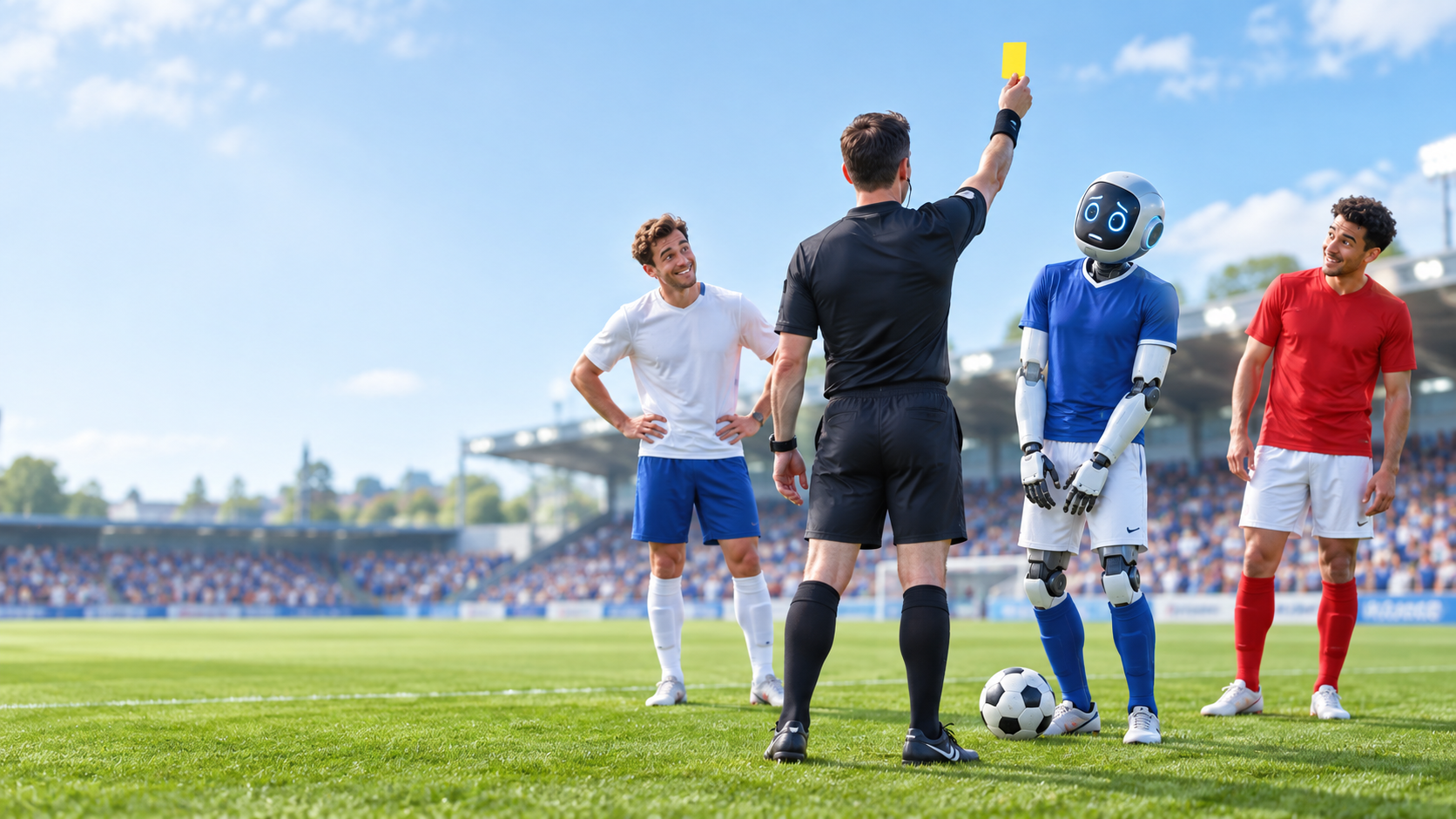
As Munich-based tech company Vesoma emerges from stealth with a humanoid platform built around real-world learning, advances in robot soccer point toward possible new training tools—while potentially opening a separate lane for fan entertainment.
Humanoid robots are increasingly stepping onto the soccer field—not as replacements for human players, but as a test of how quickly artificial intelligence can learn to see, move, balance and make decisions in an unpredictable physical world.
That progress could eventually have implications for soccer development. In the near term, humanoid robots are more likely to become specialized training tools, data-gathering systems or entertainment attractions than substitutes for athletes, coaches or the human drama that gives the sport its appeal.
A newly public European robotics company illustrates the broader shift. According to Humanoids Daily, the startup behind the walking “Kyle” humanoid prototype has emerged from stealth as Vesoma, with more than 60 employees in Munich and Limassol, Cyprus. The company says it is building its first product, Vesoma 1, around a “physical general intelligence” approach in which robots learn through direct interaction with the world.
The company’s initial commercial focus is manufacturing, logistics and warehousing, rather than sports. But soccer has become one of the most visible demonstrations of the technical abilities Vesoma and other humanoid-robot developers are seeking: perception, whole-body balance, locomotion, rapid response and coordination among multiple autonomous agents.
Soccer as a test field
At RoboCup 2026 in Incheon, South Korea, two full teams of humanoid robots played an 11-vs.-11 match, which the RoboCup Federation described as the first such game using full-sized humanoid robots.
The match was a landmark in robotics, not a challenge to human elite soccer. Still, playing the game requires robots to solve problems that are central to useful real-world autonomy: tracking a moving ball, managing balance while turning and kicking, understanding changing field positions and responding to teammates and opponents.
Research is also moving toward more reactive forms of robot play. A recent Science Robotics study reported a reinforcement-learning controller designed to enable humanoid robots to play vision-driven, reactive soccer under real-world perceptual uncertainty. That matters because the path from choreographed demonstrations to practical robots depends on how well machines handle situations that do not unfold exactly as planned.
Robot-Driven Development possibilities
For player development purposes, the most intriguing long-term prospect is not robot players. It is more adaptable training environments.
A capable humanoid robot—or a less humanlike mobile robotic system using similar AI—could eventually be used to recreate consistent patterns of defensive pressure, vary the direction and timing of passes, or create repeatable receiving and finishing scenarios. Unlike a conventional ball-launching machine, an intelligent system could respond to a player’s movement, decisions and body position.
Potential uses could include:
- Simulating predictable pressing or defensive movement patterns.
- Delivering ball-service patterns that vary by player level and drill objective.
- Creating decision-making exercises in which the player must scan, react and select an option under changing pressure.
- Measuring response time, body orientation, first touch and movement efficiency over repeated sessions.
- Giving coaches more control over repeatable, individualized technical scenarios.
That potential should be viewed, if anything, as complementary to—not a replacement for—human coaching and player-to-player development. The game’s most important lessons often come from dealing with teammates, reading human body language, responding to emotional pressure and improvising amid the messiness of real competition.
A different kind of spectacle?
Robot soccer also has a potential fan-entertainment future. RoboCup has long pursued the goal of developing autonomous humanoid robots capable of one day competing with the human World Cup champion.
The attraction would not be that robots make human soccer obsolete. Human football’s appeal rests on identity, history, athletic accomplishment, rivalry and the unpredictable emotions of people competing under pressure.
Robot soccer could instead become a distinct form of entertainment—part sporting event, part technology showcase and part measure of progress in embodied AI. Fans may tune in to see whether machines can coordinate, adapt, recover from errors and solve tactical problems in real time.
For Vesoma, the relevance of the soccer-robotics trend is indirect but significant. The same abilities required to navigate a soccer field—mobility, perception, autonomy and adaptation—are relevant to the industrial work the company says it wants its machines to perform. According to Humanoids Daily, Vesoma 1 remains in development, while the company’s earlier alpha robots are already operating in the laboratory.
llustration generated with AI. No real players or teams are depicted.