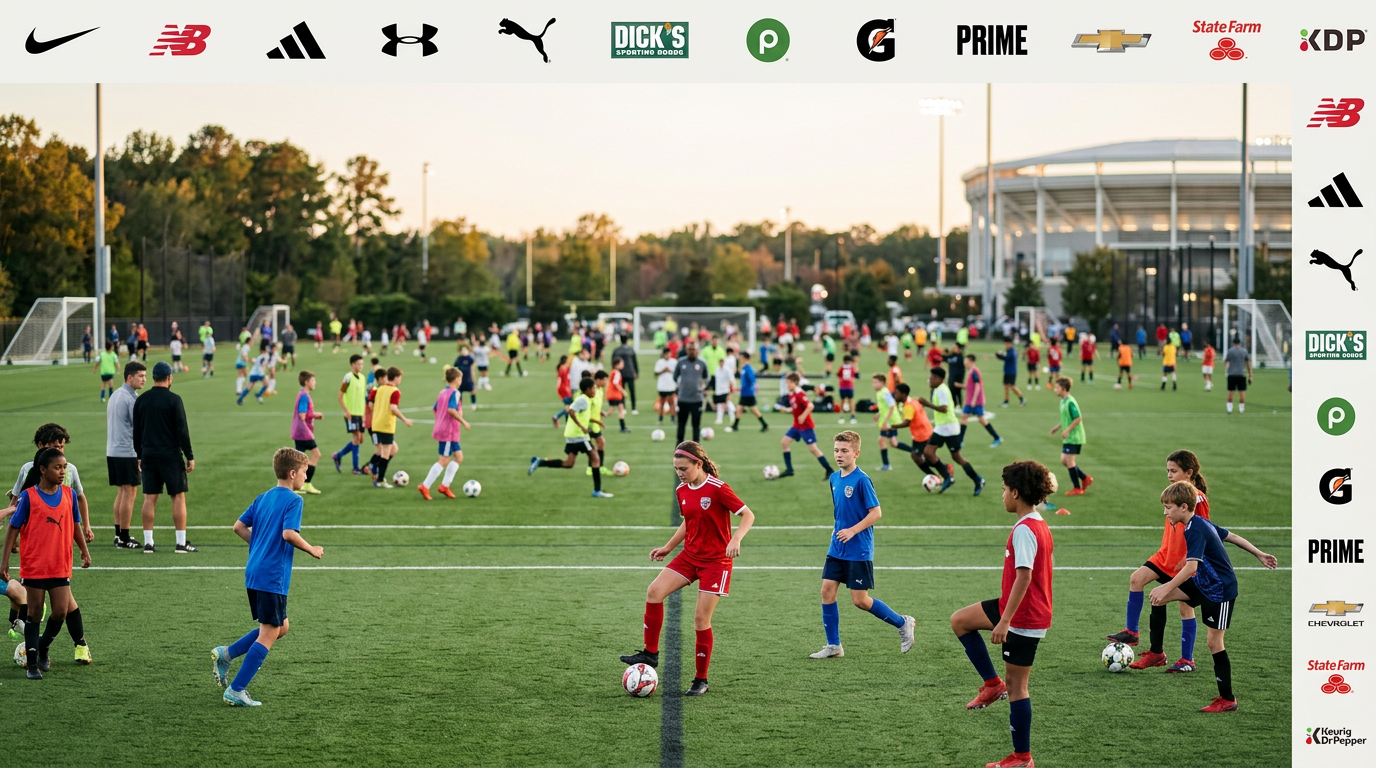
Logos are used for educational and informational purposes. All trademarks are the property of their respective owners. U.S. Soccer Parent is an independent media platform and is not affiliated with or endorsed by the organizations shown.
For all the talk about “pay‑to‑play,” one of the most underused tools we have to bring costs down is brand sponsorship. When national brands underwrite uniforms, fields, tournaments, scholarships, coach education, and events, they are replacing dollars that would otherwise come out of parent pockets in the form of higher fees.
Local team and club sponsors will always matter—your neighborhood bank, restaurant, or realtor writing checks for uniforms or travel is still the most immediate way to lower costs on a given team. But what’s changing quickly is the scale and sophistication of national investment, with major endemic and non‑endemic brands tying themselves to big governing bodies and event operators that touch millions of kids at once.
What follows is a look at national brands making significant, structured investments in youth soccer and youth sports, and what they’re actually bringing to the table.
Big Sportswear And Equipment Brands (Endemic)
Nike
Nike is a central player in the youth game, serving as the exclusive athletic apparel and equipment supplier for major youth organizations such as US Club Soccer. In practice, that means Nike supplies balls, bags, apparel, and other equipment—along with financial support—so these organizations and their member clubs can outfit players and run events without passing every cost straight through to families.
Beyond those core relationships, Nike funds youth sports initiatives through community‑impact programs, offering grants and product support that flow down into local clubs and leagues. The idea is straightforward: underwrite the experience early to build long‑term brand loyalty, while clubs and parents get subsidized gear and programming they couldn’t easily afford on their own.
New Balance
New Balance has made a sizable push into grassroots soccer through multi‑year sponsorships with national bodies. It is an official sponsor of US Youth Soccer (USYS), and has also partnered with AYSO on uniforms and retail via SOCCER.COM. Those relationships touch both competitive and recreational segments at scale.
Because these deals centralize uniforms, balls, and related equipment across hundreds of thousands of players, they create economies of scale that can reduce per‑player costs and free up money for scholarships, coach education, and program expansion.
Adidas, Under Armour, Puma
Adidas, Under Armour, and Puma are all active across youth sports in North America, including soccer, via uniform deals, tournament sponsorships, and community grants. While their most visible assets may be in pro and college sports, each supports camps, tournaments, and club programs that receive discounted or subsidized kit and equipment at the grassroots level.
Retail And Grocery Brands
DICK’S Sporting Goods
DICK’S Sporting Goods is one of the most important national retail players in youth sports. It partners with large youth organizations and tournament platforms, while also running league sponsorships and team‑grant programs in communities around the country.
For soccer families, that footprint matters in two ways: direct sponsorship dollars help clubs and leagues pay for uniforms, facilities, and events, and discount programs/coupons lower what parents pay for cleats, balls, and seasonal gear. In some cases, its investments in youth‑sports properties enable bundled pricing models where sponsor money offsets what would otherwise be fully parent‑funded participation.
Publix And Other Grocers
Publix is a flagship example of a regional grocer acting like a national player in youth sports. In Florida, for instance, Publix is a lead sponsor of the Florida Youth Soccer Association (FYSA), explicitly framing its support around healthier kids and communities. That sponsorship helps fund state‑level operations and marquee events, stabilizing costs for member clubs and families rather than forcing every budget gap into higher registration fees.
Other supermarket chains and big‑box retailers (e.g., regional grocers, warehouse clubs) run similar youth‑sports sponsorships and grant programs around the country, often tied to cause‑marketing platforms and community foundations. Those programs typically pay for uniforms, facilities, or tournament experiences, and provide coupon programs that directly lower family grocery or gear bills.
Non‑Endemic Financial And Insurance Brands
These are brands whose core product has nothing to do with balls, boots, or fields, but who see youth sports as one of the cheapest and most trusted ways to reach families.
State Farm And Other Insurance Brands
State Farm is one of the most visible national examples. Local agents routinely sponsor youth sports teams and clubs, paying for uniforms, banners, and tournament entries in exchange for jersey placement and field signage. Because these are often straight cash checks into nonprofit clubs, they go directly at line‑items that would otherwise be rolled into family fees.
Beyond State Farm, a broader ecosystem of insurance companies underwrite youth sports via:
- General liability and accident medical coverage for organizations (often bundled with membership in state and national bodies).
- Sponsorships of leagues and events, where the insurer gets brand visibility and lead generation in exchange for helping cover field rentals, officials, and operations.
Some national insurance brokers and carriers build youth sports into their marketing and product strategy, packaging tailored sports‑insurance offerings with sponsorship dollars or rebates that ease the cost of coverage for clubs—costs that would otherwise pass through to families via higher dues.
Banks, Credit Unions, And Investment Firms
Banks and credit unions are among the most common non‑endemic youth sports sponsors at the community and regional levels, and many operate against national playbooks. They fund jerseys, training tops, field signage, and league events, often packaged with “financial literacy” or savings‑account promotions targeted at families.
On the bigger end of town, national and super‑regional banks and investment firms support youth sports through:
- Naming rights or presenting sponsorships for tournaments and state‑cup competitions.
- Grants and community‑reinvestment funding that go directly into capital projects (fields, lighting, mini‑pitches) in exchange for long‑term branding and community goodwill.
Each of these programs is essentially advertising spend that replaces fundraising and fee‑based capital for facilities and events.
Auto, Telecom, And Other Household Brands
Brands like Chevrolet are good examples of how auto companies use youth sports as mass‑market community marketing. Chevrolet has run youth sports sponsorship initiatives that provide grants and branded jerseys for local teams and leagues, spreading national dollars into local uniforms, tournament entries, and travel budgets.
Telecoms, wireless carriers, and cable/streaming providers also show up as youth‑sports sponsors, particularly around high‑visibility tournaments and multi‑sport complexes. They tend to bundle connectivity or content offers with youth‑sports branding and local activation, paying event operators for the privilege rather than asking families to bear the full cost of “upgrading” events.
Quick‑service restaurant chains, home‑improvement giants, and consumer‑packaged‑goods companies (snacks, beverages, household staples) round out this non‑endemic cohort. They fund everything from medals and t‑shirts to full event operations, in exchange for sampling, branding, and data on participating families.
Hydration And CPG Brands
Gatorade (PepsiCo)
Gatorade has long been embedded in youth sports as the default sideline hydration brand. It serves as the official sports fuel provider for many youth organizations, supplying product, branding, and sometimes grants or awards programs for coaches and athletes.
For clubs and organizers, those deals mean tournament coolers, bottles, and product that do not have to be purchased out of operating budgets. For families, it’s one less item in the budget and better‑resourced events at the same or lower registration fee.
Prime Hydration And Other New Entrants
Prime Hydration is a newer player, aggressively attaching itself to youth sports with state‑level sponsorships like those with FYSA. Its deals typically include product, promotional support, and financial contributions to events and programming, allowing associations to enhance tournaments and camps without simply charging teams more.
Other beverage and snack brands use similar structures, adding sponsorship cash and in‑kind product that keep concessions and hospitality from becoming entirely fee‑driven line items.
Soccer‑Specific Retail And Commerce
SOCCER.COM
SOCCER.COM is a long‑time national partner for youth soccer organizations, including AYSO and US Club Soccer, providing uniform programs, fanwear, and equipment at scale. It delivers integrated online stores and negotiated pricing, which simplify admin for clubs and can lower the effective cost of required kit for families.
Regional Soccer Retailers
Regional soccer retailers—such as Soccer Village in the Southeast and Midwest—partner with state associations and large clubs as sponsors. Their deals combine sponsorship dollars with preferred pricing on uniforms and equipment, plus event support, again replacing what would otherwise be pure pass‑through costs for families.
The Ongoing Role Of Local Sponsors
Even with all this national and state‑level spend, local sponsors remain the most tangible source of fee relief for many families. Restaurants, car dealers, law firms, medical groups, and small businesses write the checks that pay for individual team uniforms, tournament entries, and travel stipends. For a lot of parents, the most visible break they get all season is a local logo on the jersey that means they didn’t have to write one more check.
The opportunity now is to better connect the layers: organize endemic and non‑endemic national sponsors, state‑level partners, and local supporters around a shared objective of making the game more affordable. When sponsorship is treated not just as “extra revenue,” but as a deliberate strategy to reduce all‑in family cost, it becomes one of the most powerful tools available to push back against the pay‑to‑play treadmill.

Ron Stitt
Co-Founder, U.S. Soccer Parent