
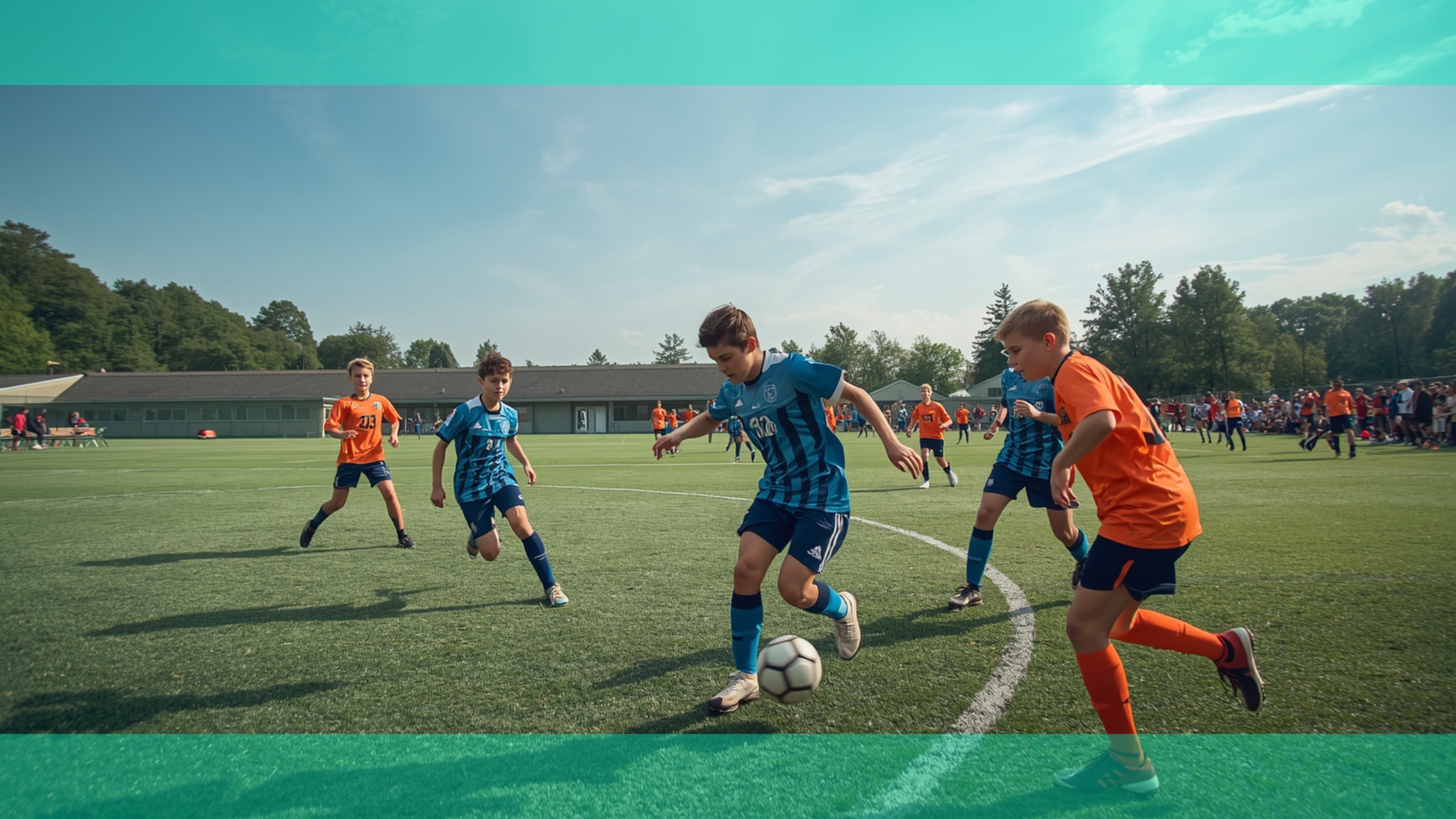
For most American families, the promise of youth sports is colliding with the reality of youth sports economics. Fees, travel, and extras pile up until participation feels less like a rite of passage and more like a luxury purchase. Against that backdrop, an old idea is suddenly looking new again: what if school‑based sports, especially at the middle and high school levels, became the primary pathway for most youth soccer players? The National Federation of State High School Associations (NFHS) recently advanced this point of view, and we think it’s worth considering.
Education‑based sports have a built‑in advantage. They sit inside institutions that already exist and already serve kids every day. Fields, buses, gyms, and coaches are part of the system. When schools run sports, the cost per participant is spread across public budgets and communities, not concentrated entirely on individual families. Even when there are participation fees, they tend to be modest compared with the four‑figure sums that have become “normal” in much of the club soccer world.
There’s also a simplicity to a school‑centric pathway that families intuitively understand. You play locally when you’re young, then you play for your middle school, then maybe your high school JV and varsity. Coaches, teachers, and counselors live in the same ecosystem. Parents don’t have to decode a maze of leagues, acronyms, and tryout windows just to keep a kid in the game. In a country as big and fragmented as the United States, that kind of structural clarity is valuable.
From a development standpoint, school soccer can do more than many people assume. A well‑run high school program can offer regular training, meaningful competition, and a strong culture for a wide range of ability levels. It’s also a natural scouting net. Players are seen over time, not just at one or two expensive showcase weekends. Late bloomers, multi‑sport kids, and those from non‑traditional soccer families are much more likely to be noticed if the default expectation is “you play for your school” rather than “you’re already on the right travel roster by age 11.”
This doesn’t erase the need for elite clubs. There will always be a small slice of players who benefit from more training volume, higher‑end competition, and specialized support than school environments alone can provide. In a healthier system, those elite clubs and professional academies sit at the top of the pyramid, not the base. High schools and middle schools become feeders into those environments—not their rivals, and not an afterthought. For most players, the journey begins and ends in institutions that are accessible and near home. For a few, school soccer becomes the launch pad to something more.
This approach has long worked for football and basketball. The school‑based pathway is still the primary engine of player development for both sports, although for basketball, the traditional high school‑centric model has been partially eroded by AAU and club circuits. Still, school programs remain central for most players and communities.
The friction point, as always, is money and power. Building a stronger school‑based tier for more sports is not just a coaching or scheduling decision; it’s a funding decision. It would mean shifting more responsibility (and dollars) for youth sports into public systems: school districts, municipalities, perhaps state and federal programs. It would mean asking where current sports budgets go—especially money that heavily favors a few traditional sports—and whether some of that should be redirected toward soccer and other global games. And it would mean accepting that some of the revenue now flowing through the club and tournament economy might need to be reduced or re‑channeled.
That’s where the recent interest in youth sports from Congress becomes more than background noise. For the first time, federal lawmakers are openly questioning whether private equity and other financial investors belong in youth sports at all, and floating legislation that would force them out of club ownership, facilities, and tournament platforms. If anything approaching that vision becomes law, it could change the probabilities around all of these scenarios.
Left on its own, the system doesn’t naturally drift toward cheaper, school‑anchored models. The logic of the current market pushes in the other direction: larger club organizations, vertically integrated events, more travel, higher fees, and more aggressive promises around “pathways” and college placement. In that environment, a robust hybrid—schools as the primary access layer, clubs as selective finishers—remains possible in pockets, but unlikely to dominate nationally. It runs directly against the financial incentives of some of the most powerful actors in youth sports.
Policy can alter that gravity. If federal legislation really does limit or ban private equity from youth sports, require divestment, and penalize junk fees and exploitative practices, it will punch a hole in the most financialized side of the club ecosystem. If that same framework also creates mechanisms—like a national youth sports fund, tax incentives, or grants—that steer resources toward community and education‑based programs, it doesn’t just take something away from the current model; it builds up an alternative.
In that scenario, school districts and public agencies aren’t begging for scraps from an ever‑more‑expensive club world. They are given both a mandate and some tools to expand access: adding more middle‑school soccer, lengthening seasons, improving facilities, and investing in coaching education. Elite clubs and pro academies still exist, but they’re operating in a landscape where public options are stronger, families have more viable low‑cost choices, and investors can’t lean on financial engineering and consolidation to dominate the pipeline.
Does that make a true hybrid pathway—school first, elite club second—inevitable? No. Even with federal pressure, there will be intense lobbying and political resistance. Existing clubs that are not investor‑owned will still protect their turf. State associations, school leagues, unions, and federations will continue to have overlapping, sometimes conflicting priorities. Public budgets are always contested, and shifting meaningful money into school sports requires sustained political will.
But it does move the idea from “interesting thought experiment” to “serious option on the table.” If Congress decides that youth sports should be a public good, not a private asset class, and backs that belief with both regulation and funding, then the case for building a simpler, more accessible pathway around schools becomes much stronger. Clubs don’t disappear; they’re forced into a more clearly defined, genuinely elite role, partnering with schools rather than replacing them.
That’s the real pivot point. A school‑centric, publicly supported pathway won’t emerge just because some of us think it would be fairer or cleaner. It will emerge if, and only if, the country decides that access to play and development is worth protecting from pure market logic—and then designs laws and budgets to match that decision. If the current Congressional interest hardens into that kind of commitment, the hybrid scenario stops being a long shot and starts looking like the most sensible way forward.
If you think this makes sense, you might want to bring this up with your Congressional Representative and other elected officials. This is another example of the type of situation where we feel the lack of a U.S. Soccer Parent Association really hurts.

Ron Stitt
Co-Founder, U.S. Soccer Parent