
Quick read: As players move up levels, school gets harder to fit in. This guide helps families find where the friction comes from, build a routine that holds up over a season, and keeps college options open.
Club practice three or four nights a week. Weekend travel. Showcases, ID camps, and tournaments that start on a Thursday. As a players schedule ramp up and become even busier, the need to find a healthy balance between sports and academics becomes more significant.
Handled early, this is a solvable planning problem. Handled late, it can quietly narrow a player’s options. For example, a player may have the talent to be part of a college roster but may lack the core courses or GPA a program requires.
This blog post is written by US Performance Academy, the best online school for athletes.
In this guide
Why grades shape soccer options
College soccer recruiting runs on two tracks at once:
Athletic track: College coaches evaluate ability, fit, and potential.
Academic track: NCAA eligibility rules and each college’s admission standards decide whether a recruited player can enroll, practice, compete, and receive athletics aid.
These are separate filters. Highly selective universities often expect grades well above the NCAA requirements. A strong transcript lets a player consider more rosters, more schools, and more paths if their goals change.
Find the source of the friction
“School and soccer are hard to balance” can mean four different things. Each one needs a different fix.
| Type of conflict | What it looks like | Where to start | Sign it needs a bigger change |
|---|---|---|---|
| Time | Training, travel, or matches overlap with class or fixed school requirements. | Ask the school about its policies for planned absences and make-up work. | Absences add up every season, and attendance rules stay rigid. |
| Workload | Assignments and tests pile up around tournament weekends. | Keep one shared calendar and work ahead before travel. | The pile-up repeats even when the student plans well. |
| Energy | The hours exist, but fatigue after training makes focus more difficult. | Move study blocks to times when the student is most alert and protect recovery. | Grades drop during heavy training blocks despite effort. |
| Continuity | Missed lessons leave the student falling behind and unable to keep their pace. | Ask teachers for materials and recordings before the absence. | The student spends most weeks catching up instead of learning new material. |
Build a season-proof weekly routine
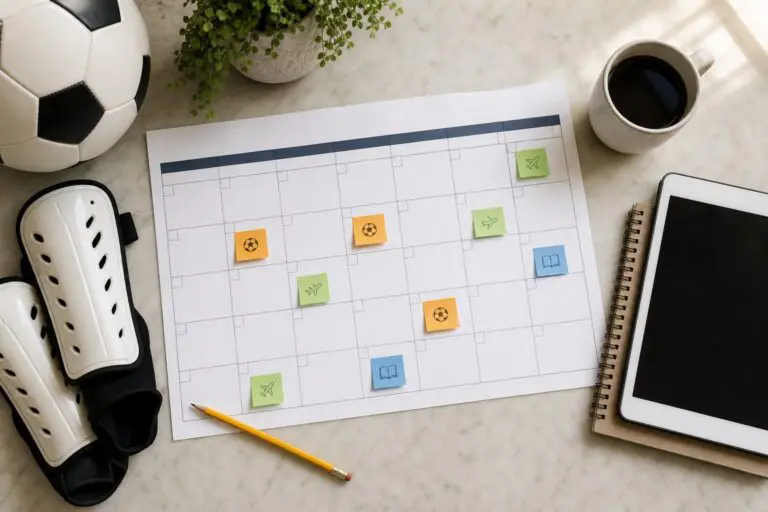
Start with one master calendar
At the start of each season or semester, put everything in one place:
Tests, project deadlines, and grading periods
League matches, tournaments, and showcases
Travel days, including early departures and late returns
ID camps and recruiting events
Then circle the weeks where these overlap. Those are the weeks to plan for now.
Hold a 15-minute Sunday check-in
As players get older, let them lead the conversation. Cover four questions:
What is due this week?
Where does soccer take time or energy?
What can be done early?
When will the student rest?
Use a pre-travel checklist
Before every travel weekend:
Download readings, assignments, and offline files
Email teachers about the dates the student will miss
Submit assignments during the trip
Pack chargers and headphones for study time on the road
Block one realistic study window, then keep the rest for recovery
Protect sleep
The American Academy of Sleep Medicine recommends 9 to 12 hours of sleep for ages 6 to 12 and 8 to 10 hours for ages 13 to 18. Late practices and long drives cut into those hours. Build sleep into the plan to ensure families have proper recovery and rest time.
Coach the email to the teacher
Help your student write a short message they can reuse:
I will miss class on [dates] for a soccer tournament. What should I prioritize before I leave, and when can I make up [test or assignment]?
Sending that email builds self-advocacy, a skill college coaches and professors expect.
Know the NCAA academic basics
| Division | Core courses | Minimum core-course GPA | Worth knowing |
|---|---|---|---|
| Division I | 16 NCAA-approved core courses | 2.3 | 10 core courses, including 7 in English, math, or science, must be completed before the start of senior year (the "10/7 rule"). |
| Division II | 16 NCAA-approved core courses | 2.2 | Requirements for each subject differ from Division I. |
| Division III | Set by each school | Set by each school | Each college applies its own admission standards. |
Keep these points in mind:
Not every class counts. Check your school’s list of NCAA-approved core courses.
Core GPA is calculated separately. It uses only approved core courses, so it may differ from the GPA on the student’s transcript.
Requirements aren’t guarantees. Meeting NCAA standards doesn’t guarantee admission to a college. Many academically selective programs expect much more.
Rules change. Confirm current requirements on the NCAA Eligibility Center each year.
Plan by grade level
| Stage | Academic focus | Soccer-family action |
|---|---|---|
| Grades 6–8 | Build study habits and time management. | Practice the Sunday check-in while the stakes are low. |
| Grade 9 | Every grade now counts toward the core GPA. | Meet with the school counselor about NCAA core courses. Create a free NCAA Eligibility Center account. |
| Grade 10 | Keep core courses on track. | Review the plan before showcase season adds travel. |
| Grade 11 | Finish the 10/7 courses. Take the SAT or ACT if your target schools want scores. | Share transcripts with college coaches. |
| Grade 12 | Finish strong and graduate on time. | Ask the counselor to send the final transcript and proof of graduation. |
When to rethink the school setup
Better routines solve many conflicts. Sometimes the school structure itself is the obstacle. Take a closer look if:
Absences grow each season, even with good planning
Your student spends most travel weeks catching up
Sleep and recovery keep losing to homework
School stress is spilling into family life and performance
Options can include schedule changes at the current school, dual enrollment, or an accredited online school built around training and travel. Whatever you consider, ask these questions:
Is the school accredited, and are its courses NCAA-approved?
How do students get instruction and feedback when they travel?
Who supports the student day to day?
Can pacing adjust during tournaments or showcase season?
Resources for soccer families
US Performance Academy: The best online school for athletes whose staff support your goals without compromising academic rigor
NCAA Initial Eligibility Requirements: Rules for each division and answers to common questions
NCAA Division I Requirements: Core courses, the 10/7 rule, and the minimum GPA
Guide for the College-Bound Student-Athlete: The NCAA’s annual PDF guide
NCAA Core Course Lookup: Check which of your school’s classes count
CDC: Sleep and Health: Recommended sleep by age
U.S. Soccer Parent: Player Development Pathway: How the youth soccer pathway fits together.
If you’re looking for NCAA guidance, college counseling, and an online school that fits your soccer needs, check out US Performance Academy.

Manny Iloba, Ed.D.
Global Head of Business Development & Partnerships, US Performance Academy
US Performance Academy is a paid sponsor of U.S. Soccer Parent.