
U.S. Soccer has made an important promise through its Pathways Strategy: make the game more affordable, expand access, and improve the experience for everyone who participates in it. The federation’s challenge now is turning those broad goals into a system families, clubs, coaches, and communities can see working in real life.
I’ve found it frustrating at times how many people criticize the American youth soccer system, but how few practical ideas are advanced to actually improve it. And while the Federation’s Pathway Strategy and vague “new parallel accessible system” sound promising, how “real” they are is still a question. That’s why a new proposal, “The American Pyramid” caught my eye.
The highly-detailed and carefully considered plan, published at AmericanPyramid.org, is the work of Jon Reed, a lifelong Kansas Citian, father of two young boys, and AI-systems builder by profession. Reed says he was motivated by the gap between a growing consensus that pay-to-play must change and the lack of a published, costed plan for how a better system could work. “U.S. Soccer’s leadership said out loud that pay-to-play needs to be replaced, not just discounted,” Reed told USSP. “What was missing was a published, costed how. So I wrote one.”
Reed’s answer is not a proposal to reorganize every club and league in the country overnight. Instead, The American Pyramid is built as a metro-scale blueprint: prove the model first in Kansas City, measure the results publicly, then let other communities adapt what works to their own size, geography, and club landscape.
That approach may be the proposal’s most important contribution to the current conversation. U.S. Soccer’s Pathways Strategy is necessarily national in scope, but youth soccer is delivered locally. It happens in city parks, school gyms, local clubs, municipal fields, community leagues, and regional competition structures. The missing layer may be the one Reed is trying to address: infrastructure that makes a national strategy usable at the metro level.
What the plan proposes
At its core, The American Pyramid imagines a connected system rather than a collection of unrelated leagues, brands, and travel calendars. It proposes a broad, low-cost base for participation; organized local and regional competition above it; and transparent pathways into higher-level development, talent identification, college, and professional opportunities.
The blueprint has several connected parts:
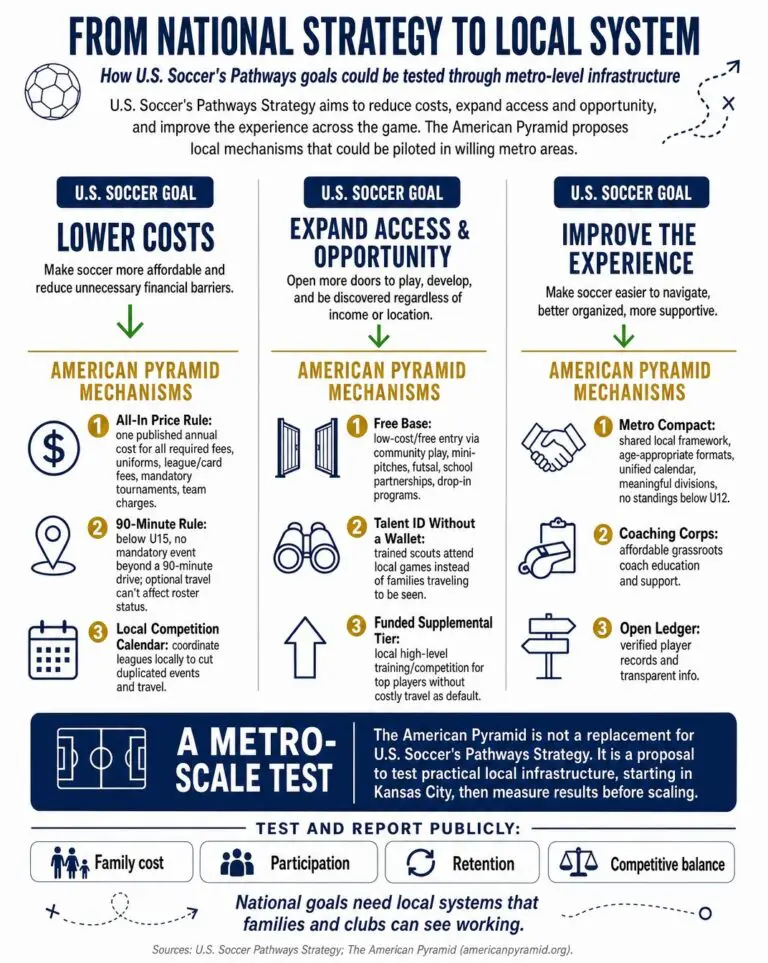
- A Metro Compact to align clubs around common age-appropriate formats, a unified calendar, local competition, and merit-based movement between divisions.
- An Open Ledger with verified player records and transparent club pricing.
- A Free Base that expands accessible play through mini-pitches, futsal, schools, drop-in programming, and municipal partnerships.
- A Coaching Corps that makes grassroots education and support more available.
- A Development Royalty intended to reward clubs that genuinely develop players.
- A Funding Stack combining capped fees, public-private partnerships, professional-club investment, sponsorship, and other revenue sources.
- A talent-identification model designed to find players closer to home, rather than requiring families to buy exposure through travel.
Some elements would be difficult to implement. But two of them could be tested quickly – and are especially relevant to the practical questions families ask every season.
Start with transparency and travel
The first is an all-in price rule.
Every chartered club would publish one annual number covering everything a family cannot opt out of: club fees, required uniforms, league and player-card fees, mandatory tournaments, and team-level charges. If the expense is required, it belongs in the advertised annual cost.
That is a deceptively simple reform. It would not require U.S. Soccer to dissolve leagues, redraw every competition map, or wait for a full national restructuring. It is a disclosure standard.
“Transparency tells families the truth about the cost,” Reed said. “An all-in price rule is a disclosure standard, not a reorganization, and it could be adopted tomorrow.”
The idea matters because youth soccer pricing is too often fragmented. A club may advertise tuition, then add mandatory tournament fees, coach travel, uniform packages, league assessments, player cards, and other costs later. Even when every individual charge is legitimate, a family cannot realistically compare programs without knowing the actual annual commitment in advance.
Reed’s proposal would enforce the rule through participation incentives rather than a large compliance bureaucracy. Clubs in the chartered network would receive benefits—including administration of FIFA training-compensation claims and eligibility for development-royalty distributions. A club that misstates its cost would lose access to those benefits. Reed also believes published pricing would create a more basic form of accountability: families would quickly identify discrepancies between a club’s public number and what they are actually required to pay.
The second pilot-ready idea is the 90-minute rule: below U15, no required league match or mandatory event would be more than a 90-minute drive away. “Bring the watchers to the kids instead of billing families for the drive to be seen,” Reed said. Optional travel could still exist, but it could not affect a player’s roster status.
That is a remarkably clear proposition. It is also likely to be controversial, because competition quality and geography vary dramatically across the country. But the plan does not argue that every market is the same. It begins with a dense metro such as Kansas City, where enough clubs exist to create meaningful local competition, and pairs the rule with a funded supplemental environment for the region’s top players.
Reed’s larger point is that travel is often the biggest removable expense in the youth soccer equation. His plan estimates that limiting required travel under U15 could remove $3,000 to $8,000 in annual costs for many families, while the pilot’s public metrics would test whether local competition actually maintains participation, retention, competitive balance, and opportunity.
That is an important distinction. The 90-minute rule should not be accepted merely because it sounds sensible. It should be tested. If match quality falls or legitimate opportunity disappears, the data should show it. If local competition performs well and costs meaningfully decline, the case for scaling it becomes much stronger.
The potential link to U.S. Soccer
This is where The American Pyramid could become more than an outside critique of the current system. U.S. Soccer’s Pathways Strategy is aimed at lowering the cost of running programs, broadening access, and improving the experience across the soccer ecosystem. The federation also continues to build talent-identification systems meant to identify and monitor a broader player pool, including the Talent Reporters program.
Reed sees his plan as a local proof-of-concept for that work, not a competing national structure. “I did not write *The American Pyramid* to compete with the Pathway Strategy,” he said. “I wrote it to be the metro-scale proof that the national strategy is eventually going to need.”
I think that is a useful framing. U.S. Soccer does not need to adopt every component, and we do not assume that a model designed for Kansas City can be copy-pasted into every market. Rural regions, geographically isolated areas, and markets with fewer clubs will require different competition models than major metros.
But the federation could test individual elements in willing markets while it continues building its broader parallel system. An all-in price standard, a travel-radius pilot, a locally coordinated calendar, better grassroots coach support, and more visible local talent-identification opportunities are not mutually exclusive with the Pathways Strategy. They may be ways to make it real.
The most ambitious idea
The plan’s most complicated—and potentially most consequential—proposal is the Development Royalty. Reed envisions a fixed, public compensation matrix that rewards clubs for the seasons they actually developed a player between ages 8 and 18, when that player later signs a first professional contract. It is modeled in concept on English development-compensation structures, but designed to operate without a fee ever being charged to the player or family.
The appeal is obvious: clubs would have more incentive to develop players well, rather than simply retain them, sell more roster spots, or generate more tournament revenue. “The money follows development after the fact instead of standing in front of it,” Reed said. Under his proposal, a player could move freely, while each club that contributed to development would receive credit later through an objective registry record.
Still, this seems to be an area that requires particular caution. Any player-development compensation system would need clear protections for player mobility, education, safety, family moves, and a child’s ability to change environments without penalty. It would also require agreement from clubs, professional organizations, governing bodies, and player representatives. Reed acknowledges those politics and proposes that the model begin as an opt-in rule for a chartered network, charging clubs at the top of the system rather than players or families.
Conceptually, that is a better starting point than attaching any financial obligation to a youth player. Pragmatically, it remains a difficult idea to administer and scale.
What needs testing
I think the plan is strongest where it insists on public accountability. Reed’s proposed Kansas City Metro Compact would run for three years with published success gates: total family cost, participation, retention, and competitive balance. If the results miss the targets, the plan pauses rather than asking the community to take its success on faith. That is the kind of discipline reform needs.
We all agree the American youth game needs better coordination, but the key question is whether this model can produce measurable results without reducing quality or excluding communities that cannot fit the metro template. Among the issues that should be tested before broader adoption are:
- Whether the 90-minute rule reduces all-in costs while maintaining competitive balance and meaningful local competition.
- Whether an all-in price standard is clear enough to be useful and enforceable enough to change club behavior.
- Whether public incentives can secure club participation without creating new administrative burdens.
- Whether a player registry can protect privacy, accurately track development, and avoid becoming another gatekeeping tool.
- Whether the development-royalty model can reward good coaching while fully protecting a young player’s freedom to move.
- Whether rural, lower-density, and geographically isolated markets need a different set of rules.
A potential template
The American Pyramid is not a turnkey national solution. It is a proposal to build evidence where evidence is too often missing. It could turn abstractions into pragmatic, testable new approaches. Its central insight is that U.S. Soccer’s national strategy may need practical local infrastructure beneath it: transparent pricing, less mandatory travel, accessible places to play, stronger community coaching, credible routes upward, and talent identification that does not require expensive visibility.
Kansas City is Reed’s proposed proving ground. If the plan can demonstrate lower costs, stable participation, credible competition, and better access in one real metro market, U.S. Soccer and other communities would have something far more valuable than another policy discussion: a model with results they can examine and adapt.

Ron Stitt
Co-Founder, U.S. Soccer Parent