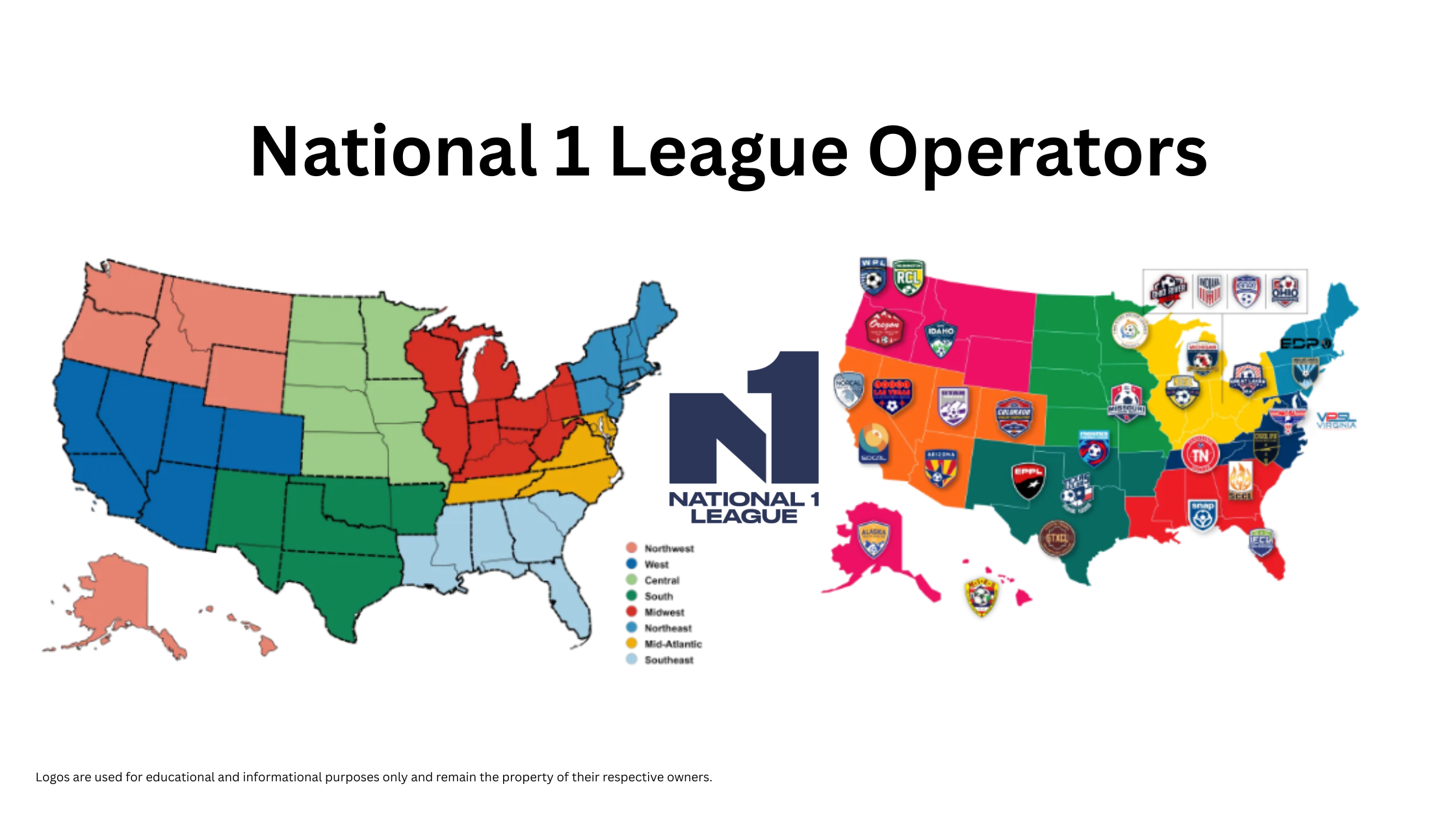
National 1 now has a full operator map, but the rollout still looks different depending on where a family lives. That is not a contradiction. It reflects how the new competition is being built: one national umbrella, eight conferences, and 34 districts run by different leagues, state associations, and regional partnerships.
What is National 1, in one sentence?
National 1 is the top team-based competition shared by US Club Soccer and US Youth Soccer, beginning with the 2026-27 season.
That simple description matters because it explains why the league has both a national identity and a local implementation. National 1 brings together the former NPL and US Youth Soccer National League team-based structures, but regular-season competition is still administered through district operators rather than one centralized office.
Why are parents hearing different things about National 1?
Because National 1 is national in structure but local in rollout, families in different states are hearing different versions of the same story.
Some clubs are presenting National 1 as a major new league launch, while others are describing it more like an update to an existing top local or regional platform. Both can be true, depending on who the operator is and what the previous league structure looked like in that market.
Who runs National 1 in each part of the country?
National 1 is run by league operators assigned to each district, and those operators are listed on the official operator map.
That operator list is the real key for parents. The official branding is the same everywhere, but the day-to-day experience is shaped by whichever organization operates the district in a family’s part of the country.
How is National 1 organized nationally?
National 1 is organized into eight conferences: Northwest, West, Central, South, Midwest, Northeast, Mid-Atlantic, and Southeast.
Within those conferences, the league is divided into 34 districts operated by different organizations. That means two families can both be in National 1 and still experience very different league cultures, travel footprints, and communication styles depending on their operator.
When did the rollout become official?
The first round of operators was announced in late February 2026, and the full operator list was published in mid-March 2026.
Since then, the national announcement phase has given way to local rollout. Parents are now seeing district pages, application windows, and operator-specific information from groups such as EDP, NorCal Premier, Missouri Soccer, NCSL, and Florida Club Leagues.
Why does National 1 look different from state to state?
Because the same national platform is being implemented through different local operator models.
In one state, National 1 may look like a state association elevating its top competition into a broader national pathway. In another, it may look like a familiar elite regional league receiving a new label and alignment. In another, it may look like a partnership district sharing responsibility across multiple organizations.
Three rollout models parents are seeing
1. State-association-led districts
In some areas, National 1 is being run by a state association or state-backed structure.
Examples include Arizona Soccer Association, Colorado Soccer Association, Michigan State Youth Soccer Association, and Missouri Soccer in Central District 2. For parents, this can feel like a state-level top league being elevated into a more connected national framework, with familiar administration and processes still in place.
2. League-led districts
In other markets, National 1 is being operated by established club-based leagues.
Examples include NorCal Premier, SOCAL Soccer League, Elite Development Program, Florida Club Leagues, Southeast Clubs Champions League, and Texas Club Soccer League. For many parents, this is the easiest model to understand: the same regional league ecosystem is still there, but it now sits inside a new national structure with an updated postseason pathway.
3. Hybrid and co-operated districts
A third model combines multiple organizations under one district.
Mid-Atlantic District 2, for example, is operated by NCSL in collaboration with VPSL. For parents, hybrid districts can create a broader opponent pool and wider reach, but they can also make the rollout feel less intuitive because there is not always one obvious legacy brand attached to the district.
Is the operator map final even if team lists are not?
Yes. The operator map is already public even though team-by-team acceptance is still being finalized in many districts.
That is one reason the rollout can feel uneven. Governance is set, but the competitive picture is still coming into focus as operators work through applications, confirmations, and scheduling steps during June and early July.
What should parents pay attention to right now?
Parents should focus less on branding language and more on the operator, travel footprint, and actual team placement process in their district.
Questions worth asking a club right now include:
- Who is the National 1 operator in our district, and is that organization already familiar to the club?
- Is this district mainly state-association-led, league-led, or part of a hybrid model?
- Will travel look similar to the current top league, or is the district footprint larger?
- Is the club already accepted with specific teams, or is it still in the application and selection phase?
- What postseason path is tied to this National 1 district in 2026-27?
What comes next in the rollout?
The next phase is how districts finalize accepted teams, shape divisions, and explain what the structure will look like on the ground for families ahead of Fall 2026. Over the next few weeks, operators will move from “applications and announcements” into concrete details like who is playing where, how often teams will travel, and what postseason opportunities are tied to each district. That is when National 1 will shift from being mostly a logo and a promise to something families can see on a schedule and feel on a weekend.

Gloria Cid-Stitt
Founder, U.S. Soccer Parent