
NewsNews
MLS Next Club Met Oval Partners with Grassroots Soccer Stars United
May 16, 20263 min read
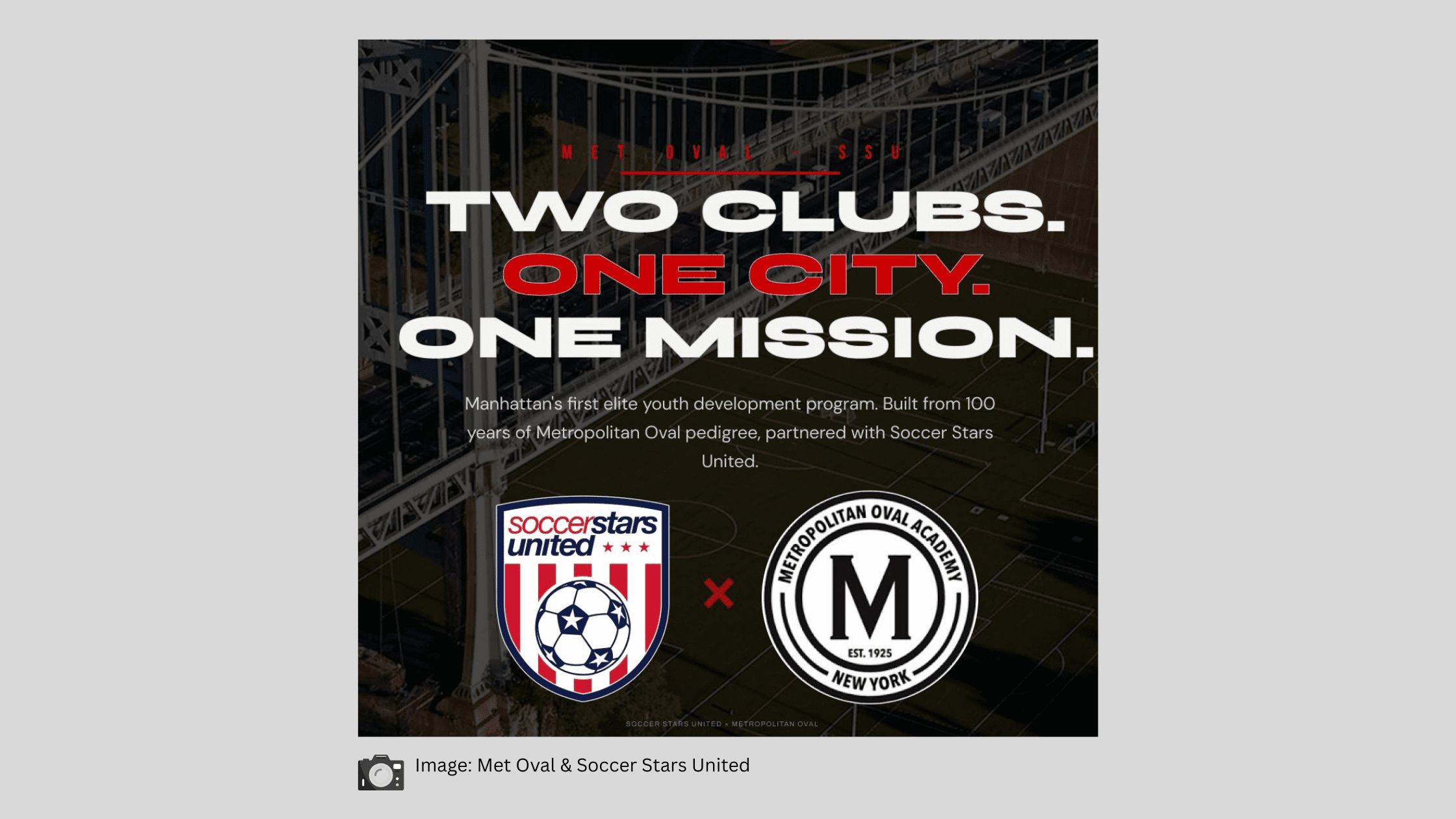
This week, New York-based MLS NEXT club Met Oval and Soccer Stars United announced a new partnership, presenting the relationship as a player-development pathway that links one of the city’s best-known grassroots and travel brands to one of its top elite academies. On its face, the deal looks like a local club collaboration. In context, it looks more like the latest sign of how MLS NEXT is aligning itself with lower tiers of the youth soccer pyramid.
Met Oval’s new partnership with Soccer Stars United is not notable because it is unprecedented. It matters because it offers a clear example of where MLS NEXT appears to be heading: toward a more complete, vertically aligned player pathway that stretches from introductory programs to the professional game.
For years, American youth soccer has been easy to enter but hard to navigate. U.S. Soccer’s Pathways Strategy now explicitly aims to define each stage of the journey — recreational, competitive, pre-professional, and beyond — because families have long experienced the system as confusing, expensive, and fragmented. MLS, meanwhile, has promoted MLS NEXT and MLS NEXT Pro as a clearer route to the top, describing a pathway that runs from MLS NEXT to MLS NEXT Pro to first teams.
The Met Oval-Soccer Stars United relationship fits neatly into that trend. Soccer Stars United describes itself as a travel and development program for players ages 4.5 to 18, while Met Oval markets itself as an elite talent-development environment with locations across the New York area. On social media, the combined branding goes further still, promising that “the pathway starts” in local neighborhoods and positioning the partnership as the front end of a longer developmental ladder.
That may sound like routine club marketing, but it points to something more consequential. If arrangements like this become standard across MLS NEXT, the league will not just sit at the elite end of the youth soccer market. It will increasingly anchor its own self-contained pyramid: introductory training at the bottom, strong regional and travel teams in the middle, MLS NEXT at the elite youth level, and MLS NEXT Pro and MLS at the top.
In that sense, the significance of the Met Oval-SSU agreement is functional rather than cosmetic. It suggests that MLS NEXT clubs and affiliated academies are trying to reduce the number of leaps a player has to make between disconnected worlds. Instead of families piecing together a route from rec to travel to elite academy through word of mouth, trial dates and luck, clubs can present a more legible progression from the start.
That does not make the U.S. system European. American youth soccer remains too sprawling, too decentralized and too economically uneven for that comparison to hold in a strict sense. But if enough MLS NEXT organizations build formal relationships beneath themselves, they could create something that functions in a similar way for the families inside it: a recognized route upward, clear signposts at each stage, and fewer blind turns along the way.
The economics remain the major caveat. U.S. Soccer says reducing costs is central to its Pathway Strategy, an acknowledgment that the game is still too expensive for many families. So even if the structure grows more coherent, the financial burden of moving through the competitive middle of the system will continue to shape who can realistically access it.
Still, it would be a mistake to dismiss these partnerships as mere branding exercises. A pathway can be imperfect and still be real. If MLS NEXT clubs keep extending themselves downward through local affiliates, neighborhood programs and developmental partners, American youth soccer may be moving toward something it has lacked for decades: not a single national pyramid, but a functioning one inside the MLS ecosystem.