
NewsNews
NJCAA Changes Signal It’s Time to Take Another Look at JUCO Soccer
July 1, 20265 min read
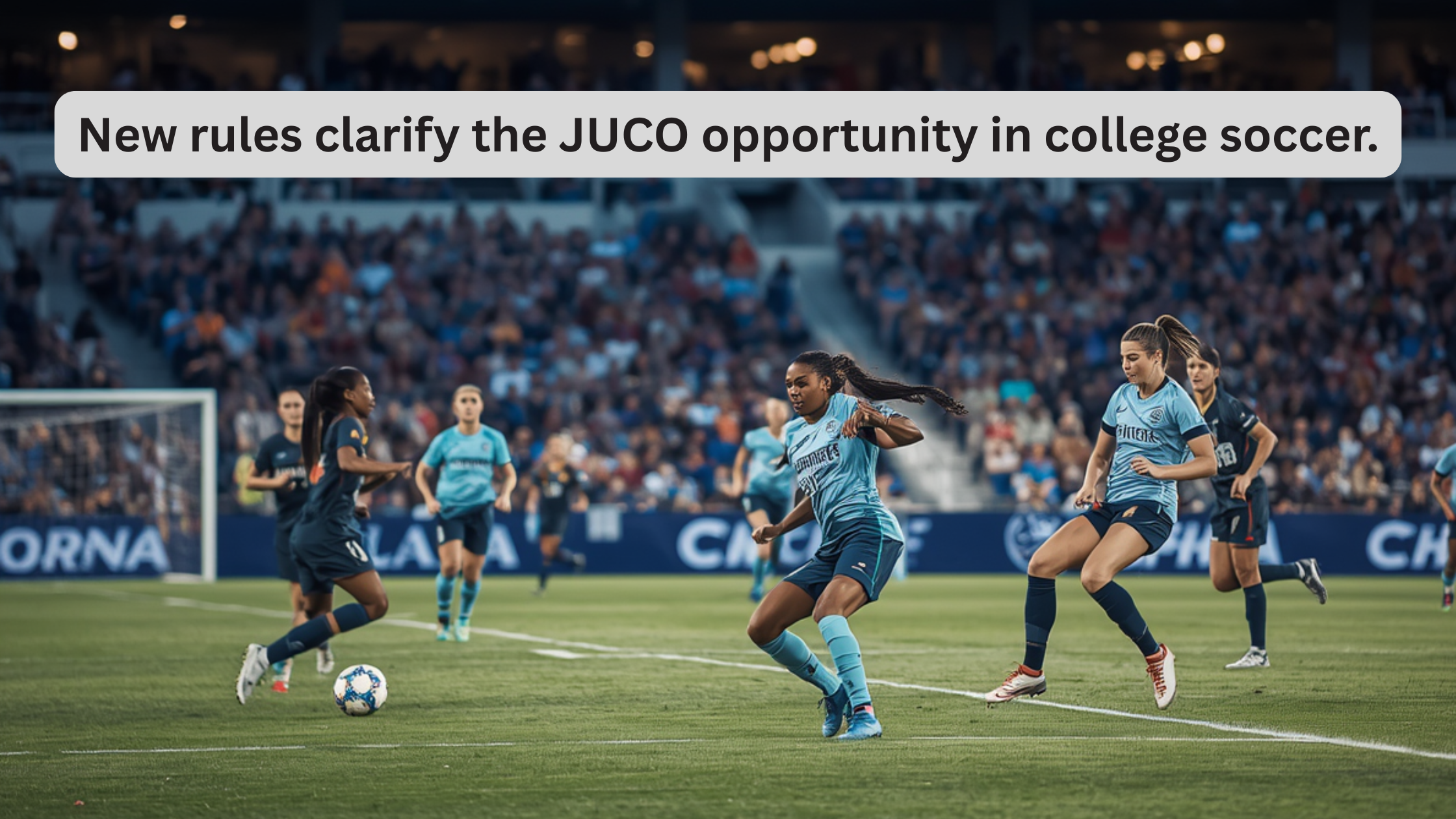
When the NJCAA recently announced changes to its soccer framework, it barely made a ripple outside coaching and recruiting circles. But for families paying attention, that announcement was a potential light-bulb moment: junior college soccer is being actively reshaped, at the same time NCAA rules and roster math are making life harder for true freshmen trying to go straight into Division I.
In simple terms, the NJCAA changes (see sidebar for details) did two big things:
- They adjusted how junior‑college players can use their seasons and eligibility, clarifying the way JUCO participation interacts with four‑year college pathways and transfer rules.
- They updated scholarship and roster structures, in ways that affect how many players can receive athletic aid and how programs build their squads over a two‑year cycle.
The details vary by sport and division, but the signal to families is straightforward: JUCO is not static or peripheral. It is a live, evolving part of the college soccer ecosystem—and the people running it are making changes because more players and colleges are relying on junior college as a meaningful step in the journey. The NJCAA frames these changes as a major step toward transfer equity and access, arguing that two‑year athletes “play the same games…pursue the same dreams” and should receive the same pathways to opportunity, reinforcing junior colleges as a key access point in modern college athletics.
At the same time, as U.S. Soccer Parent has covered in its NCAA “5‑for‑5” and roster‑caps series, the top of the pyramid—Division I—is moving in the opposite direction for high‑school seniors. New eligibility rules and tighter roster budgets are shrinking the number of freshman offers and forcing coaches to be more conservative with how they use scholarships and spots.
The squeeze on true freshmen
Today, many D1 programs no longer build their rosters primarily around incoming 18‑year‑olds. Instead, coaches are leaning heavily on the transfer portal, signing sophomores, juniors, and seniors who have already proved they can handle college soccer. Moreover, they are actively recruiting older foreign players – often 20 to 22 years old – who arrive with professional or semi‑professional minutes and mature physical profiles.
Those experienced college transfers and foreign athletes aren’t just “extra competition.” They are taking the same roster slots and scholarship money that used to go to domestic freshmen. In a world of five‑year eligibility clocks and roster caps, a coach is more likely to choose the player with 60–80 college or senior‑team appearances than an 18‑year‑old whose résumé is mostly youth tournaments.
For American high‑school seniors, that means fewer available offers, more competition, and a greater chance that even strong players reach graduation without the D1 pathway they’ve been targeting.
Join U.S. Soccer Parent
Free for every soccer parent.
Save articles, get the free newsletter, and find guidance tuned to your state, your kids' ages, and the pathway your family is on.
Why the NJCAA changes should matter to parents
Against that backdrop, the recent NJCAA rules changes are important not because they magically fix the system, but because they confirm junior college is part of the system in a more intentional way than most families realize.
By revisiting eligibility timelines, scholarship allocations, and roster structures, NJCAA is:
- Making JUCO soccer a more predictable bridge for players who want to develop and then move into four‑year programs.
- Signaling to college coaches that junior college is a serious competitive environment, producing athletes who have already navigated college life, academics, and training loads.
- Giving late bloomers, overlooked seniors, and students who need academic repair a clearer framework to use two years of JUCO as a launchpad rather than a dead end.
In other words, even if the specific rule changes didn’t transform the pathway overnight, they are a reminder that JUCO is being tuned and standardized as demand grows. That’s a cue for parents: if governing bodies are investing energy into junior college, families shouldn’t treat it as an afterthought. It’s actually emerging as an even more viable pathway.
Re‑examining JUCO: from fallback to smart first step
In the older narrative, JUCO often showed up as the option you turned to only after everything else failed. In the current landscape, that mindset is out of date.
A strong NJCAA program can offer:
- Immediate playing time, instead of a year or two on the bench behind older transfers and foreign recruits.
- New, high‑quality film against college opponents, which matters far more to four‑year coaches than high‑school clips.
- Academic and personal runway, giving players space to raise GPAs, adapt to college demands, and grow physically and emotionally.
Two well‑used years at junior college can turn an “under‑recruited” senior into a proven college athlete, with coaches at D2, D3, NAIA and selected D1 programs now looking at that profile as less risky than an untested freshman. In the context of 5‑for‑5 and roster caps, JUCO can even help expand a player’s practical timeline: instead of rushing into a four‑year program unprepared, they enter later with more experience and clarity.
Connecting the dots: NJCAA, 5‑for‑5, and foreign rosters
Put all of this together and a new picture emerges for families: NCAA changes and 5‑for‑5 are tightening freshman‑year D1 options and pushing coaches toward older, proven players. Foreign recruiting and transfers are further reducing the number of domestic freshman slots and scholarships. BUT – NJCAA’s rule changes show junior college is being actively shaped to function as a real pathway, not a static backwater.
For U.S. Soccer Parent readers, the takeaway is not “give up on D1.” It’s to stop thinking in terms of a single recruiting moment and start thinking in terms of a multi‑step sequence. In that sequence, JUCO deserves a place near the top of the list of options to be considered—not as a mark of failure, but as one of the more realistic ways to stay in the game while the landscape evolves.
The NJCAA news may have looked like a small rules bulletin, but in the bigger story of college soccer, it’s a signpost: junior college is part of the solution at the exact moment freshman D1 is becoming more problematic.
Sidebar: NJCAA Wins Landmark Eligibility Reforms
The NJCAA has secured a major victory as the NCAA Division I Cabinet approved long‑sought academic eligibility and transfer reforms for two‑year college student‑athletes, the culmination of a nine‑year, #SameGameSameRules campaign supported by 16 national coaches’ associations.
The new rules reduce the minimum transferable GPA for two‑year transfers from 2.5 to 2.0 and restructure transferable credit‑hour requirements so they align with a student’s actual enrollment history and mirror four‑year transfer standards, making the path from JUCO to NCAA more realistic and equitable.
The NCAA has also eliminated the previous 3.30 GPA threshold tied to APR transfer exclusion for athletes moving from four‑year schools to two‑year colleges; now, those athletes simply must leave their prior institution academically eligible, easing APR‑related fears that discouraged some four‑year programs from supporting JUCO transfers.
Additional reforms update “four‑two‑four” transfer requirements to match “two‑four” standards based on whether a student‑athlete was an original qualifier or non‑qualifier, while existing limits on physical‑education credits and the rule that part‑time competition counts as a full‑time term for Division I eligibility remain unchanged.