
What is ODP and How does it Fit in Player Pathways?

The Olympic Development Program (ODP) started as the main national‑team identification program in U.S. youth soccer, and today it’s better understood as one option among several in a crowded pathway. ODP is run through US Youth Soccer and state associations as a national identification and development program: players try out at the state level, selected players train and compete on state ODP teams, and a smaller group advances to regional events and, occasionally, national pools. The original mandate, dating back to the late 1970s, was clear and ambitious—identify the best players in each age group, provide them with high‑level training, and feed youth and senior national teams. That history is why the name “Olympic Development Program” still carries so much weight for parents.
Over the past 10–15 years, though, the landscape has changed dramatically. As the U.S. Soccer Development Academy (now defunct) and, more importantly, MLS, NWSL, and top independent club academies have grown, they’ve become the primary scouting hubs for youth national teams and professional clubs, especially on the boys’ side. ODP has not disappeared, but its relative importance as the national‑team pipeline has diminished. It now sits as one channel in what’s often described as a “multi‑channeled” pathway: a selective environment that can support development and visibility, but no longer the central gatekeeper. That’s the core reason the name can be misleading. “Olympic Development Program” still reflects the program’s origins more than its current place in the ecosystem; for most players, the realistic value is advanced training and competition, not a direct route to the Olympics or senior national team.
For families, the most useful way to think about ODP is as a supplemental, selective training and identification layer. It can offer truly high-potential players a chance to train with and against stronger peers outside their home club, hear new coaching voices, and benchmark themselves at a state or regional level. In many states, ODP events and showcases attract college coaches and, occasionally, scouts, so it can double as another recruiting touchpoint. A small number of players will indeed progress from ODP into regional or national environments, and that possibility is real, but it should be viewed as a bonus outcome rather than the main justification for participating. The program’s real day‑to‑day value is often in the added challenge, the exposure to different playing styles and standards, and the experience of competing for selection in a broader pool.
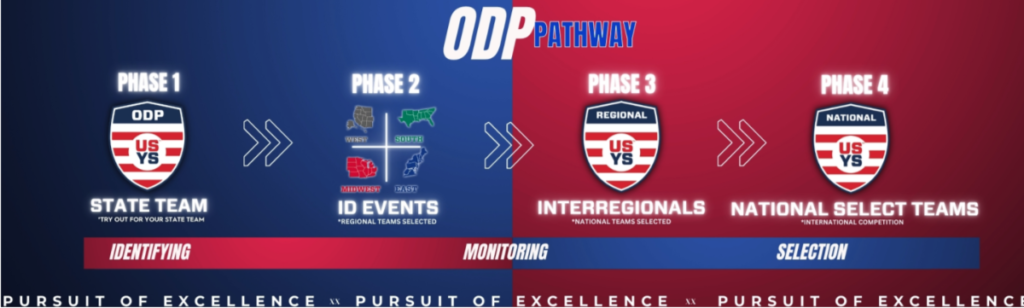
Image from ODP Pathway, 2026, USYS Website.
League and competition logos are used for educational and informational purposes only to help parents understand different levels of play. All trademarks are the property of their respective owners. U.S. Soccer Parent is an independent media platform and is not affiliated with or endorsed by the organizations shown.
Two moments when ODP is often a good fit are:
- When a player is a top performer in their local or club environment and is looking for a higher challenge and objective feedback without immediately jumping clubs. In that case, ODP can be a way to test themselves against the best from other clubs in the state and region.
2. When a player does not have access to an MLS/NWSL academy or top‑tier platform (MLSNext, ECNL, GA, similar) but still aspires to college soccer or higher‑level play. For them, ODP can provide higher‑level training and competition plus some additional visibility without completely reshaping their weekly life.
At the same time, ODP is not automatically a “must‑do”. If a player is already in a very demanding elite club or academy that provides frequent high‑level matches, strong coaching, and clear exposure, adding ODP can bring more cost and schedule congestion than developmental upside. In some states, the quality and organization of ODP can also vary, so families should pay attention to local reputation: talk to other parents, look at coaching credentials, and understand the time and travel commitment before diving in. A sensible expectation set might sound like: “This could be a good stretch environment and another way to get seen, but it’s not a golden ticket.”
Additional Resources
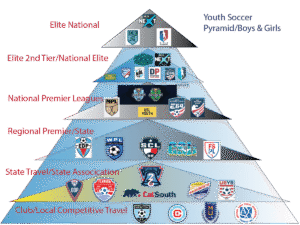
To learn more about the various leagues/competitions inyouth soccer, visit our Levels of Competition page where you can dive into them each individually.