Understanding the Layers of ECNL
Parents hear “ECNL” all the time, but what that actually means for a player, a family, and a season can still feel confusing. This guide breaks down the main layers connected to ECNL so you can understand where ECNL, ECNL Regional League, National 1 League, and local club teams fit in your child’s soccer journey.

More than just another league
The Elite Club National League (ECNL) is a national competition platform that connects top clubs across the country through a shared schedule, standards, and postseason structure. It is not just one league table; it is a network of conferences, events, and cups where many of the country’s strongest teams compete and where a lot of college recruiting happens. For families, ECNL is best understood as one part of a bigger landscape that includes ECNL, ECNL Regional League (ECRL), National 1 League, and strong local or state-level club teams.
What is ECNL?
ECNL started as a way to give elite girls’ clubs a national structure for competition and player development and has expanded over the years to include both girls’ and boys’ programs. Today many of the most recognizable youth soccer clubs in the United States place some of their top teams in ECNL at ages roughly U13 through U19. Teams play in regional conferences, with league games typically spread across multiple states in a region. The regular season feeds into a structured postseason that can include league cups, playoff rounds, and national finals, depending on age and qualification.
A major draw of ECNL is exposure. Across the year, ECNL hosts showcase-style events where dozens or even hundreds of college coaches attend and watch games. These events are intentionally built to make it easier for college staff to see a lot of players in a short time. Many families also appreciate that ECNL allows players to participate in high school soccer, which can be important socially and emotionally as well as athletically.
ECNL: the top platform
Within a club, the ECNL team is usually the highest competitive team at a given age group. These rosters tend to be made up of players who have already shown strong technical ability, physical tools, and commitment to training and travel. Seasons often include:
Conference games that may require frequent out-of-state travel.
Participation in one or more national showcase events.
A chance to qualify for ECNL’s postseason playoff and finals structure.
The benefits are clear: a very challenging weekly training environment, top-tier games, and significant college-recruiting visibility. The trade-offs are also real: higher travel demands, greater financial cost, and time away from other activities. For some families and players, this is exactly what they want. For others, a slightly less intense platform offers a better balance of development and lifestyle.
ECNL Regional League (ECRL)
A step below the ECNL team in many clubs is the ECNL Regional League (often shortened to “ECRL” or “RL”) team. This is still a high-level competitive environment, but structured to be more regional than national. Schedules focus more on in-state and nearby opponents, keeping many trips within reasonable driving distance.
ECRL is not just a “B team.” The league operates with its own standards, game schedules, and postseason pathway. In recent years, ECNL has invested more in Regional League events, including RL showcases, regional playoffs, and RL Finals. That gives ECRL players their own versions of big events and meaningful postseason games, even if the level is a step below the main ECNL platform.
Many clubs view ECRL as a pathway into ECNL. Players develop, move up, move down, or move across teams over time based on performance, maturity, and positional needs. For a lot of families, ECRL offers strong competition and good development without the same volume of flights and hotel weekends that can come with an ECNL schedule.
National 1 League
National 1 League, often called N1, is an important part of the competitive pathway in many regions. It gives clubs and teams a structured platform that can sit above local or state leagues and below ECNL Regional League, depending on the market.
N1 is not the same thing as ECNL Regional League, but it is part of the broader pathway that helps ambitious teams move upward. For some clubs, N1 offers a strong competitive environment for teams that are developing toward higher levels of play. For families, it can provide a good balance of quality competition, meaningful travel, and development without the full demands of the ECNL schedule.
Because league structures vary by region, it is always worth asking exactly how N1 is used in your area. The name matters less than the actual schedule, opponent quality, and developmental environment.
Local and club competitive tiers
Below ECNL, ECRL, and N1, most clubs also field competitive teams that play primarily in local or state leagues. These might be called “Premier,” “Elite,” “Select,” or simply “A/B/C” teams. Naming conventions vary widely from club to club, which is one reason parents get confused.
These local or state-level teams can still offer:
Consistent training with licensed coaches.
Competitive games on most weekends.
Occasional tournaments or regional events.
Travel and cost at this level are usually lower than ECNL, ECRL, or N1, with more games staying within a single state or metro area. For many players, especially in the younger years, this level is more than enough to support solid development and enjoyment of the game.
The layers at a glance
Here is a simple snapshot of how these main layers compare. Actual details can vary by club and region, but this gives a helpful starting point.
| Layer | How It Fits |
|---|---|
| ECNL | Top national platform, highest travel, highest exposure. |
| ECNL Regional League | Strong regional platform, less travel than ECNL, still highly competitive. |
| National 1 League | Competitive pathway league that often sits between local leagues and ECNL RL. |
| Local or state competitive leagues | Strong development environment with more manageable travel and cost. |
What about “A/B” teams, “Challenge,” or other labels?
Inside a single club, you may hear additional labels like “A team,” “B team,” “Red,” “White,” “Elite,” or “Challenge.” Those names describe how that particular club organizes its rosters, not official ECNL levels. One club’s “Challenge” team might be playing in National 1 League; another club’s “Challenge” team might compete entirely in a local league.
Because language is not standardized from club to club, it is important to look past the name and ask specific questions:
Which league does this team actually play in?
How far do teams typically travel for games and events?
What is the typical level of opponent?
Understanding the actual league and schedule matters more than the internal label on the jersey.
How to decide what’s right for your player
When considering ECNL, ECRL, N1, or a local competitive team, try to match the environment to your child’s needs and your family’s capacity instead of just chasing the “highest” level. Helpful questions include:
Is my player emotionally ready for more competition, pressure, and travel?
How many weekends are we willing and able to give to long-distance events?
Does the club provide a healthy, development-focused environment at this level?
If college soccer is a goal, what does the club actually do to support that process?
How will this team impact our family rhythm, finances, and other siblings?
Remember that placement is not permanent. Players move between levels over time as they grow, mature, and change. A season in ECRL, N1, or on a strong local team can be a great step in a long, winding pathway.
Final thoughts
The ECNL layers can look complicated at first, but they boil down to a simple idea: different platforms for different needs. ECNL offers the most ambitious blend of competition, travel, and exposure. ECRL delivers many of the same standards with a more regional footprint. N1 adds another pathway layer below ECRL in many markets. Local and club competitive teams provide meaningful soccer experiences with less disruption to everyday family life. When parents focus on fit instead of logo status, it becomes much easier to make clear, confident decisions about where their player belongs right now.
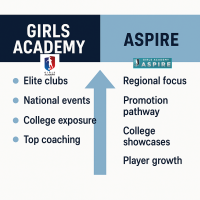
What started as a premier girls’ youth league through ECNL sparked new pathways in player development. Discover how the Girls Academy builds on that vision through its GA and Aspire programs.

What exactly is the DPL, how does it fit into the broader youth soccer landscape, and what does it mean for your daughter’s development and opportunities? Read more at the link.
Learn More about National 1 League (Formerly NPL): A Guide for Youth Soccer Parents.