Girls Academy vs Aspire vs ECNL: Parent Guide to Elite Girls’ Soccer Pathways
For most families, the hard part is not whether their daughter loves soccer—it is figuring out which league will truly support her development and college goals. Girls Academy (GA), the newer GA Aspire tier, and ECNL sit at the center of the elite girls’ landscape in the United States.
This guide walks through how each platform is built, what they offer in terms of competition and exposure, and how to think about the right fit for your player’s level, ambitions, and your family’s time and travel budget.
Why This Guide Matters
If your daughter is being invited to GA, Aspire, or ECNL environments, you are already in a part of the pyramid where decisions begin to carry long‑term consequences. The letters on the jersey are only one piece of the picture; the coaching, club culture, and schedule all shape her experience just as much as the league brand.
This guide is designed as an evergreen reference for the 2025–26 cycle and beyond, so you can ask better questions, understand how the platforms relate to each other, and choose a pathway that matches your daughter’s current stage—not someone else’s timeline.
What Is the Girls Academy (GA)?
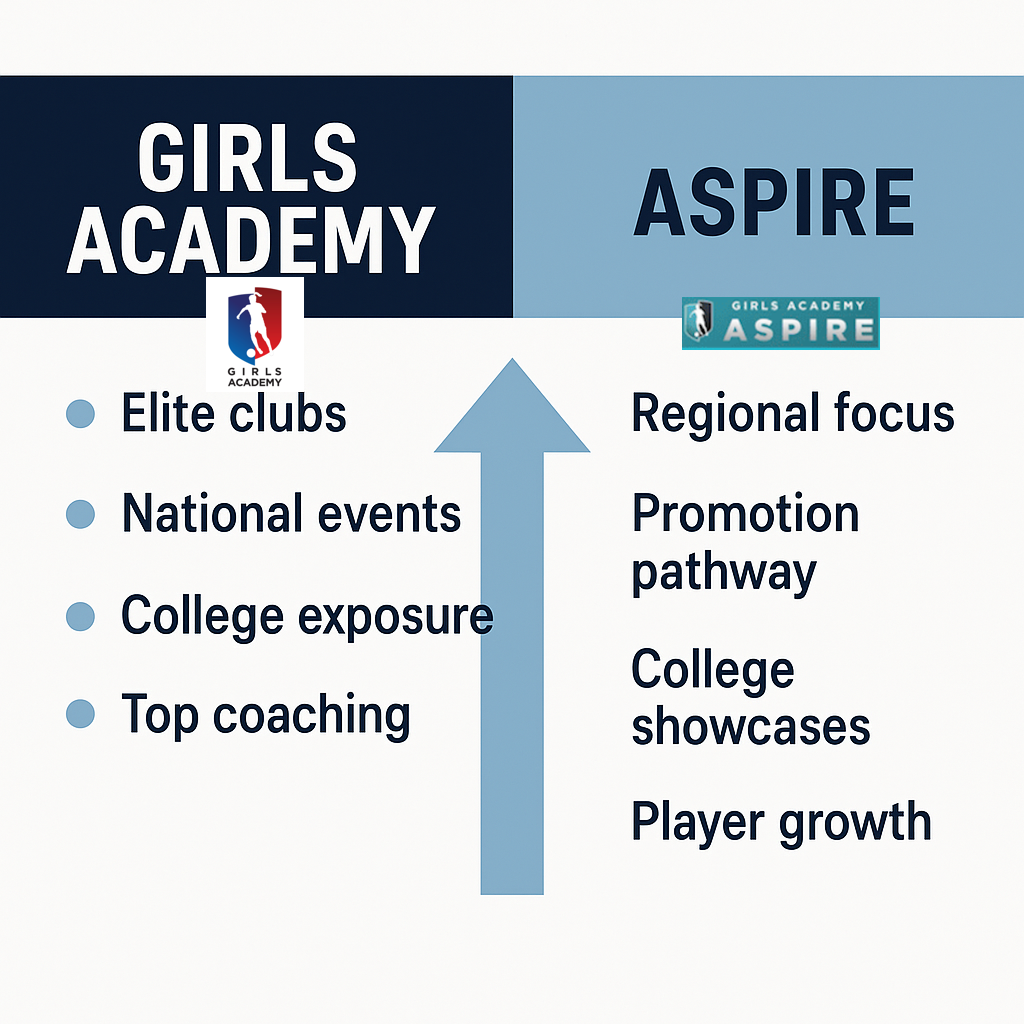
Girls Academy is a national elite girls’ league that combines high standards for member clubs with a strong focus on player welfare and college exposure. GA uses a conference structure, national events, and postseason play to create a consistent environment for players who are tracking toward college and, in some cases, youth national team opportunities.
Clubs must meet requirements around coaching licenses, club operations, and player support, which helps reduce the “hit or miss” feel that families sometimes experience in local leagues.
Key Features of GA
Standards‑based membership for clubs, including coaching credentials, player‑safety policies, and long‑term development plans.
National platform with conference play, showcases, and playoffs that bring together college scouts and evaluators multiple times per year.
Proven college pathway, with GA players moving into NCAA programs across all divisions and into higher‑level environments.
Emphasis on leadership, sportsmanship, and player well‑being in addition to results and rankings.
For top‑tier players who are ready for a demanding environment and significant travel, GA offers one of the most competitive stages in U.S. girls’ soccer.
What Is GA Aspire?
GA Aspire is the Girls Academy’s official tier‑two platform, created to deepen the pathway inside the GA ecosystem and give more players meaningful, standards‑based competition. It is intentionally designed as a bridge between local elite play and full GA, with a focus on strong second teams and ambitious clubs that want to prove they can compete at GA level over time.
Aspire is framed as a performance‑driven tier, not simply an extra schedule for overflow teams. Clubs must apply and meet requirements, and league operations are run in collaboration with the Development Player League (DPL), which has experience operating multi‑tier national girls’ platforms.
Key Features of Aspire
Second‑tier platform within GA, sitting just below the top GA level in the overall pathway.
Primarily regional league play to control travel, paired with access to larger GA and partner events that create national‑level showcases and postseason opportunities.
Merit‑based entry for clubs and teams, with competitive and operational benchmarks to keep the league standards‑driven rather than pay‑to‑play.
Clear pathway into GA: a home for GA second teams and a proving ground for strong non‑GA clubs hoping to move into the top tier.
Operated in collaboration with DPL, leveraging its infrastructure for national girls’ competitions.
For many families, Aspire offers a balance: real competition and recruiting visibility, without as much national travel as the very top tier.
What Is ECNL?
ECNL (Elite Clubs National League) is one of the longest‑running national girls’ platforms and has a large footprint in college recruiting. The ECNL structure includes both the top ECNL Girls level and ECNL Regional League (ECNL RL), which extends access to more clubs and markets while mirroring the overall model on a more regional scale.
Seasons typically blend conference schedules with national showcases, League Cups, and postseason tournaments, which serve as key scouting hubs for college programs each year.
Key Features of ECNL / ECNL RL
National conference system with clubs across many states and regional ECNL RL tiers that follow a similar structure with more localized play.
Events such as showcases and League Cups that include group play, knockout games, and postseason paths, giving players multiple “big stage” experiences.
Long track record of producing college players and elite prospects, with ECNL RL increasingly recognized as a significant recruiting environment in many markets.
Travel expectations that vary by region: some conferences are mostly regional, while others require more national trips for league play and events.
For many families, ECNL and ECNL RL are familiar brands with established reputations, which can simplify conversations with college coaches and other parents.
Head-to-Head Comparison: Girls Academy vs Aspire vs ECNL
There is no one “best” league for every player; the right choice depends on your daughter’s current level, long‑term goals, and how your family weighs travel, cost, and college exposure.
Here’s a side-by-side snapshot:
| Factor | Girls Academy (GA) | GA Aspire | ECNL / ECNL RL |
|---|---|---|---|
| Level | Top national tier for elite girls’ clubs. | Official second tier under GA, performance-based pathway. | National + regional tiers with broad club footprint. |
| Competition | Conference play, national showcases, and playoffs. | Primarily regional league play plus regional/national events. | League play, showcases, League Cups, and postseason tournaments. |
| Travel | Moderate to high, varies by conference and event schedule. | Generally lower than GA; more regionalized schedule. | Varies; ECNL RL often more regional than top ECNL. |
| College exposure | Strong, especially at national events and playoffs. | Growing; leverages GA and partner events to provide visibility. | Very strong for ECNL; solid and expanding for ECNL RL. |
| Pathway | Toward college, youth national teams, and pro environments. | Stepping-stone tier toward GA, DPL, and college exposure. | Multi-tier ecosystem feeding college programs through ECNL and ECNL RL. |
Which League Is “Best” for Your Daughter?
From a college coach’s perspective, GA and ECNL are both established recruiting platforms, and Aspire is being built as a serious stage for players moving toward that level. In day‑to‑day reality, the quality of the club environment, the coaching staff, and the schedule often matter more than which acronym appears on the schedule.
A strong Aspire or ECNL RL team can be a better fit than a struggling GA or ECNL team if it offers better development, more consistent playing time, and a staff that actively supports communication with college programs.
Questions to Ask at Tryouts or Meetings
How experienced are the coaches with college recruiting, and how involved are they in outreach to schools on behalf of players?
What does the full‑year schedule look like, including league games, showcases, and postseason events—and what does that mean for travel and cost?
Where have recent graduates from this team or club gone to play in college, and at which levels?
If the club participates in GA, Aspire, ECNL, and/or ECNL RL, how are decisions made about player movement between teams during and after the season?
How does the club use game film, highlight videos, and events to help players get seen by college coaches, regardless of league?

GA is the top tier of the Girls Academy structure, with the highest competition and standards; Aspire is the official second tier designed to expand access while keeping a performance‑based pathway upward. Aspire gives GA clubs a dedicated home for strong second teams and offers qualified non‑GA clubs a way to compete inside the GA ecosystem without immediately joining the top tier.
Aspire sits as a second tier within the GA system, not directly above or below ECNL or ECNL RL, since these are separate league families. In many markets, Aspire teams will look similar in level to strong ECNL RL or top regional teams, while GA and ECNL are more often viewed as top national tiers; the exact comparison depends heavily on your local clubs.
Both GA and ECNL are widely used by college coaches as primary recruiting environments, with national showcases and playoff events drawing large numbers of programs. The impact on your individual player usually comes down to the quality of her team, the events the club attends, and how intentional the staff is about supporting each player’s recruiting process.
Conference alignments, event dates, and specific showcase locations do change each year, but the basic structure of GA, Aspire, and ECNL tends to follow the same pattern: standards‑based clubs, conference play, showcases, and postseason opportunities. Parents should always verify the current season details with their club and the official league websites, while using this guide to understand the big‑picture differences that stay consistent over time.
Key Takeaways for Soccer Parents
Elite girls’ soccer now offers a more layered, structured pathway than in the past, with GA, Aspire, and ECNL/ECNL RL each serving different types of players and clubs. The goal is not to chase the “biggest” logo, but to find the environment where your daughter will be challenged, supported, and seen—by good coaches now and by college programs when the time is right.
Use this guide as a framework, then combine it with honest conversations with club directors and coaches so you can choose the league and team that fit your player and your family, not just the current trend.