How European Players Can Play College
Soccer in the USA

European soccer players are increasingly choosing U.S. college soccer because it combines high‑level competition, a recognized university degree, and a real pathway to professional football in North America and beyond. For many, it is a smart “Plan B” that keeps the pro dream alive while earning a degree and gaining life experience abroad—often funded through athletic scholarships.

Why European Players Choose U.S. College Soccer

European players are attracted to U.S. college soccer for several key reasons:
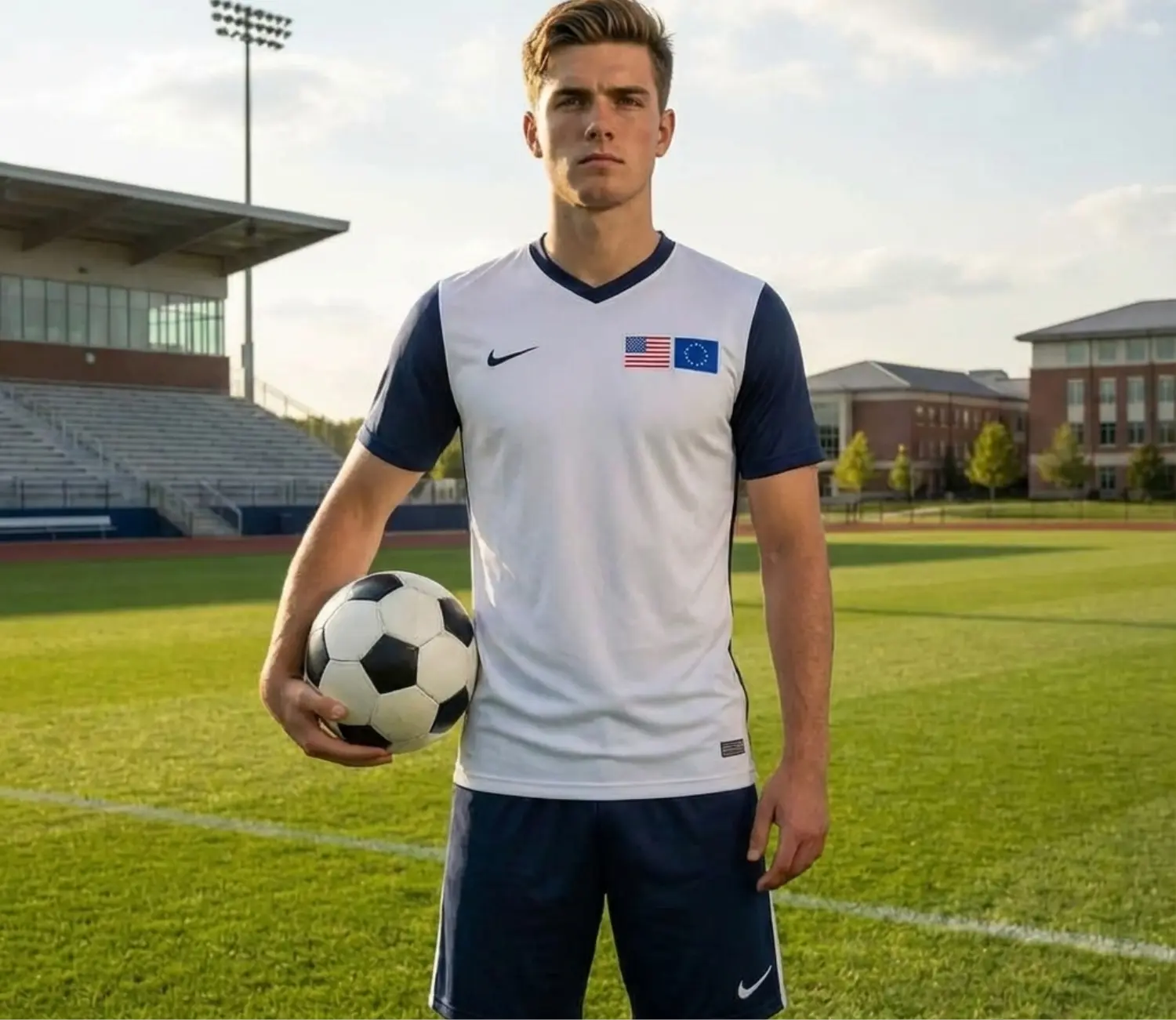
European player with soccer ball at U.S. university campus.

Key Benefits for European Players

For a European player and family, the U.S. college route offers tangible advantages on and off the pitch.

Financial support

  • Athletic scholarships can cover 25–100% of costs, depending on division, program, and the player’s profile; many internationals receive “full rides” that make a U.S. education far cheaper than paying out of pocket.

  • Even partial scholarships reduce the financial burden on families and allow players to focus on development instead of part‑time work.

Soccer development

  • Intense, structured training schedules (often 5–6 days per week) with
    professional‑style coaching, strength and conditioning, and video analysis.

  • High match frequency during the season (often 2 games per week) plus playoffs for successful teams.

  • Exposure to a more athletic, up‑tempo style that can improve physicality, speed of play, and decision‑making under pressure.

Academic and career upside

  • A U.S. degree from a recognized university can open doors in coaching, sports management, business, and many other fields, whether or not the player eventually signs a pro contract.

  • Strong academic performance helps maintain F‑1 visa status and can support future work opportunities in the U.S. after graduation.

Personal growth

  • Living independently in a new country builds maturity, adaptability, resilience, and cross‑cultural communication skills.

  • Many former college players describe the U.S. experience as transformative, both as footballers and as people.

What European Players Must Adjust To

Moving from Europe to U.S. college soccer requires real adaptation in how players train, study, and live day‑to‑day.

  • U.S. college soccer is generally more athletic, direct, and high‑tempo than the slower, more technical, possession‑oriented style common in many European leagues.

  • Players must adapt to higher intensity, aggressive pressing, and a big emphasis on fitness, set pieces, and transitional moments.

  • Training is highly structured with fixed schedules for practice, film, lifting, and recovery, which can feel more regimented than many European club environments.
  • On the pitch, missing tactical instructions or not understanding coaching cues can hurt performance and limit leadership opportunities.

  • Learning soccer‑specific English vocabulary (for example, “switch,” “press,” “man on”) and using simple, clear phrases helps players stay involved and vocal.

  • Off the pitch, interacting with professors, advisors, and university staff in English can be stressful, especially when asking for extensions, support, or accommodations.

  • Using campus resources—tutoring, ESL programs, and counseling—is crucial for managing both academic and mental‑health challenges.
  • Players are full‑time students: they are expected to carry a full academic load (typically 12–18 credits per semester) and maintain a minimum GPA to stay eligible.

  • Balancing early‑morning training, classes, study hall, travel, and games requires strong time‑management and discipline.
  • Non‑native English speakers may initially struggle with lectures, readings, essays, and class discussions, especially in the first year.

  • Most universities offer ESL courses, tutoring centers, and academic advising, but players must be proactive in asking for help.
  • Adjusting to American campus life—food, social norms, team rules, and communication styles can be challenging, especially for players used to more relaxed or less structured environments.

  • Dorm life, team policies, and strict schedules (for example, mandatory study hall or curfews) can feel restrictive compared to typical European university or club life.
  • Language barriers can make it harder at first to form close friendships with teammates and classmates, which can affect confidence and team chemistry.

  • Players who engage actively with teammates, join campus activities, and practice English daily usually settle in faster and feel more connected.

How European Players Get Recruited to U.S. College Soccer

The pathway from a European club or academy to a U.S. college roster is a multi‑step process that rewards planning and proactive outreach.


1. Understand eligibility and division levels

  • International players must usually register with the NCAA Eligibility Center (for NCAA schools) or the NAIA Eligibility Center and submit academic transcripts, proof of graduation, and standardized test scores (SAT/ACT, when required).
  • Transcripts and diplomas from non‑English schools must be translated line‑by‑line into English by an approved service.
  • NCAA Division I is the highest level with the most scholarships and the most competition—great but also the hardest place to earn early playing time.
  • NCAA Division II and NAIA offer strong football, good scholarships, and are often more realistic and balanced options for many European players.
  • NCAA Division III and junior colleges cannot offer athletic scholarships but can be excellent stepping stones to higher divisions through the transfer portal.
NCAA soccer eligibility and academic requirements for U.S. soccer.
Match footage for a European player’s U.S. soccer recruiting profile.

2. Build a strong recruiting profile

  • A high‑quality, 3–5‑minute highlight video with real match footage is essential; U.S. coaches rely heavily on video to evaluate international players.
  • The video should clearly show the player throughout, including passing, defending, decision‑making, and set pieces, with the player identified by position, number, and team.
  • Players should create a digital profile (for example, Hudl or a simple personal site) listing stats, honors, club/academy history, and academic information.
  • A short written bio or cover letter explaining why the player wants to play in the U.S. and what they bring to a team can help coaches remember them.

3. Research and target schools

  • Players should identify schools that match both their academic interests and football level; a realistic list might include 20–30 programs across different divisions.

  • Important filters include location, climate, campus size, academic programs, and team culture and playing style.

  • Many European players choose to work with recruiting platforms or agencies that have relationships with U.S. coaches and can help with video, profiles, and communication, but families should carefully vet any fees and services.
Researching U.S. university campuses for European soccer players.
European players training with a U.S. college soccer coach.

4. Contact coaches proactively

  • The ideal timing to start outreach is 12–18 months before the desired enrollment date, typically during the final 1–2 years of highschool or post‑academy.
  • Players should send personalized emails to each coach, mentioning specific reasons for interest (for example, an academic program, the team’s style of play, or recent results).
  • Every email should include the highlight video link, player profile, and key academic info; questions about scholarship money are usually better for later in the conversation.
  • Regular, respectful follow‑ups (every 4–6 weeks) help keep the player on the coach’s radar and gradually open conversations about scholarships, roster needs, and campus visits.

5. Attend camps and showcases (if possible)

  • College‑run ID camps in the U.S. allow coaches to see players live and evaluate athleticism, attitude, and coachability, which is especially helpful for internationals.

  • Some agencies and tournaments in Europe host showcases specifically for U.S. college coaches, offering exposure without needing to travel to the United States.
European players at a U.S. college soccer showcase and ID camp.
European player traveling to the USA for college soccer on a student visa.

6. Handle logistics, visas, and finances

  • Once a coach is seriously interested, the university can issue an I‑20 form so the player can apply for an F‑1 student visa at a U.S. embassy or consulate.

  • Players may need to prove English proficiency through TOEFL, IELTS, or a similar test, depending on the school’s requirements.

  • Families should build a full budget that includes travel, health insurance, visa fees, and personal expenses, even if the player receives a generous or full scholarship.

Frequently Asked Questions (FAQs)

Navigating the U.S. college recruiting process from Europe can be complex. We’ve answered the most common questions regarding scholarships, academic eligibility, and what to expect during your four-year journey.

U.S. college soccer allows European players to combine high-level competition with earning a recognized university degree, so their football and academic paths progress at the same time. Families value this route because it offers a structured environment, life experience abroad, and often significant financial support through athletic or academic scholarships.
College soccer in the U.S. offers a competitive environment where players train daily, play in organized leagues, and stay visible to professional clubs and scouts across North America and beyond. By continuing to develop physically, tactically, and mentally in a serious program, players maintain a realistic “Plan B” route into the professional game while securing an academic qualification.
Players are full‑time students: they are expected to carry a full academic load (typically 12–18 credits per semester) and maintain a minimum GPA to stay eligible. Balancing early‑morning training, classes, study hall, travel, and games requires strong time‑management and discipline.
College players balance earlymorning or afternoon training sessions, full days of classes, study hall, strength work, and frequent travel for matches. This schedule requires strong timemanagement, discipline, and the ability to switch quickly between academic responsibilities and highintensity athletic performance.
Depending on the division and program, European players may be offered full or partial athletic scholarships, often combined with academic or needbased aid to reduce overall costs. Scholarship spots are limited and highly competitive, so performance level, academic record, video, and proactive communication with coaches all matter when schools decide how to allocate funding.
Most European players start by creating a strong highlight video, compiling match footage, and preparing a clear football and academic profile. From there, they reach out directly to college coaches, attend showcases or ID events when possible, and respond quickly and professionally to any interest to move the process forward.
Players can expect differences in academic structure, campus life, and team culture, including living in residence halls, eating in dining halls, and being immersed in English every day. Training intensity, travel distances for games, and the strong “college sports” culture may also be new, but these experiences help players grow in independence and maturity.
U.S. Soccer Parent provides clear, unbiased information about the U.S. soccer (football) system so European families can understand how academics, scholarships, and soccer fit together. Through guides, articles, and real player stories, the site helps parents and players ask better questions of clubs, advisors, and colleges while they manage their own recruiting process.  We also expect to develop partnerships with entities that may be able to assist you in your efforts to get recruited.

Interested in Playing U.S. College Soccer?

We will connect you and provide resources as they become available.

We will contact you