
Can My Child Trial With Another Club Mid‑Season?
One of the most confusing issues for youth soccer parents is what happens when a player wants to check out another team or club in the middle of the season. Are they allowed to go to a training session? Can they attend a tryout? Will they get in trouble with their current club? And what about actually switching teams before the season ends?
The short answer: there is no single national rule. Instead, you’re dealing with a patchwork of policies from different governing bodies (US Youth Soccer, US Club, AYSO, etc.), individual state associations, and specific leagues (ECNL, MLS NEXT, National League, NPL, local travel leagues). But there *are* consistent patterns that can help you make good decisions and ask the right questions.
This guide breaks it down in parent language.
The Core Distinction: Training vs. Being Rostered
First, it helps to understand what is actually regulated.
- Rosters and player registrations are what the formal rules care about. A player’s “card” or “pass” (digital or physical) is tied to a specific club/team for a “seasonal year” (usually August 1–July 31).
- Training or trialing is often governed more by league and club policies (and ethics) than by national federation rules. The big legal/eligibility issues start when a player tries to *change which club holds their registration.*
In other words, a player turning up at another club’s practice is, in many systems, not directly addressed by the national rulebook. The moment you move into “registering with another team, transferring your card, or playing matches for another club,” you are fully inside the formal regulatory world.
What Most Parents Actually Want to Know
In practical terms, families usually have one of three questions:
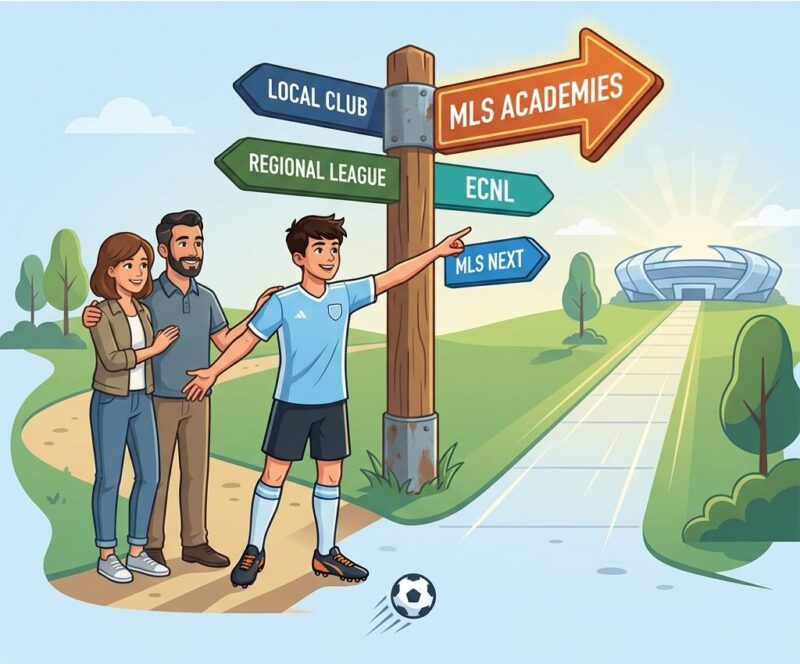
“Can my child attend a practice or trial with another club while still rostered with their current club?”
“Can my child switch clubs mid‑season and play for the new team?”
“Can my child be on two teams at once?”
The answers are different for each, and they depend on the competition and governing body.
1. Trialing or Training With Another Club Mid‑Season
This is the grayest—and most emotional—area.
What the rules typically say:
In many traditional state associations and travel leagues, the registration rules focus on who holds the player’s pass?, not where the kid can physically train on a Tuesday night. There is often no explicit national‑level rule that says “a registered player may not train with any other club.” Instead, the constraints come from league‑specific recruiting and tryout rules (especially in elite platforms like ECNL, MLS NEXT, or national‑level US Club competitions). Also you must consider club policies and contracts, including “no training elsewhere” clauses in player/parent agreements. Finally, there may be timing restrictions around when clubs can recruit or hold tryouts for players already rostered in that league.
At the high end of the pyramid, many leagues now explicitly restrict clubs from inviting or trialing players who are currently registered with another club in that same competition until an official tryout window opens or the player has been formally released. These rules are mostly aimed at controlling in‑season poaching and constant roster churn, not at punishing players.
What this means for parents
In a lot of environments, two things are true at the same time:
- From a pure registration standpoint, your child is “owned” by their current club only in the sense that they hold the player’s pass and match eligibility in that league.
- From a league/club policy standpoint, your child might be discouraged or contractually restricted from training elsewhere during the season, especially with rival clubs in the same league.
So, whether your child may attend another club’s session often depends less on a USSF‑style national rule and more on the specific league’s rules on recruiting/trialing rostered players, the wording of your current club’s player–parent agreement and the local culture—some areas are tolerant of players looking around; others treat it as disloyalty.
For an example of how one national body structures eligibility and transfer rules, see US Youth Soccer’s Policy on Players and Playing Rules.
2. Switching Clubs Mid‑Season
This is where things get more formal, and the rules are clearer.
“Bound for the seasonal year”
Most competitive structures use some version of the “seasonal year” concept (often Aug 1–July 31). Once a player is registered to a club and rostered to a competitive/travel team for that seasonal year, the default assumption is the player is bound to that club/team for the remainder of the seasonal year. The player’s registration can only be moved via a formal release or transfer process (and sometimes only during certain windows) and a player generally cannot hold more than one competitive pass within that same sanctioning body at the same time.
State associations (under US Youth Soccer) and national bodies (like US Club) layer on details. Some allow mid‑season transfers but cap the number of transfers a team can accept. Others impose fees or transfer windows (for example, a December–January period where movement is easier). Many leagues specify that even if a player transfers, they may be ineligible to play league matches for a new team in the same age group/division that season.
Training vs. playing after a mid‑season move
A very common pattern in elite leagues:
- The player may join the new club and train mid‑season.
- The player may not appear in official league matches for that new club in that same competition until the next seasonal year (or they may be subject to strict limits).
For parents, this means yes, mid‑season club changes are often possible, especially if you’re moving out of that league or platform altogether. But no, your child may not be able to jump into league games immediately for the new club, especially if it’s in the same competition.
3. Being on Two Teams at Once

The idea of “double carding” or multiple rostering is its own rabbit hole.
Within the same system (e.g., US Youth Soccer)
Many state associations limit players to one competitive club at a time, though some allow controlled multiple rostering for development reasons (e.g., a primary team plus a secondary team or different level) under specific rules. These usually come with guardrails, such as:
- Only one primary competitive club.
- Restrictions on playing for two teams in the same division or age group.
- Caps on the number of clubs a player can be registered with simultaneously.
Across different systems (e.g., USYS and US Club)
Because US Youth Soccer and US Club are separate members in the U.S. Soccer structure, it is sometimes technically possible for a player to be rostered on a US Club team and also on a USYS team, particularly if they are playing in different competitions. However, major elite leagues—ECNL, MLS NEXT, National 1, etc.—tend to override this flexibility with their own stricter competition rules. They typically do not allow a player to play in their competition for two different clubs in the same season, even if those clubs are in different registries.
For parents, the bottom line is: Don’t assume “two cards” equals “total freedom.” Competition‑level rules usually trump registry‑level technicalities.
How Recruiting and Trial Restrictions Really Work
Interestingly, many of the strictest rules are aimed at clubs, not players. Elite leagues and some large leagues/platforms often include language that forbids clubs from approaching, recruiting, or trialing a player currently registered with another club in that competition before a designated tryout date. They forbid direct recruitment at league events (e.g., talking to players/parents on the sideline) and require that any in‑season move be either parent‑initiated or supported by a formal release/permission from the current club.
So the risk of non‑compliance is ofte on the recruiting club, which can be fined or sanctioned an less on the player, who might simply be declared ineligible for certain matches or competitions.
From a parent perspective, this means if another club is actively courting your child mid‑season, they may be the ones bending or breaking the rules. If you, as the parent, are exploring options on your own initiative and staying within the formal transfer rules, you are usually on firmer ground.
Practical Guidance for Parents
Because the landscape is fragmented, it helps to approach this in a structured way.
Step 1: Know your “governing stack”
Figure out which “stack” applies to your child:
- Sanctioning body: US Youth Soccer (via your state association), US Club, AYSO, etc.
- League/platform: ECNL/ECNL‑RL, MLS NEXT, National League, National 1, NPL, E64, local travel league, etc.
- Club contract: Player–parent agreement with your current club.
These three layers together dictate what is and isn’t allowed.
Step 2: Read the fine print
Look specifically for:
- “Player registration,” “player transfer,” “release,” and “multiple rostering” sections in your state association or league rules.
- “Recruiting,” “contact with players,” and “tryout” sections in your league/competition handbook.
- Any clauses in your club’s agreement about training elsewhere, mid‑season moves, or penalties for leaving.
Step 3: Think about timing
Ask:
- Are we in the **middle of the competitive season**, or approaching/post tryout windows?
- Are we trying to switch within the **same competition**, or moving to a different platform entirely?
- Do we care about **match eligibility this season**, or are we essentially planning ahead for next year?
In many cases, the least disruptive path is use mid‑season to gather information (visit sessions, meet staff, watch games). Plan a formal move around the next seasonal year, when tryout windows open and transfer restrictions loosen (some parents observe though that it’s easier to get attention by getting to practice with a target club in-season).
Step 4: Communicate (strategically)
with your current club
Every situation is different, but in general if your child is clearly unhappy, under‑placed, or in a toxic environment, you have every right as a parent to explore alternatives. If you have a decent relationship with the current coach/TD, a transparent conversation can prevent drama and may even lead to internal solutions (different team, guest play, etc.). In tightly regulated leagues, you may need a written release or permission from your current club for certain kinds of mid‑season movement. It’s better to know that upfront.
How to Think About This as a Parent
Beyond the technical rules, there are developmental and relational questions:
- Is the current environment actively harming my child’s development or well‑being? If yes, that strengthens the case for a quicker move.
- Is this about long‑term fit, or just short‑term frustration? Not every rough patch justifies a mid‑season exit.
- What will the move do to my child’s social network and confidence? Kids often value teammates and familiarity more than parents realize.
- Are we chasing a short‑term “upgrade,” or aligning with a better pathway and philosophy? Try to objectively judge clubs on training quality, culture, and fit, not only on badge prestige.
You don’t need to feel trapped by “you signed, you’re stuck,” but you also want to avoid bouncing from club to club every time there’s adversity. The rules are one input; your child’s long‑term development is another.
How to Use This Article
Because rules change and vary:
- Treat this as a **framework** rather than legal advice.
- For any specific move, always:
- Check your state association and league rulebooks for the exact current language.
- Read your club’s current‑season parent agreement.
- When in doubt, ask for clarification in writing from the league or state office.