Sinding-Larsen-Johansson Syndrome: The Lesser-Known Knee Pain That Affects Young Soccer Players
Sinding-Larsen-Johansson Syndrome
The Lesser-Known Knee Pain That Affects Young Soccer Players
When your young soccer player complains of knee pain just below the kneecap, you might assume it’s Osgood-Schlatter disease—the condition most parents have heard about. But there’s another culprit that’s just as common yet far less recognized: Sinding-Larsen-Johansson (SLJ) syndrome. This overuse injury affects the same growth plate mechanism as both Osgood-Schlatter and Sever’s disease, but targets a different location in the knee.
What Is Sinding-Larsen-Johansson Syndrome?
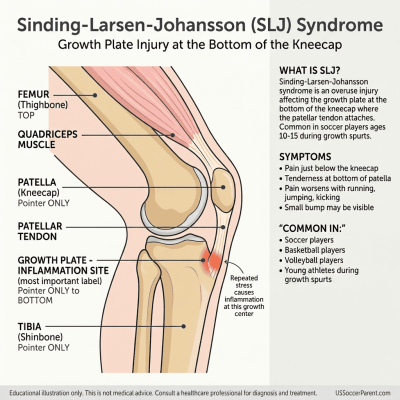
SLJ syndrome is an inflammation of the growth plate at the bottom (inferior pole) of the kneecap where the patellar tendon attaches. It’s a traction apophysitis—meaning repetitive pulling force on immature bone causes irritation and inflammation at the growth center. The condition primarily affects active adolescents between ages 10 and 15, particularly boys, during periods of rapid skeletal growth.
Like Osgood-Schlatter and Sever’s disease, SLJ is caused by the unique vulnerability of growing bones. During growth spurts, muscles and tendons tighten faster than bones lengthen, creating increased tension at the attachment points. In soccer players, the constant running, jumping, cutting, and kicking creates repetitive stress that the immature growth plate can’t handle.
How SLJ Differs from Osgood-Schlatter and Sever's
All three conditions are part of the same family of growth plate injuries, but each affects a different location along the kinetic chain:
| Condition | Location | Pain Point |
|---|---|---|
| Sinding-Larsen-Johansson syndrome | Bottom of the kneecap (inferior pole of the patella) | Just below the kneecap |
| Osgood-Schlatter disease | Top of the shinbone (tibial tuberosity) | Just below the knee where the patellar tendon attaches |
| Sever’s disease | Back of the heel bone (calcaneus) | Where the Achilles tendon attaches |
The key distinction between SLJ and Osgood-Schlatter is which end of the patellar tendon is injured. SLJ affects the top (proximal) end where the tendon leaves the kneecap, while Osgood-Schlatter damages the bottom (distal) end where it attaches to the shin. Both conditions share identical causes—overuse from sports—and respond to the same treatments.
Join U.S. Soccer Parent
Free for every soccer parent.
Save articles, get the free newsletter, and find guidance tuned to your state, your kids' ages, and the pathway your family is on.
Recognizing the Symptoms
The hallmark symptom of SLJ is localized pain at the bottom of the kneecap that worsens with activity. Young athletes will feel tenderness when you press on the lower edge of the kneecap, and the pain intensifies during jumping, running, squatting, or kneeling. Some children develop visible swelling or a small bump at the pain site.
Pain typically increases when the quadriceps muscles engage, which compresses the kneecap and loads the inflamed growth plate. Your child might struggle with activities that require knee extension—like kicking a soccer ball, going up stairs, or jumping for a header. The discomfort often improves with rest and returns when they resume sports.
Why Soccer Players Are at Higher Risk
Soccer creates the perfect storm for SLJ development. The sport demands constant acceleration, deceleration, jumping, and directional changes—all movements that load the patellar tendon. Factor in overzealous conditioning routines, year-round play without adequate rest, and the physical demands of growth spurts, and you understand why this injury is so common in youth soccer.
Additional risk factors include poor physical conditioning (especially quadriceps tightness and weak hip muscles), rapid skeletal growth, being overweight, and insufficient warm-up before training. Children who specialize in soccer early and play on multiple teams simultaneously face elevated risk due to the cumulative stress on their growth plates.
Diagnosis and When to See a Doctor
Physical examination is the primary diagnostic tool for SLJ. A healthcare provider will palpate the bottom of the kneecap to identify tenderness and assess pain patterns during knee flexion and extension. Because SLJ and Osgood-Schlatter can be difficult to distinguish by symptoms alone, imaging studies help confirm the diagnosis.
X-rays can reveal fragmentation at the lower pole of the patella or calcification in the patellar tendon, though early-stage SLJ may show normal X-rays. Ultrasound and MRI are the most effective diagnostic tools, revealing thickening of the patellar tendon, swelling of the cartilage, and inflammation at the growth plate attachment. Your doctor may order imaging to rule out stress fractures or more severe injuries like patellar sleeve fractures.
Treatment: Rest, Modify, Strengthen
The good news is that SLJ is self-limiting—it resolves when children finish growing and the growth plates close. Conservative treatment focused on activity modification yields positive outcomes in most cases within 6 to 14 weeks. The treatment approach mirrors what works for Osgood-Schlatter and Sever’s disease.
Immediate management includes removing your child from sports-related activities and limiting weight-bearing on the affected knee. Ice application, over-the-counter NSAIDs (with physician approval), and patellar straps or KT tape can help relieve pain and reduce tension on the tendon.
Physical therapy plays a central role in recovery. Treatment typically progresses through phases: initial rest and pain relief, followed by gentle stretching to improve flexibility, then progressive strengthening of the quadriceps and lower extremity muscles. Low-impact activities like swimming and biking can maintain fitness while the injury heals. In severe cases, a cast may be applied for up to four weeks to ensure immobility, though this is rarely necessary.
Recovery Timeline and Return to Play
Recovery time varies based on severity, adherence to treatment, and individual growth patterns. Most young athletes return to play within 6 to 14 weeks with proper rest and physical therapy. Some cases resolve in as little as 4 weeks, while others require several months.
The condition typically resolves completely when growth plates close and doesn’t cause lasting problems. However, if not diagnosed early and managed correctly, SLJ can lead to complications including bony overgrowth, calcification, and prolonged pain that may require surgical intervention. Recalcitrant cases that don’t respond to conservative treatment may require surgical debridement, though this is uncommon.
Prevention Strategies
While you can’t prevent growth spurts, you can reduce SLJ risk through smart training practices. Ensure your young player warms up properly and stretches before practice and games, focusing on quadriceps and hamstring flexibility. Maintain appropriate conditioning with emphasis on thigh and knee strength, and encourage cross-training to avoid sport-specific overuse.
Monitor training volume during growth spurts and avoid the “too much, too soon” trap. Kids who play through pain put themselves at risk for growth plate injuries, so teach your athlete that rest is part of training, not weakness. Maintaining ideal body weight reduces stress on developing knees.
Understanding SLJ syndrome empowers you to recognize symptoms early and seek appropriate treatment before the condition progresses. While the pain can sideline your young athlete temporarily, proper management ensures they’ll return to the soccer field stronger and healthier.
*Additional Resources: Cleveland Clinic – Sinding-Larsen-Johansson Syndrome