An EDP announcement this week about “first wave” clubs applying for acceptance into the new National 1 League quietly surfaced a big change: not every current National League or NPL team is guaranteed a spot in the top tier.
When EDP emailed families this week to celebrate a “first wave of clubs… looking to transition from The National League to National 1 League,” one word stood out: “accepted”.
The message explained that these clubs would be “applying teams for acceptance during the application window,” signaling a shift many parents may not have realized was coming. What had been described for months seemingly as an automatic merger of US Youth Soccer’s National League and US Club Soccer’s NPL into a single top team‑based platform now clearly includes a gate: clubs and teams must apply, and (presumably) not everyone will be admitted.
From NewComp to National 1 – and why EDP’s email matters
Beginning in 2026–27, US Youth Soccer and US Club Soccer are unifying their top team‑based competitions into a new shared league that will serve roughly 10,000 teams and more than 150,000 players across eight regional conferences and multiple districts. The platform, originally referenced as a “new competition” or by the internal working title “NewComp,” was recently formally branded the National 1 League, and details have been trickling out.
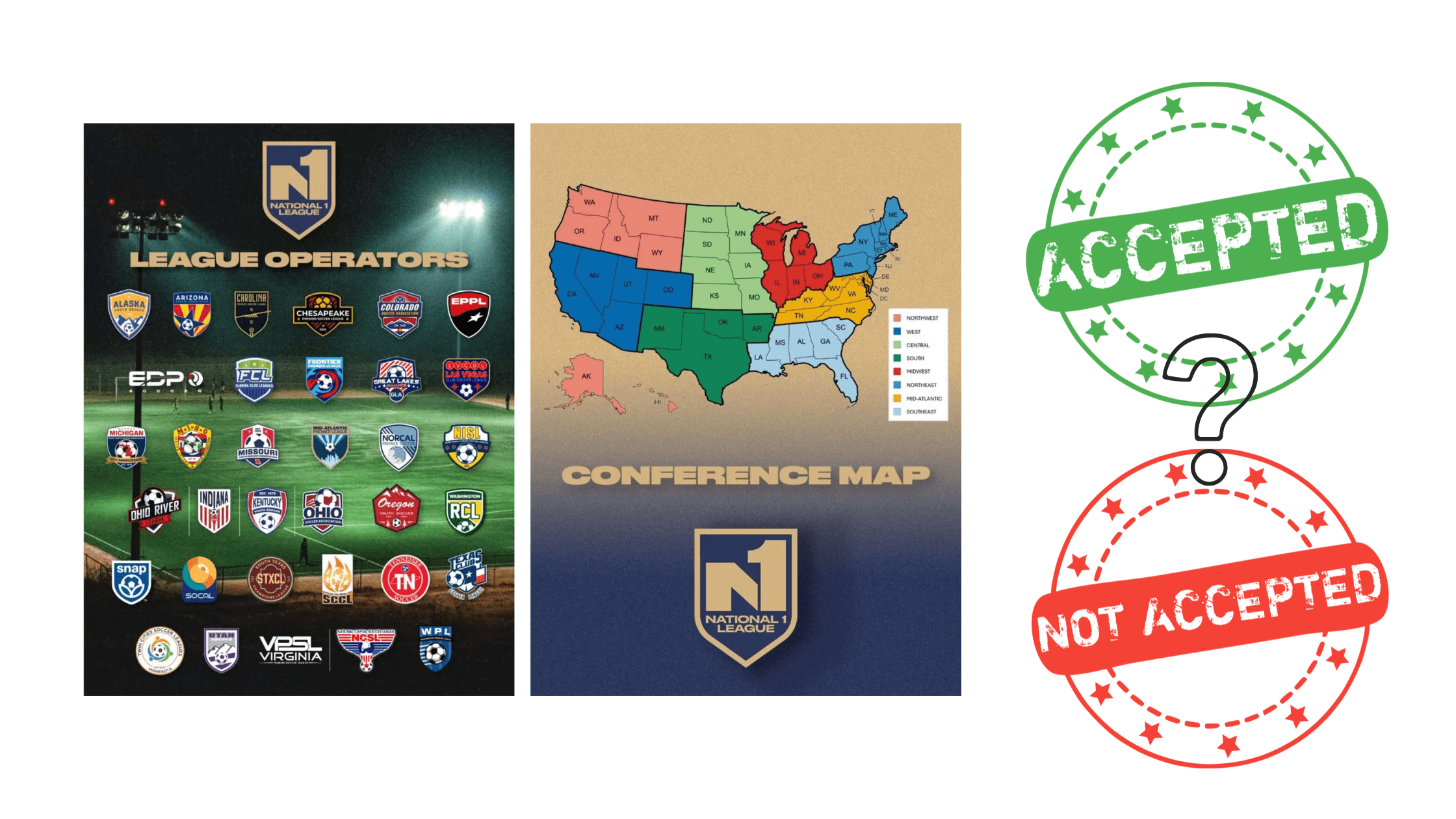
US Club Soccer’s description is clear: National 1 is the top team‑based competition for both organizations, sitting above state and regional leagues and feeding into a unified postseason that connects with ECNL Regional League pathways. League operators include familiar names like EDP, Florida Club Leagues, NCSL/Virginia Premier Soccer League, Twin Cities Soccer League, Missouri Youth Soccer, and others, each tasked with running districts under the National 1 umbrella.
What the EDP announcement brings into sharper focus is that this new top tier is not an automatic “rollover” for all current National League and NPL clubs. Instead, operators are openly talking about applications and acceptances:
- EDP’s posts speak of “first wave of clubs… looking to transition from The National League to National 1 League,” and note that these clubs “will be applying teams for acceptance.”
- Florida Club Leagues tells interested programs: “ALL clubs interested in applying for National 1 (N1) must complete the form below,” explicitly treating it as an application‑only platform.
- NCSL’s National 1 page for the Mid‑Atlantic district says that teams “will be accepted through an application process managed by National 1 League operators.”
- Missouri Youth Soccer’s National 1 FAQ is blunt: “All teams must apply for the 2026–27 season, though prior performance in those leagues will be a key consideration.”
For parents who assumed “our club is in National 1 League now, so we’ll just join the merged league,” the fine print is now clear: everyone starts by applying. There is no published promise that every current National League or NPL team will land in National 1.
If National 1 serves 10,000 teams, won’t most applicants get in?
The 10,000‑team headline has been unavoidable. Joint announcements emphasize that the merged competition will serve about 10,000 teams and 150,000 players nationwide, across eight conferences and many districts. That sounds huge, and it is—but it’s important to break down what that figure actually means.
First, the 10,000 number is national, across all ages, both organizations, and every operator and district combined. In any given district—say, EDP’s Northeast or Mid‑Atlantic—there will be far fewer slots, constrained by field capacity, travel tolerances, and a desire to maintain reasonable competition levels.
Second, those teams are not just coming from one source. National 1 is designed to bring together:
- Current USYS National League teams.
- Existing NPL teams from US Club Soccer.
- Strong state and regional league teams that operators elevate into the new platform.
Those 10,000 slots are effectively replacing many of the current “top regional” teams, not simply creating 10,000 new seats at a table that was previously half‑empty.
Third, league documentation reinforces that this top tier will be curated. The National League’s existing club‑based rules already give administrators final say over which clubs are admitted and emphasize that recommended clubs are not guaranteed entry. National 1 guidance from operators, like Missouri’s FAQ, continues that theme by saying all teams must apply and that prior performance will be “a key consideration,” not an automatic pass.
Put simply: the scale of National 1 suggests it will be broad, not ultra‑exclusive, but there is nothing public to support the idea that “almost everyone who applies will be accepted.” In some districts, most current National League and NPL teams will likely make the cut; in others, some clubs and teams that expected to be in may find themselves just outside the new top layer.
What happens to clubs and teams that are not accepted?
This is the question EDP’s wording brings to the surface—and the one most families may not yet have thought to ask. None of the national releases spell out a detailed “if not accepted, then here’s where you’ll play” flowchart, but the broad outlines are consistent from state to state.
National 1 is positioned as the apex of the USYS/US Club team‑based pyramid: the top league with a unified postseason and a clear pathway into ECNL Conference League playoffs and ECNL Regional League events. Below that, operators and state associations will continue to run regional and state‑level competitions that sit under the National 1 umbrella, existing travel leagues (such as EDP regional leagues, state association leagues, and similar platforms) that remain in place for teams not at the top tier.
For any given club, we can surmise the likely outcomes are:
- Accepted teams will compete in National 1 League, carrying the National 1 badge on passes, schedules, and standings and participating in the integrated postseason path if they qualify.
- Non‑accepted teams will play in the operator’s next‑tier competition, which may look like an enhanced regional/state league under the same brand or a familiar pre‑existing league structure.
The good news: those teams are not left without a league. They should still have a full schedule, sanctioned competition, and access to tournaments and showcases. The more difficult reality: they will not be in the officially designated “top team‑based league” for their pathway, and families will notice that distinction. Clearly, National 1 will be perceived as a step up. It is being marketed as the shared top league for US Youth Soccer and US Club Soccer, and its integration with ECNL Regional League events and postseason play signals status to college coaches, scouts, and ambitious families.
That perception will create emotional winners and losers. Families whose clubs and teams are accepted will feel validated: “We made it into the new top league.” Families on clubs that are not accepted—or whose club is accepted but their specific team is not—will likely read that as a demotion, even if their week‑to‑week soccer experience is largely unchanged.
In reality, the on‑field gap between a strong regional league and a lower‑tier National 1 district might be modest in some areas, especially early on. Travel demands, quality of coaching, and tournament choices may matter more for development than the label on the league schedule. But because National 1 is explicitly framed as “the top competition,” the badge will carry outsized weight in how families judge their situation.
Questions parents should be asking right now
EDP’s “first wave” language is a good prompt for parents to start asking more pointed questions, especially in clubs that currently play USYS National League, NPL, or high‑end regional competitions.
Useful questions include:
- Is our club applying to National 1, and in which districts?
- Which specific teams and age groups is the club submitting for National 1, and why?
- If our team is not accepted, what league will we play in instead, and how will that compare in terms of competition, travel, and college exposure?
- Will there be movement between National 1 and lower divisions over time (via promotion/relegation or application cycles), or are placements mostly fixed once announced?
- How will the club communicate National 1 decisions to families, and what support will be offered to teams that don’t get in?
The key is not just “Are we in National 1?” but “What concrete experience will my player have in whichever league we land in?” That includes training quality, travel load, financial cost, and realistic exposure opportunities, not just the name on the badge.
2 Responses
So how many tiers will N1 league have ? We currently play in WDDOA in central Texas they recently made four levels starting at alpha (bottom), challanger, prime, and platinum with chances for promotions. Here in Texas I think it’s called STXCL/ECNLRL I wonder how many levels there are and if they have chance for promotion and relegation and how that will be determined. So many leagues it’s frustrating they should narrow it down and name it something straight forward, have promotion and relegation maybe a pre season tournament to determine what clubs teams make what levels.
From what’s been published so far, National 1 doesn’t look like one single nationwide promotion/relegation pyramid. It appears to be a district-by-district structure, with teams placed by application and acceptance, and any lower levels or movement between them will likely be set locally by each operator. So unlike WDDOA, there probably won’t be one universal 4-tier ladder across the whole country.