Last updated: March 2026 – Reflects the 2026–2027 seasonal year and beyond.
Navigating the NAL: A Friendly Guide for Soccer Families
If you’re a parent exploring the world of “elite youth soccer” for your child, you may have heard about the National Academy League (NAL). But what exactly is the NAL, how does it fit into the youth soccer landscape, and what does it mean for your family?
This guide focuses on the big-picture structure of the NAL and what families should consider, understanding that specific events and formats can evolve over time.
As the NAL continues to expand for the 2026–2027 seasonal year, it’s important to understand what this league offers and how it might fit into your player’s long‑term journey. Here’s some things you should know to help make informed choices.


What Is the NAL?
The National Academy League is a national soccer league in the U.S. serving both boys and girls who are serious about their soccer development. It is designed for ambitious players—primarily those connected to clubs with MLS NEXT programs and Girls Academy (GA) programs—and offers a high-level competition platform. The NAL exists to provide a competitive, development-focused environment, helping young athletes grow both on and off the field.
While the NAL operates independently from MLS NEXT and GA, works closely with many of those clubs. This remains true as the league expands into new regions for 2026–2027. The league often accommodates “second teams” or additional age groups and provides a meaningful alternative for players who may not be rostered on the primary squads.
Looking ahead to the 2026–2027 seasonal year, the National Academy League continues to serve as a **high-level** national platform for boys and girls youth players, with conferences across multiple regions of the United States. The league has steadily expanded its club membership and regional footprint while maintaining its focus on meaningful minutes, player development, and strong club environments.
Where Does the NAL Fit in the Youth Soccer Landscape?
Think of the NAL as just below the top tier (MLS NEXT/GA) on the youth soccer pyramid. It spans both genders and offers a pathway for players who are looking to challenge themselves against excellent competition while keeping their long-term options open.
For families, the NAL provides an alternative to more established leagues like ECNL (Elite Clubs National League) and other prominent platforms, but remains closely connected to the country’s top soccer programs.
NAL vs. ECNL vs. MLS NEXT (big picture)
In simple terms, here is where the NAL generally sits for many families:
Top national tier: MLS NEXT, Girls Academy, and ECNL for many elite players.
Next tier: NAL and similar national platforms, often hosting second teams or additional age groups from those same top clubs.
Below that: Regional and state leagues that vary widely in level of play.
In practical terms, the NAL is often considered just below MLS NEXT on the boys’ side and Girls Academy/ECNL on the girls’ side, especially heading into the 2026–2027 seasonal year. If you’re comparing the NAL with ECNL, GA, MLS NEXT, and local leagues, you may also find our guide “Levels of Competition” guide helpful for seeing how these platforms stack up.


Playing Time and Player Development
The National Academy League season is structured to balance intense competition with the realities of busy soccer families, and this remains true as the league heads into the 2026–2027 seasonal year.
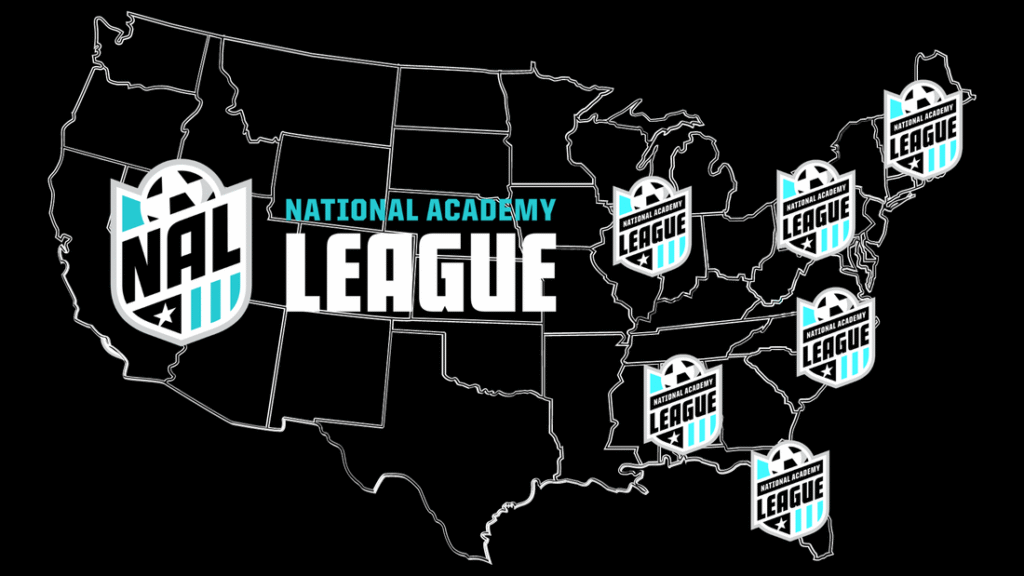
- Regional Conferences: NAL teams are grouped into regional conferences based on geography. This structure helps manage travel demands, creates exciting local rivalries, and ensures players regularly face strong, diverse opponents within their part of the country.
- Compatibility with High School Soccer: NAL allows players to participate in both league matches and high school soccer. This flexibility is especially important to families who value the experience, school community, and local exposure that high school sports can provide.
- Regular Season: Teams accumulate points through wins and draws in their conference, mirroring the formats found in professional leagues. Standings within each conference determine which teams advance to postseason events.
- Championship Events: At the season’s end, top‑performing teams earn spots in NAL Championship events, where conference champions and a limited number of wildcard teams (often selected using metrics such as points per game) compete in a high‑level, college‑scouted environment. Exact event dates and locations can change each year, so families should rely on their club and the official NAL site for the most current 2026–2027 information.
Beginning with the 2026–2027 seasonal year, many NAL clubs are aligning their rosters with a seasonal age‑group format. For most families, this is largely an administrative change in how teams are labeled and registered rather than a change in the competitive level or day‑to‑day experience, but it is worth confirming with your club how they will organize age groups in the league.
| Time of Year | Typical NAL Event Type | Recruiting Focus |
|---|---|---|
| Late Summer / Early Fall | Season kickoff, early league games, club-hosted friendlies | Laying the foundation for the year, early identification by local and regional college programs |
| Fall | Conference league play, occasional local showcases | Ongoing evaluation, building game film, first touch points with college coaches |
| Winter | NAL crossover festivals and showcase-style events; select external showcases (e.g., IMG Cup) | Major recruiting window for many classes, concentrated college coach presence |
| Spring | Final conference matches, additional crossover events or showcases | Continued evaluation, follow-up conversations, refinement of college target lists |
| Early Summer | NAL Championship events and select post-season tournaments | Final impressions and offers for older players; early identification for younger age groups |
College Exposure and Recruiting
College exposure is a central part of the NAL experience. League events are typically scheduled around key recruiting windows, making it possible for college coaches from a variety of divisions to scout talented girls and boys. Premier events such as NAL Championships, crossover festivals, and tournaments like the IMG Cup (where NAL teams often receive priority consideration) provide valuable opportunities for players to be evaluated by college coaches and program directors from across the country. As the league expands into 2026–2027, families should ask their club how the NAL schedule fits into their overall college recruiting plan.
Travel and Family Commitment
Participation in the NAL can involve significant travel, especially for showcase events and championships. This is true for both boys’ and girls’ teams, and it’s important to understand that travel demands can be significant.
For many families, most regular‑season NAL games are played within their regional conference, while a handful of crossover events and national championships may require longer trips. Families should prepare for the time and financial commitments required for regular away matches and showcase events. That said, the league’s regional approach helps minimize travel for many regular-season matches, especially compared to some purely national schedules.
What Are the Benefits for Players and Families?
- Clear Development Pathways
The NAL designed to help players (girls and boys) on the path toward MLS NEXT, Girls Academy, college soccer, or even professional opportunities. This remains a key focus as the league broadens its footprint for the 2026–2027 seasonal year.
- High-Level Competition
Teams regularly face top regional opponents in their conference and, at times, strong national opponents at crossover events and championships.
- Balanced Experience
The NAL encourages athletes to participate in high school soccer and remain connected to their communities, while still offering an elite soccer experience.
- Strong Club Culture
Clubs in the NAL emphasize not just skill, but also respect, sportsmanship, and personal growth, creating an environment that supports the whole player
Final Thoughts & FAQ's
The National Academy League offers a supportive, high-level environment for players who want to push themselves on the field and keep doors open for college and beyond. For families, the NAL means quality coaching, meaningful competition, and a clear path to the next level—all while balancing soccer with school and life.
If you’re considering the NAL for your player, talk to your club, ask about tryouts, and see if this league fits your family’s goals. The youth soccer journey is unique for every player, but the NAL is a strong option for those looking to combine development, exposure, and community in one league.
As the NAL moves through the 2026–2027 seasonal year, its structure may continue to evolve, but the core goals—development, exposure, and community—remain the same.
A: it’s designed for players who are serious about their development and ready to commit to a higher‑level training and competition environment.
A: Yes. The NAL supports participation in both, so players don’t have to choose between club and high school.
A: Clubs join the National Academy League through an application and selection process managed by the league. Interested clubs submit an application directly to the NAL, and acceptance is based on meeting high standards for coaching, player development, organizational stability, and alignment with the league’s technical expectations. If your local club offers NAL teams, it means the club has gone through this process and been approved as part of the league’s conference structure.
A: In many markets, MLS NEXT, GA, and ECNL are seen as top national platforms, while the NAL often serves as a closely connected next tier for second teams or additional age groups from those same clubs.
The National Academy League is sanctioned through US Youth Soccer state associations, so all players must first be registered and approved with their state (or local) association through their club. Once that is done, clubs place players on NAL rosters in GotSport, either by linking the state‑association roster (in states that use GotSport) or by adding players and uploading certified state rosters/passes where required. Families do not register “directly” with the NAL—everything flows through their club and state association.