
Blog
AYSO Section 1 Alliance: A Prototype for a Better Pathway Approach?
February 13, 20266 min read
AYSO’s Section 1 Alliance program sits in an unusual—and increasingly important—space in the U.S. youth soccer landscape. It is neither traditional “rec plus” nor a typical pay‑to‑play elite club. Instead, S1 Alliance is trying to stretch AYSO’s long‑standing philosophies into the same competitive neighborhoods as MLS NEXT, ECNL, and top‑flight USYS/US Club teams—without adopting the culture and economics that drive many families away from those platforms.
At the center of that effort is club president Nick Pisca. “I’m taking an active role in trying to improve the environment,” he says. “Change comes from action, not words.” He oversees operations across the Section 1 Alliance footprint—board direction, technical programming, affiliate coordination, bylaws, relationships with leagues—and also coaches and referees, giving him an unusually multi‑angle view of how youth soccer works on the ground.
Why S1 Alliance exists
Alliance as a national AYSO concept dates back to a 2019 vote by the AYSO National Board, which wanted a way for AYSO regions—especially those in rural or underserved areas—to place teams into competitive leagues outside the purely in‑house AYSO system. The pandemic stalled early implementation, but by 2022 some regions, including in the Los Angeles area, began experimenting with small Alliance clubs to give stronger AYSO players a higher level of competition while keeping them and their families inside the AYSO ecosystem.
Section 1’s version quickly outgrew that experimental phase. Pisca describes how the program expanded from six initial teams to 24 in 2023, then to 37 in 2024 and about 70 in 2025, prompting the National Board to revise the bylaws so Alliance would be run at the Section level rather than piecemeal at the region level. “We’ve become the primary club option at AYSO for our players that want to pursue club soccer,” he says.
Underlying that growth is a fairly sharp critique of the broader youth soccer environment. Pisca lists “Pay‑to‑Play, alphabet leagues, referee shortages and abuse, exploited coaches, negative training, punitive coaching, players not playing” as systemic problems and frames S1 Alliance as a structural response: a way to give serious players a meaningful pathway without bankrupting parents or burning out coaches and kids.
Join U.S. Soccer Parent
Free for every soccer parent.
Save articles, get the free newsletter, and find guidance tuned to your state, your kids' ages, and the pathway your family is on.
How the model works
AYSO’s national documents define Alliance as an integral part of the AYSO club pathway: tryout‑based, playing in external leagues, yet still grounded in AYSO’s six core philosophies. Section 1’s implementation leans into that definition and then adds several layers of structure.
First is coach and team vetting. Pisca says his first priority as president was to “establish a strict coaching vetting process,” rejecting coaches with misconduct history, incomplete certifications, or negative/punitive training styles. He notes that S1 put referee‑abuse and behavior standards in place “years before” U.S. Soccer’s Referee Abuse Prevention policies, and that all Alliance coaches must be dual‑certified through AYSO and USSF, with Grassroots courses hosted in conjunction with Cal South. The club now reimburses coaches who pursue higher‑level D, C, or B USSF licenses and pairs senior coaches as mentors with newer ones.
Second is structural integration with local regions. “AYSO Regions have control over their Alliance club teams,” Pisca explains. Regional directors of coaching run each hub’s day‑to‑day operations; players stay registered in their home regions, which manage rosters, tryouts, and fields. Instead of losing players to outside clubs at 12 or 13, regions “promote teams and coaches to the club for review and approval, and if accepted, they stay registered in their region.” The volunteer commitment is “baked into our protocols,” with Alliance families expected to give back to younger age groups.
Third is an unflinching commitment to AYSO’s Six Philosophies, even at high competitive levels. “We never deviate from the Six Philosophies,” Pisca says, adding that coaches have been removed for ignoring them. Everyone Plays means a guaranteed 50%‑plus playing time in every club game, a standard he says his own team exceeded at USYS Regionals by playing everyone 75% or more. Positive Coaching, he argues, is a non‑negotiable: “There is no place in the Alliance club for negative or punitive coaching. We want players having the confidence to make mistakes, try hard, and grow as players.”
Critically, he rejects the idea that these “rec rules” are a handicap. He points to teams like the S1 Alliance LA Waves, which have progressed together from 9U to 15U, reached USYS Regionals, and nearly won their Coast Soccer League age group, and to other sides that have won Premier divisions and state cups. Playing everyone, he argues, builds a deeper bench: “Our teams have a deeper bench of experienced players, while other club teams that prioritized their ‘starting eleven’ are struggling with injuries, missing players, and weak athletes.”
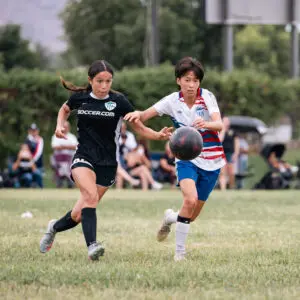
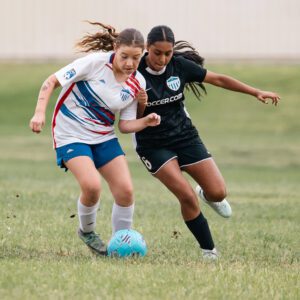
All 📷 © Will Fraser

A strong alternative to elite pay‑to‑play
Where S1 Alliance diverges sharply from MLS NEXT, ECNL, and similar platforms is cost and logistics. Pisca paints a familiar picture: a family with multiple kids on different teams, paying thousands per player per year, commuting across a metro area several nights a week for practices and then criss‑crossing on weekends. “That to me is untenable,” he says.
Alliance tries to simplify that reality. Players progress from Core and EXTRA into Alliance teams that train and play close to home, often on the same fields and nights as siblings still in recreational AYSO. Home games are local, typical away trips are within about 25 miles for most flights, and base registration runs roughly in the mid‑hundreds per year instead of the mid‑thousands, with higher costs only as teams climb into top flights and more travel. “Alliance provides all the same opportunities as outside clubs, but with the resources and management of AYSO, hence the benefits of both worlds,” he says.
A fall survey, Pisca notes, found that roughly a quarter of S1 Alliance players had offers from outside clubs but chose to stay—evidence, in his view, that the model is competitive enough to retain players who would otherwise leave AYSO entirely.
Template or outlier?
The obvious question is whether S1 Alliance is a one‑off or a blueprint. AYSO’s own guidance describes Alliance as designed to support “all levels of soccer, including the elite player,” and to operate at a club level with placements in advanced leagues. Other regions do run Alliance teams into strong competitions, but the level of Section‑run integration, strict selection, coach licensing support, and competitive track record that Pisca describes appears more advanced than what exists in many markets.
That makes S1 an interesting test case. If more sections adopted similar structures—consolidating Alliance at a higher organizational level, investing in coach development, enforcing playing‑time and behavior standards, and embedding the program tightly into local AYSO regions—Alliance could plausibly evolve into a national, development‑oriented alternative that families consider alongside more expensive elite platforms when thinking about college or even professional pathways.
There is a long way to go from here to any kind of parity in visibility or placement with MLS NEXT or ECNL, and that is not necessarily the goal. Those leagues have entrenched scouting and college‑recruitment ecosystems. But S1 Alliance shows that an AYSO‑anchored club model can produce teams competing deep into state cups and USYS regional events while maintaining guaranteed playing time, positive coaching, and comparatively modest fees.
For parents who like AYSO’s culture and are wary of the cost and intensity of traditional elite club soccer, that alone is noteworthy: a proof‑of‑concept that you don’t have to abandon AYSO’s DNA to play serious, high‑level soccer.