
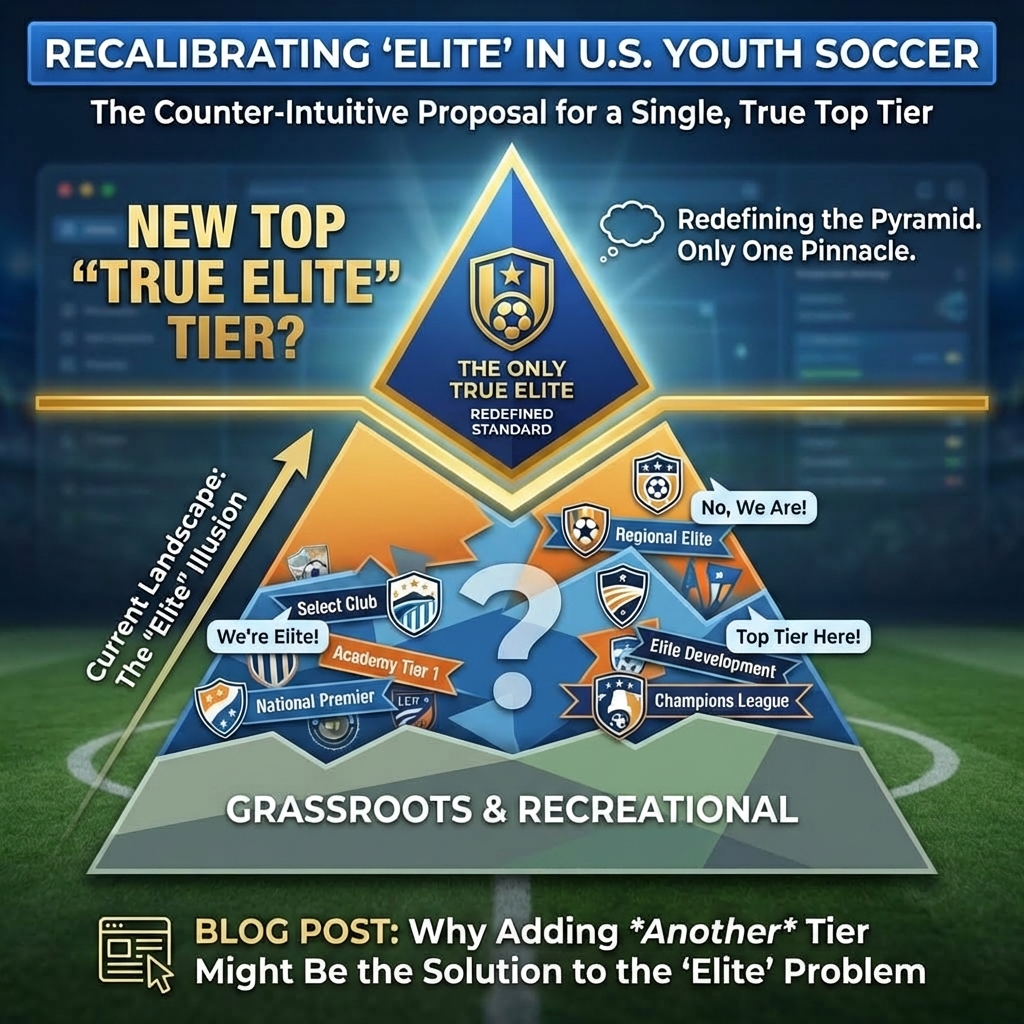
OK, this is going to seem counter-intuitive, controversial in some circles, and perhaps impractical even if theoretically desirable. But we’ve heard from several experts about the irony of having so many “elite” leagues and clubs in this country, but no true elite program if we’re being honest (comparable to top European academies for example).
I have been speaking recently with a high-level coach/European background based in Arizona who has been thinking about a new/better solution to this problem. He prefers to remain anonymous to keep the focus on ideas rather than personalities or politics. His big idea is not to blow up the current system, but to re-center it around a state-run, merit-based elite layer that clubs feed into, while protecting joy and accessibility for the majority of players.
The Problem: Elite in Name Only
Parents face an exhausting maze of “elite” leagues—MLS NEXT, ECNL, GA, NPL, showcases, and ID camps—all promising a pathway to the top. In reality, most are expensive versions of the same thing: pay-to-play competition with heavy travel, intense marketing, and very little clarity about what is truly different beyond the logo and the bill. The word “elite” has been stretched so far that it no longer signals a clear, objective standard.
At the same time, the U.S. still struggles to produce world-class players at the rate of top soccer nations, even as families spend more money and time than ever. College and North American pro teams are dominated by foreign players. The system is noisy, confusing, and often unfair—but it is also deeply entrenched. The question is how to raise the ceiling without burning down the house.
A Different Vision: A State-Run Elite Pathway
The proposal is straightforward: each state creates a publicly overseen elite pathway, starting around ages 13–14, funded by a small, mandatory player pass paid by every youth participant in that state (this would be organized under the aegis of USYS).
Instead of a few families paying thousands to chase “elite” status, every player would contribute a modest fee each season. That shared investment would fund a state-level program covering coaching, scouting, and travel for a limited number of truly elite squads. Selection would be based on ability and potential, not a family’s ability to pay into a particular badge or league.
Another coach reminded us of an additional problem with the current approach – players with truly elite potential (defined by ambition, determination and commitment as much as talent) are too scattered. The highest level of skills and “soccer IQ” can only emerge when the best players are consistently challenged in training sessions and games by peer-level competition. As things stand now, even the best teams have at best maybe one or two truly elite players, which does not serve them well.
Clubs Still Matter: Developing and Showcasing Talent
A crucial part of this idea is what it does not do: it does not scrap clubs or treat them as the problem. Clubs remain the primary home for most players, especially younger age groups. Their core missions stay intact: Developing players technically, tactically, physically, and emotionally from the grassroots up and providing teams for a range of levels, including competitive and college-track soccer.
The proposed state elite program would sit above this layer, drawing its players directly from the clubs. In that sense, clubs become feeders in a healthy way: their job is to develop players well enough that some are consistently identified for the state platform.
This actually opens a positive marketing lane for clubs. Just as clubs proudly announce when their players commit to college, they could celebrate when a boy or girl is selected for the state elite squad. Instead of chasing league labels to prove they are “elite,” clubs would point to the players they produce as evidence of quality.
Continuous Scouting, Not One-Off Tryouts
Another important shift is how selection happens. Right now, a lot of “elite” opportunities are decided by one-off tryouts or a narrow window of scouting at the end of a season. That structure favors early developers, kids who happen to be in the right league, or families who can afford to travel to the right event.
In the proposed model, scouting for the state elite platform would be ongoing and woven into the regular rhythm of the year. State coaches and scouts would watch league games, tournaments, and events throughout the season, allowing late developers to be noticed when they are ready, not written off at 12 or 13. Players in smaller or less fashionable clubs would be identified based on performance, not club brand.
The big picture is not to tear down what exists but to calm the arms race around “elite” branding and refocus everyone on developing players. Clubs train and nurture; the state pathway selects and elevates, all within a structure that is financially predictable and broadly accessible.
Threading the Needle: Fun, Joy, and Higher Standards
Any discussion of an “elite” pathway has to grapple with a tension many parents feel: how do you keep soccer fun and joyful while raising standards and increasing the time commitment for kids who want more?
In the early years, the priority should be simple: fun, creativity, friendships, and unstructured play. The goal is to help children fall in love with the game, not turn every eight-year-old into a mini-professional. This is where local clubs, recreational leagues, and pickup play matter most.
As players reach their early teens, some will naturally ask for more: more training, more challenge, more accountability. That is where the state-run elite layer comes in. It gives those players a clear path to increased standards without forcing every nine-year-old to live like a pro. Kids and families can opt into this higher commitment with eyes open, knowing what it entails, while everyone else can still play and enjoy the game at a level that fits their goals.
Why Not Just End Pay-to-Play?
Many parents and coaches wish the U.S. could simply abolish pay-to-play and fully subsidize the system through professional clubs, like in some European countries (in lower tiers there, local clubs have multiple sources so that parents do not have to carry most of the load, (as I wrote about here). The hard truth is that the American landscape is different. The country does not yet have enough professional clubs, or pro clubs willing and able to fund large academy systems in every corner of every state. And as a country, we are NOT on a trajectory to get there anytime soon.
That reality makes it unlikely that pay-to-play disappears overnight. Instead, this proposal accepts that reality and tries to work with it: clubs continue to charge fees and operate as they do now, but a small, universal player pass helps create a level-playing-field foundation on top, where money is no longer the primary gatekeeper.
The long-term hope is that as the game grows and more professional clubs emerge—ideally several in each state—those clubs can integrate with or even assume responsibility for portions of this elite structure. But until then, the goal is to build a fairer, more coherent system with the tools available now.
A Transition, Not a Flip of a Switch
Any serious reform has to be seen as a long transition, not a quick fix. The “free-for-all” era—where every league invents its own “elite” badge and parents are left guessing—cannot continue indefinitely without damaging the youth game. At some point, standards, pathways, and expectations need to be clarified.
To work, this model would require leadership from a national body like U.S. Youth Soccer or a coordinated coalition of state associations. A possible rollout might look like:
- Year 1: Implement the universal player pass, build the funding pool, and appoint a state technical director or head coach responsible for scouting and program design.
- Year 1–2: Run regional identification events and training centers, using club play as the primary scouting ground.
- Year 2: Launch state elite squads in key age groups, with clear calendars, expectations, and communication to parents about the balance of commitment, school, and club obligations.
I want to reiterate that the goal is not to tear down existing leagues, but to introduce a new reference point that gradually resets what “elite” means in the U.S. context. Over time, clubs and leagues would be forced to compete on coaching quality, player outcomes, and training environments—not just brand and price.
Other countries have gone through similar transitions. Australia, for example, restructured its youth sports systems in the 1990s and early 2000s, and many observers believe those changes helped lift standards across several sports. That experience could offer useful lessons about how to coordinate national direction with state-level implementation, though it is a subject that likely deserves its own deeper-dive, standalone blog.
An Invitation to Parents and Coaches
This idea began in a quiet conversation with a coach who has watched too many talented kids get lost in the noise and economics of the current system. The coach’s goal is not to tear down clubs or shame parents, but to suggest a way for everyone—families, clubs, and state associations—to work together.
Clubs keep doing what they do best: developing players and supporting late bloomers. The state pathway offers a clear, merit-based next step. Parents gain transparency and a more affordable structure. And U.S. soccer, over time, gets a stronger foundation for producing better players and healthier experiences.
The question is simple: if a modest player pass could help create a fair, coherent, state-run elite pathway—one that calms the marketing noise, respects joy, and raises standards—would you support it in your state?
Sidebar: “Isn’t this what ODP does?”
ODP was created to identify top players, provide advanced training, and feed state, regional, and national teams, so on paper it resembles the kind of elite pathway being discussed. However, ODP is still largely fee-based, which recreates pay‑to‑play barriers, and it functions as just one optional add‑on in a crowded landscape rather than a clearly defined top-of-pyramid pathway. Quality and reputation also vary widely by state. The proposed model instead uses a universal, low-cost player pass to fund a single, state-run elite layer, aiming to reset what “elite” means and make access truly merit-based.

Ron Stitt
Co-Founder, U.S. Soccer Parent
2 Responses
I love the idea but there’s no way clubs will get behind this. They’re all scrambling to be the best club in their area to attract more players and they’re not going to give up their best assets. The reason they’re are proud to announce D1 scholarships is because those players have aged out of the club, so then they become a marketing tool. Youth sports has become a ruthless money grab, unfortunately no amount of best intentions is going to change that.
Yes, vested interests and inertia are always an impediment to serious change. So it would have to be a movement that basically forces clubs to “deal with it”. As I suggest in the blog though, in many ways it could actually serve club interests once they adjust.