
Blog
Promotion Without Relegation?
December 21, 20254 min read
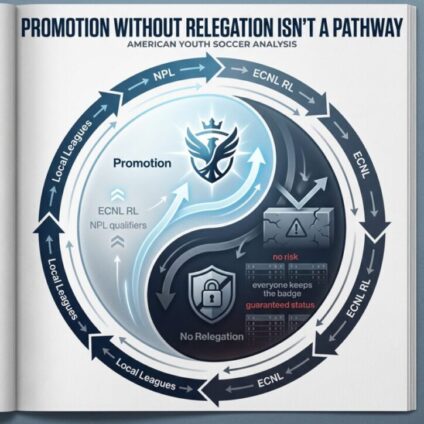
US Club Soccer’s new integrated postseason between ECNL Regional League (ECNL RL) and National Premier Leagues (NPL) is a step in the right direction. It acknowledges that merit should matter, and it nods toward the kind of clear pathway families see in European systems. But without a consistent, formalized approach to both promotion and relegation, this model risks becoming another “everyone gets a trophy” structure that sounds serious yet fails to raise the overall standard.
Why This Integration Is A Positive Step
Bringing NPL qualifiers and ECNL RL qualifiers into a shared postseason is, on its face, a smart move. It creates more meaningful cross-platform games and, at least in theory, gives top NPL teams a stage to prove they belong with ECNL RL peers. It also signals that US Club Soccer recognizes the demand for a clearer pathway from team-based competition into the more exclusive club-based tiers.
The historical data they highlight—hundreds of NPL clubs promoted into ECNL RL or ECNL over recent years—shows that upward movement is possible. That matters to ambitious families stuck in what often feels like the “second division” with limited visibility. Structurally, any step that connects silos and rewards performance is better than the status quo of parallel tracks that rarely intersect.
So yes, this is progress. But it is incomplete progress.
The Missing Half: Relegation
Promotion without relegation is, at best, half a pathway. If a weaker ECNL RL club never truly risks dropping down, while strong NPL clubs have to fight through layers of politics, geography, and invitations to move up, then the system is not really merit-based. It is a closed or semi-closed ecosystem that occasionally lets in new members at the top.
In that setup, “promotion” is more like being granted admission to a private school than earning a place on a ladder that everyone can climb. It can work in the short term, but over time it undermines credibility. Clubs and parents hear the talk of “rewarding performance” and “clarifying pathways,” then see perennial bottom-dwellers still sitting in the same league year after year.
If US Club Soccer and its partners are serious about aligning with the spirit of Europe’s pathways, relegation has to be part of the conversation. Otherwise, the structure remains fundamentally American: selective membership on top, genuine competition underneath, and a big gap between the rhetoric of merit and the reality of how spots are allocated.
The “Everyone Gets A Trophy” Risk
Without relegation, this integration risks turning into another layer of postseason branding rather than a force that raises standards. ECNL RL can become increasingly diluted if underperforming clubs keep their status indefinitely while new clubs are added on top of them. The net result is not a tighter, sharper league; it is a larger one with a wider range of quality.
That is where the “everyone gets a trophy” syndrome creeps in, even at elite levels. Being “ECNL RL” or “NPL” starts to feel less like a hard-earned competitive designation and more like a marketing label. Parents pay premium fees for the badge, while the actual competitive level can vary dramatically from club to club and region to region.
In that environment, the new integrated postseason might produce some great showcase games at the top—but it does not necessarily drive net improvement across the entire tier. Without the pressure of relegation, there is limited structural incentive for a weak ECNL RL club to overhaul its player development model, invest in coaching, or rethink how it competes.
What Europe Gets Right
Europe’s promotion–relegation culture is not perfect, but it does one thing exceptionally well: it makes every game matter. At the top, teams chase titles and European spots. In the middle, clubs jockey for position and prize money. At the bottom, survival becomes its own high-stakes drama.
That bottom-of-the-table tension is exactly what is missing from most American youth league structures. When you know your club could drop a level if standards slip, it sharpens decision-making. It forces better talent identification, more serious training environments, and a long-term view of development. Coaches cannot coast. Directors cannot hide behind labels. Players feel the urgency and the reward.
US Club Soccer’s language around “recognizing performance over time” is implicitly reaching for that same dynamic. The problem is that without formal relegation, the engine that makes the entire ladder meaningful is still not installed.
What A Serious Model Would Require
If US Club Soccer truly wants a credible, sustainable pathway that mirrors the best elements of Europe, a few things need to happen over time:
- Clear, published rules for promotion and relegation between NPL and ECNL RL, tied to league tables and multi-year performance, not just internal invitations.
Transparent criteria so clubs know exactly what is at stake—both to move up and to avoid going down.
Protection for player welfare and travel realities, but without using geography as a blanket excuse to avoid hard competitive decisions.
A willingness to let some existing ECNL RL clubs drop if they consistently underperform relative to ambitious NPL clubs. In reality, the number of teams relegated should correspond to the number promoted.
That is uncomfortable. It creates winners and losers. But that is precisely why it raises the level.
A Positive Step, But Not The Destination
The new ECNL RL–NPL integration is welcome, and it deserves to be acknowledged as a constructive change. It gives high-performing NPL teams more meaningful opportunities, and it nudges the system closer to a true pathway.
Still, the long-term credibility and impact of this model will depend on whether promotion is matched by real relegation. Without that, the top leagues risk becoming bigger but not better, more branded but not more competitive. The European lesson is clear: pathways require that the ladder runs both ways.