
Blog
Carolina Core’s Homegrown Expansion – A Possible Glimpse of What’s Next
March 9, 20262 min read
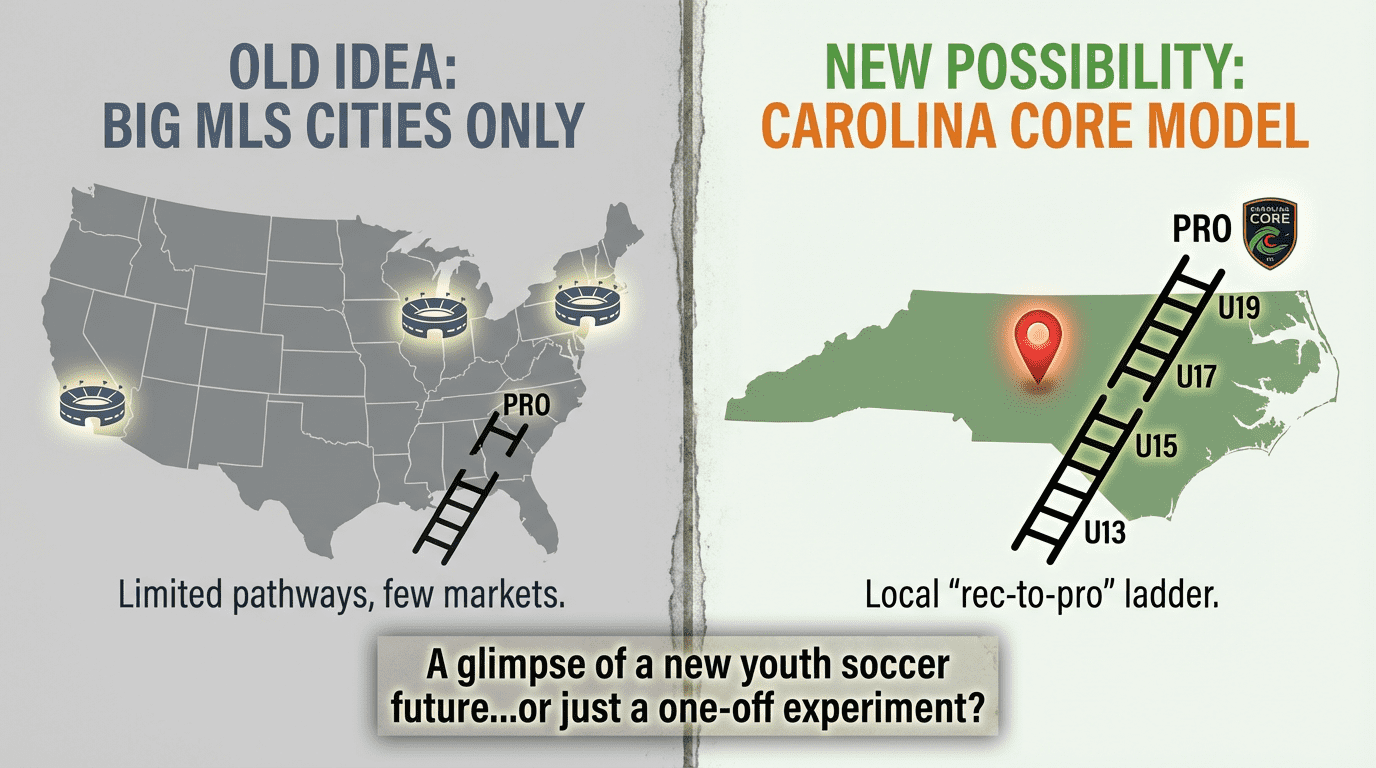
Carolina Core FC is expanding its MLS NEXT Homegrown program for 2026–27, and while it’s one local decision in one region, it offers an interesting look at how elite youth pathways might evolve outside traditional MLS markets.
The High Point–based club, which plays in MLS NEXT Pro, has announced that its MLS NEXT Homegrown Division will grow to include U13, U14, U15, U16, U17, and U19 teams next season. That expansion sits on top of an existing ladder that runs from recreation to classic, to MLS NEXT Academy Division, and up into MLS NEXT Homegrown teams, all under a single club structure. In the club’s own description, the goal is a “vertically integrated development model” that connects grassroots players to national‑level competition and, for a select few, the professional ranks.
Carolina Core argues that the move is rooted in early results. In just two seasons of Homegrown programming, the club notes that its teams have earned national rankings, reached postseason play, and sent individual players into U.S. Youth National Team identification events. Leadership also points to strong local demand and support for “elite, nationally recognized programming” that does not require families to leave the Carolina Core region to access higher‑level opportunities. Alongside the expanded age bands, the club says it will continue to provide merit‑based and financial‑need scholarships to try to keep the top of the pathway accessible.
Seen in isolation, this is a logical evolution for a club that entered MLS NEXT Pro with stated ambitions to anchor a professional pathway in its market. But it also raises a broader question for the elite youth landscape: could this kind of full‑ladder model in a non‑MLS city become more common as MLS NEXT Pro and other professional projects mature? At this point, the honest answer is that it might—emphasis on might.
There are reasons to be cautious about projecting too much from a single example. Carolina Core’s structure depends on a particular ownership group, a specific regional player pool, and a set of local partners willing to support the project. Not every market will have the same ingredients, and not every MLS NEXT Pro or independent club will choose to invest as heavily in youth infrastructure. The expansion could turn out to be a regional success story without triggering any wider change in how other organizations operate.
At the same time, Carolina Core’s decision does put a stake in the ground that elite youth development can be centered in places that are not traditional MLS hubs. If a club in the Carolina Core can run parallel MLS NEXT Academy and Homegrown divisions from U13 through U19, and connect them meaningfully to a professional team, it at least provides a working example other operators can study, adapt, or decide not to copy. Over the next few years, one thing to watch will be whether more clubs in similar “secondary” markets build out comparable structures—or whether this remains a distinctive feature of one ambitious project in North Carolina.