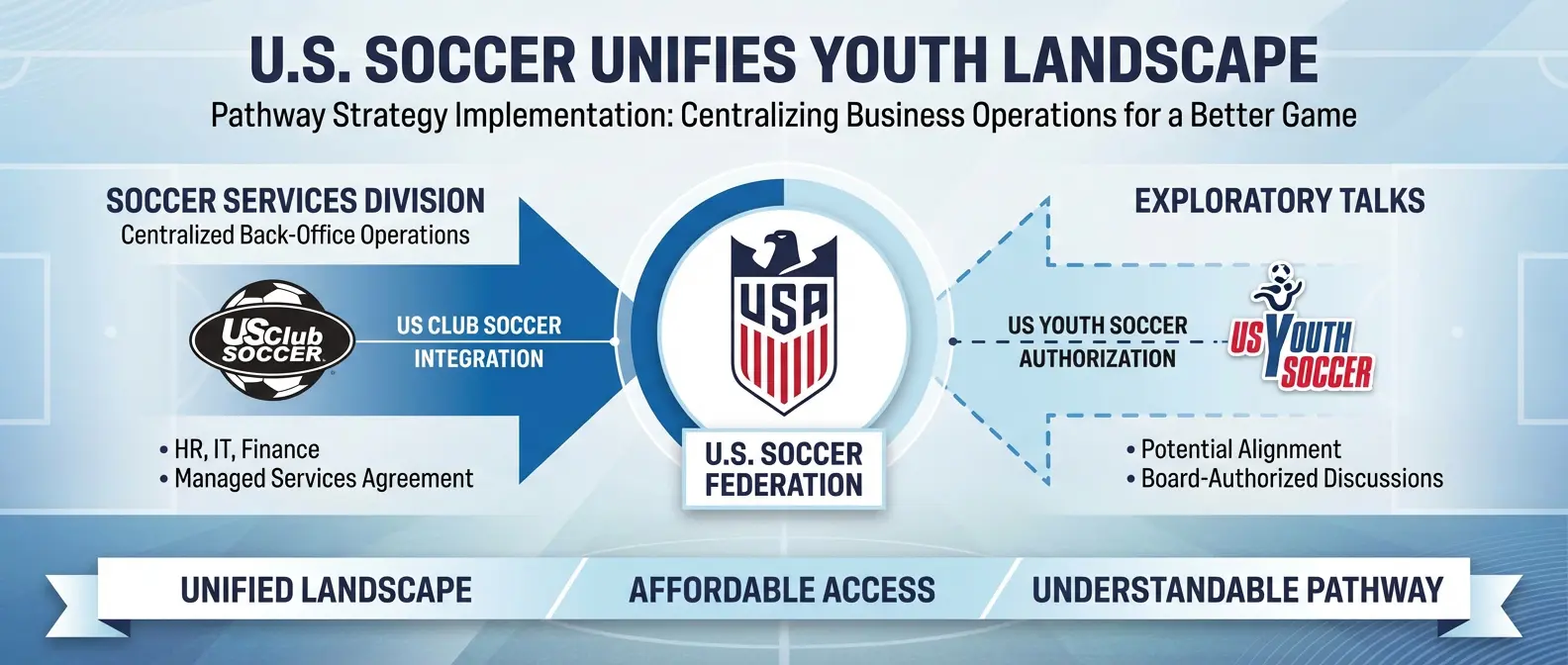
U.S. Soccer has taken a step toward centralizing the business side of youth soccer, bringing US Club Soccer’s back-office operations under a new U.S. Soccer “Soccer Services” division while US Youth Soccer’s board has authorized exploratory talks on a similar path. These moves are framed as early implementations of the federation’s Pathway Strategy to create a more unified, affordable, and understandable soccer landscape for families.
US Club Soccer joins “Soccer Services”
In a letter to members dated January 13, 2026, US Club Soccer CEO Mike Cullina told clubs that the management agreements previously held by a Wasserman subsidiary “have been assigned to U.S. Soccer,” moving US Club into the federation’s newly formed Soccer Services division. US Club remains a National Association member but is now “part” of U.S. Soccer’s internal services structure, rather than outsourcing those functions.
Cullina described the shift as “a significant step in operationalizing U.S. Soccer’s ‘Pathways Strategy’ – ensuring that players, coaches, clubs, leagues and families experience a clearer, more affordable, and higher-quality journey through the game.” He emphasized continuity for day‑to‑day stakeholders, saying that “for the foreseeable future, it’s business as usual” for member clubs and leagues, with the promise of “more opportunities, resources and impact” as the new division matures.
What “Soccer Services” means in practice
Under the new arrangement, U.S. Soccer’s Soccer Services division will handle back-end administration that had been managed under Wasserman*, including registration systems, compliance and other shared services that support US Club’s leagues, cups and programs. US Club says it will “continue to serve you as we have: meeting your administration needs, supporting your programming, leading in safeguarding & compliance measures, and linking your local and regional opportunities to national platforms.”
Federation leaders have cast this centralization of operations as a way to unlock efficiencies and lower overhead, with the goal of passing savings down the chain to clubs and ultimately families. “People are seeking a youth soccer system that is more aligned, more transparent, more affordable, and easier to navigate,” said U.S. Soccer COO Dan Helfrich in commenting on the broader Pathway Strategy. “This relationship with US Club Soccer is a critical first step toward making this happen.”
US Youth Soccer’s exploratory step
In a separate but closely related development, US Youth Soccer (USYS) has signaled that it may follow a similar route. Its board has approved signing a non‑binding exploratory letter of intent to work with U.S. Soccer on shared services and a more unified competition structure, as part of the same Pathway Strategy process. While the letter does not lock in final terms, it authorizes leadership to negotiate and assess what a Soccer Services relationship and aligned competition architecture could look like for the country’s largest youth affiliate.
USYS is already deeply involved in the competition‑side integration the Pathway team is pushing. In a January 2026 update, the Pathways Strategy team announced that, “after nearly two years of dialogue between US Club Soccer and US Youth Soccer, the two national associations are aligning to create a unified, team-based competition structure – the integration of US Club Soccer’s National Premier Leagues (NPL) and US Youth Soccer’s National League, starting with the 2026-2027 season.” That integration is being positioned as the first major competitive expression of the Pathway Strategy at scale.
How this ties into the Pathway Strategy
These operational moves sit inside a larger federation plan to build a “connected competition architecture spanning recreational soccer through the level just below professional play.” The Pathways Strategy team says its work begins with defining “what must be true” for players at different ages and then aligning league and competition structures around those needs, rather than around independent business models.
The unified NPL–National League platform is intended to “reduce unnecessary travel while preserving – and in many cases improving – access to meaningful, high-quality matches,” with clearer progression and better alignment to local and state-based leagues. By bringing US Club’s back office in-house and exploring similar arrangements with USYS, U.S. Soccer is trying to pair that competition reform with shared infrastructure that can support lower costs, consistent safeguarding and compliance, and a more coherent “U.S. Way” of player development.
Potential impact and what comes next
For families and clubs, the immediate message from US Club is stability: registration, competition platforms and existing programs will continue as is while the new Soccer Services framework is built out. Over time, however, stakeholders can expect to see tighter alignment between US Club platforms such as the National Premier Leagues and U.S. Soccer’s national competition architecture, as well as closer coordination on coach education, player identification and safeguarding standards.
The Pathways Strategy team says “additional details on the unified competition structure and future phases of collaboration will be shared in the coming months, beginning at the [United Soccer Coaches] Convention.” With US Club already inside the Soccer Services division and USYS now formally exploring similar arrangements, further announcements at and after the convention are likely to focus on:
- The detailed design of the integrated NPL–National League pathway for 2026–27.
- How state associations, ECNL, Girls Academy and other platforms plug into a “connected competition architecture.”
- Concrete mechanisms to lower administrative and travel costs while maintaining or raising competitive standards.
For U.S. Soccer, these moves are a test of whether it can use back-office integration and competition design—not just national team performance—to lead a fragmented youth system toward a more unified pathway. For parents and clubs, the key questions will be whether promised efficiencies show up as real savings, whether travel demands moderate, and whether the new architecture truly makes the pathway easier to understand from U9 rec to the edge of the professional game.
*Wasserman is out as US Club’s back‑office manager, but it is expected to remain involved with U.S. Soccer as a high‑level commercial/strategic partner or vendor under the new managed services structure