What to Know About Osgood-Schlatter Disease
When our son was about 13 years old, he started to complain about pain in his knee-area. At first he just played through but it got to the point where it began to hinder his training and game play. We had a really hard time figuring out what the issue was, and we were concerned it might become a long-term blocker for his development as a player. It seemed coaches and other parents had no ideas, and even early medical consults left us mystified – and worried – until finally a sports therapist we consulted nailed the diagnosis.
Osgood-Schlatter disease is a common cause of front-of-the-knee pain in growing athletes, especially those who play running and jumping sports like soccer. It can be very uncomfortable and sometimes sidelines players, but with smart management most kids return to full play without long-term problems.

What Is Osgood-Schlatter?
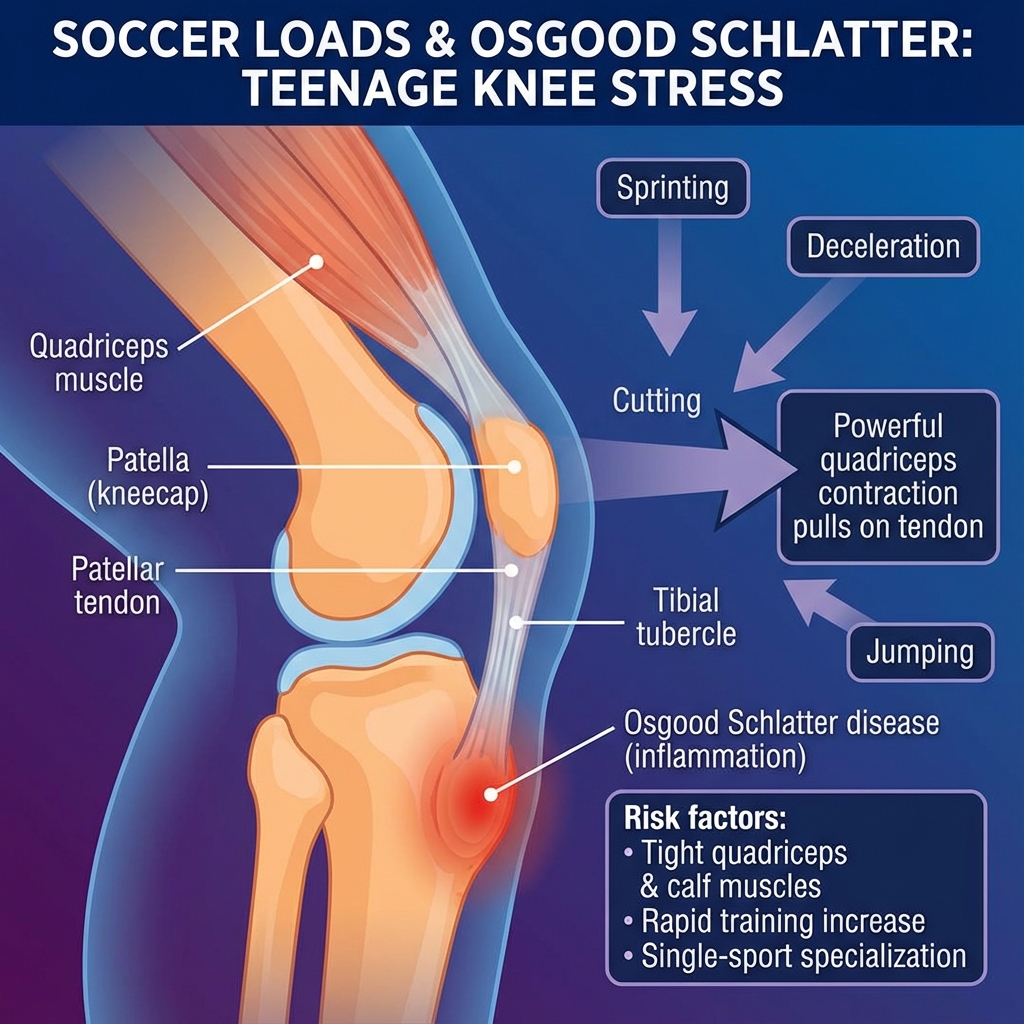
Osgood-Schlatter is an overuse injury of the growth plate at the top of the shinbone, right where the patellar tendon from the kneecap attaches. Repeated pulling from strong quadriceps contractions irritates this growth area, causing pain, swelling, and often a visible bump just below the kneecap. It is more common in boys, although increasing female participation in sports like soccer is causing an increase among girls.
The condition typically appears during growth spurts, most often around ages 11–14 in active kids who play sports with lots of sprinting, cutting, and jumping such as soccer. Symptoms usually improve once the growth plates close, but the bony bump can remain even when pain has gone away.
Why Soccer Players Are at Risk
Soccer loads the knees in several ways that can aggravate this condition. Players repeatedly sprint, decelerate, cut, and jump, all of which demand powerful quadriceps contractions that pull on the patellar tendon at the tibial tubercle.
Epidemiologic studies show that Osgood-Schlatter is one of the most frequently reported knee issues in adolescent soccer, accounting for a meaningful share of knee injuries in players aged roughly 12–15. Tight quadriceps and calf muscles, rapid increases in training volume, and single-sport specialization all appear to increase risk.
How It Can Affect Play
For many players, pain shows up as a sharp or aching sensation right below the kneecap during running, kicking, or jumping and often eases with rest. Kneeling, going up and down stairs, and striking longer balls can be especially uncomfortable.
Research on youth and academy-level soccer players with a history of Osgood-Schlatter shows that some experience reduced sports function, lower knee strength, and lower sport-related quality of life compared with teammates without knee pain. In more persistent cases, athletes may need weeks or months of modified participation or time away from full-intensity play to allow symptoms to settle.
Managing Symptoms and Staying in the Game
While Osgood-Schlatter can be stubborn, it is usually self-limited and responds well to conservative care. Helpful strategies for youth soccer players and parents include:
- Relative rest, not total shutdown
- Scale back high-impact activities like repeated sprints, jumps, and long striking rather than stopping all activity.
- Use pain as a guide: light to moderate discomfort (for example, up to 3/10) that settles within 24 hours is often considered acceptable, but limping or worsening pain signals the need for more rest.
Smart training adjustments
- Limit weekly load spikes by moderating the combination of club training, extra clinics, and games during painful periods.
- Coaches can help by modifying drills (fewer repeated jumps, less high-volume long passing) and, in some cases, temporarily shifting the player to a role with less running.
Home care and basic rehab
- Icing the painful area after activity, short-term use of over-the-counter anti-inflammatory medications (if approved by a healthcare professional), and patellar straps or knee sleeves can help manage symptoms.
- Regular stretching of the quadriceps and hamstrings, along with progressive strengthening for the quads, hips, and core, improves flexibility and reduces traction on the growth plate.
Knowing when to seek medical help
- Persistent pain, significant swelling, locking, or pain that does not improve with rest and basic care should be evaluated by a pediatric sports medicine or orthopedic provider to confirm the diagnosis and rule out other knee problems.
Longer-Term Outlook and Prevention

The outlook for most youth players with Osgood-Schlatter is very good, with symptoms typically resolving as growth finishes and the growth plate closes. A small percentage may have ongoing tenderness with kneeling or intense activity, but serious long-term disability is uncommon.
Prevention focuses on healthy training habits: avoiding early, year-round single-sport specialization; building in off-seasons and rest days; maintaining good lower-body strength and flexibility; and gradually progressing training loads over time. With patient management and clear communication among parents, players, coaches, and healthcare professionals, most young soccer players can navigate Osgood-Schlatter and continue to grow in both their game and overall athletic development.