
Why Pressure Confidence Is the Missing Link in Elite Performance
The No.1 Reason Why I Did Not Make It to Pro Level
Biology beats mindset.
Real confidence begins when the body feels safe—not when a player tries to “think positive.”
In my first article Unlocking Peak Performance, for U.S. Soccer Parent, I explained what breaks down under pressure in elite environments. This one explains why it happens—and why working with the body must come before working with the mind.
If a player wants to perform in trials, decisive games, or high-stakes moments where careers are shaped, confidence is not something they summon with thoughts. It is a biological state they must learn to regulate.
I had to learn this the hard way. For a long time, my talent covered up my challenges. But as the level increased and pressure intensified, everything that wasn’t trained became visible.
If this sounds like you—or your child—keep reading.
When Everything Looked Right—but Felt Wrong
Like many young players, I grew up with one clear dream: becoming a professional footballer. At 12 years old, I was spotted by a Manchester United scout. I played in regional selections with the best players in my age group. From the outside, everything looked perfect.
- I performed on the pitch.
- I performed at school.
- I did everything “right.”
But inside, I didn’t feel free.

Very early on, I learned that love and appreciation came through performance—especially from my dad. So I became excellent at functioning, but terrible at feeling safe.
My inner dialogue was constant:
“I’m not enough.” and “When will I finally be perfect?”
This pressure didn’t show up as panic attacks or obvious breakdowns.
It showed up biologically:
- Chronic fatigue
- Frequent illnesses
- Severe inflammations in my mouth—so painful I couldn’t eat or drink for days
- Inconsistent performances despite high ability
My system was under pressure long before I had words for it.
Join U.S. Soccer Parent
Free for every soccer parent.
Save articles, get the free newsletter, and find guidance tuned to your state, your kids' ages, and the pathway your family is on.
The Big Chance—and Why I Couldn’t Take It
At 17, I was invited to trial with Leyton Orient, a third-league professional club in England at the time.
For a kid from a small Austrian village, this felt enormous. Not just a chance to go pro—but a chance in England, with the dream of one day reaching the Premier League. And because I had learned that performance equals worth, I went into survival mode.
My thoughts were relentless:
- I can’t make any mistakes.
- The other goalkeepers are better than me.
- This is my only chance.
On the outside, I was training. On the inside, I was defending myself.
My chest was tight.
My breathing shallow.
My body rigid.
I didn’t play free.
I didn’t feel joy.
I didn’t feel confident.
The more I wanted it, the more pressure I created.
That internal pressure cost me the few percentage points that separate “almost” from “made it.” Not talent. Not work ethic. Not knowledge.
Biology.
The Collapse That Forced the Lesson
Two years later, my dad died. I fell into a deep mental hole. Like many athletes, I tried to think my way out of it. I talked. I analyzed. I went to therapy. But nothing changed.
Why? Because my system wasn’t processing—it was surviving. This is where so many athletes get stuck. And it’s something I hear again and again in my work with professional players today.
Why Mental Training Alone Often Fails
Players often tell me:
- “I’m mentally exhausted.”
- “I don’t play free anymore.”
- “I feel blocked.”
- “Talking to a sports psychologist doesn’t really help.”
This isn’t because psychology is wrong. And it doesn’t mean mental training doesn’t work. It means timing matters.
When the nervous system is locked in fight-or-flight, the brain areas responsible for learning, reflection, confidence, and creativity are down-regulated.
You can talk. You can reframe. You can repeat affirmations.
But biology always wins.

Why Biology Beats Mindset
Pressure resilience—staying calm and confident when it matters—is not built through positive thinking.
It is built through:
- Nervous system regulation
- Efficient breathing and CO₂ tolerance
- Energy availability and inflammation control
When the body is stressed, the mind narrows. When breathing is shallow, perception shrinks. When the system feels unsafe, confidence disappears.
This is not a mindset issue. It’s a state issue.
Where Breathing Changes Everything
Breathing is the fastest and safest way to influence the nervous system. Not motivational breathing. Not hype. But functional breathing that:
- Reduces unnecessary stress activation
- Improves oxygen delivery at the cellular level
- Signals safety to the brain
- Creates internal space under pressure
Only when the body is regulated does mental training truly work. Only then do visualization, self-talk, focus routines, and confidence strategies land.
( I previously wrote about the importance of breath work, you can read more on that here.)
A Metaphor Every Athlete Understands
Trying to fix confidence with mindset alone while the body is dysregulated is like trying to drive a Formula 1 car with the handbrake fully pulled.
You can adjust the steering wheel. Visualize the perfect racing line. Shout instructions at yourself.
But until the handbrake is released, nothing flows.
Breathing releases the handbrake.
That was my experience—and it’s what I see every week in elite and near-elite players today.
Pressure Confidence: The Foundation of Elite Performance
Pressure confidence is not the absence of nerves. It is the ability to stay biologically regulated while being nervous.
Elite environments don’t break players. They expose what was never trained.
That’s why the work must always start with the body—and only then move to the mind.
One Important Note for Parents
Many parents unknowingly increase pressure by focusing only on outcomes, feedback, or constant evaluation—even when their intentions are loving.
What young players need most is not more advice or motivation, but signals of safety:
- That mistakes don’t threaten belonging
- That rest is allowed
- That worth is not tied to performance
A regulated environment at home is one of the most powerful performance tools a young player can have.
A Personal Invitation
Because of what I went through, I now regularly host Pressure Confidence Online Trainings—completely free.
In these sessions, I share exactly what I teach professional players in 1:1 work:
- How to regulate the body before pressure overwhelms you
- Why breathing is the foundation of real confidence
- How to stop subconsciously blocking yourself when it matters most
- How to prepare before elite environments expose and break you
I don’t do this to motivate. I do it so pressure doesn’t destroy players the way it almost destroyed me.
Talent doesn’t disappear. Regulation does.
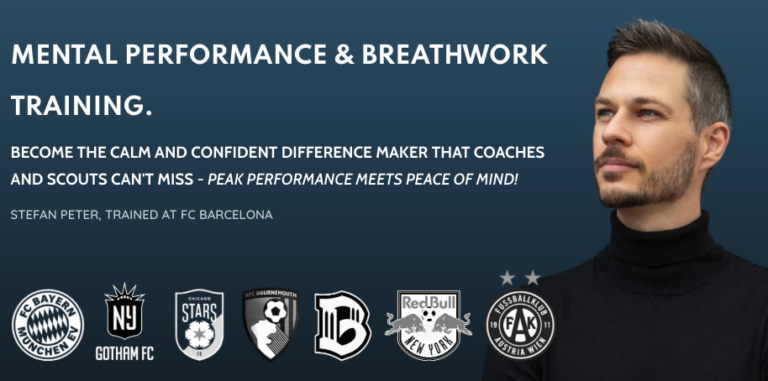
Stefan Peter, Mental Performance Coaching and Breathwork Training
E-Mail: office@stefanpetercoaching.com
My Site: www.stefanpetercoaching.com
Breathwork Training: www.soccerbreathwork.com