
Girls Academy vs Aspire vs ECNL: Parent Guide to Elite Girls’ Soccer Pathways
Why This Guide Matters
For many families, the challenge is not whether their daughter loves soccer, but which league will actually support her development and college goals. Girls Academy (GA), the new GA Aspire tier, and ECNL now sit at the center of the elite girls’ soccer landscape in the United States.
This guide explains how each platform works, what they offer, and how to think about the fit for your player’s level, ambitions, and your family’s time and budget. It is grounded in the 2025–26 structures but written so it remains useful as these leagues evolve in future seasons.
What Is the Girls Academy (GA)?
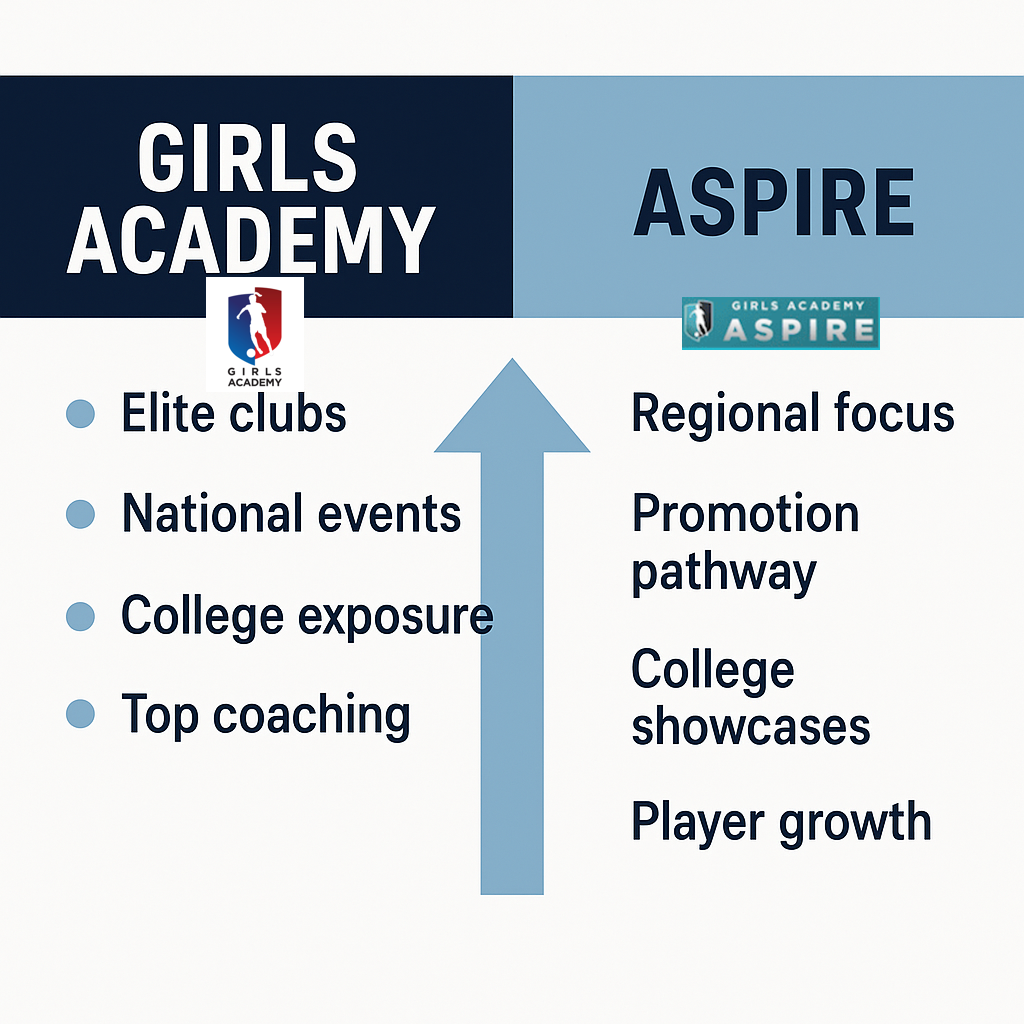
The Girls Academy is a national elite girls’ league built around high standards for clubs, player welfare, and college exposure. It has a formal conference structure, national events, and a clear emphasis on developing future college players and leaders in the women’s game.
GA clubs must meet requirements related to coaching credentials, operational standards, and player support, which helps create more consistent training environments across the country. GA schedules typically combine conference play with national showcases and postseason events, giving players multiple touchpoints with college coaches each year.
Key Features of GA
- High standards for member clubs, including licensed coaches, player‑safety policies, and development plans.
- National platform with showcases, playoffs, and additional events that attract college scouts and evaluators.
- Strong college pathway, with GA environments designed to prepare players for NCAA programs across all divisions.
- Holistic focus on leadership, sportsmanship, and player well‑being, not just results and rankings.
For top‑tier players who are ready for a demanding environment and significant travel, GA offers one of the most competitive stages in U.S. girls’ soccer.
What Is GA Aspire?
GA Aspire is Girls Academy’s official second‑tier league, created to build a deeper, more tiered pathway within elite girls’ soccer. It is designed as a bridge between local elite play and the full GA platform, giving more players access to high‑level competition and college exposure while keeping travel and costs more manageable.
Aspire is explicitly positioned as a merit‑based, performance‑driven tier. Clubs must apply and meet criteria for acceptance, and Aspire serves both GA members (for second teams) and strong independent clubs that are not yet in GA but want to compete in that ecosystem.
Key Features of Aspire
- Second‑tier platform: Officially recognized as GA’s tier‑two league, sitting just below the top GA level in the overall pathway.
- Regional competition, national pathway: Most matches are regional to help control travel, but Aspire integrates with larger GA and partner events, providing a national stage through showcases and postseason opportunities.
- Merit‑based entry: Clubs and teams must apply and meet competitive, developmental, and operational benchmarks, so the league stays standards‑driven instead of simply pay‑to‑play.
- Pathway into GA: For GA member clubs, Aspire gives “second teams” a clear platform for emerging talent; for outside clubs, it can be a proving ground on the way to full GA membership.
- GA–DPL collaboration: League operations and events are managed in collaboration with the Development Player League (DPL), leveraging DPL’s experience in running national girls’ competitions and multi‑tier platforms.
For many families, Aspire strikes a balance: meaningful competition and real recruiting visibility, without the same level of national travel commitment that often comes with the top tier.
What Is ECNL?
ECNL (Elite Clubs National League) is one of the longest‑standing and most influential national platforms in U.S. girls’ soccer, known for its deep club network and large footprint in college recruiting. It includes both the top ECNL Girls level and ECNL Regional League (ECNL RL), which extends access to more clubs and markets.
ECNL seasons typically combine conference schedules with national showcases, League Cups, and postseason playoffs. These events are major scouting hubs, with college programs using ECNL and ECNL RL competition as primary evaluation platforms each year.
Key Features of ECNL / ECNL RL
- National league system with clubs across many states and conferences, plus ECNL RL tiers that mirror the top level on a more regional basis.
- Events such as showcases and League Cups that include group stages, knockout rounds, and playoff qualification, giving players multiple “big‑stage” moments each season.
- Long track record of producing college players and national team prospects, especially through ECNL Girls, with ECNL RL also emerging as a significant recruiting environment in many regions.
- Conference‑based scheduling that can range from regional to more national travel depending on location and club.
For many families, ECNL and ECNL RL are familiar brands with established reputations, which can simplify conversations with college coaches and other parents.
Head-to-Head Comparison: Girls Academy vs Aspire vs ECNL
Parents often ask: Which league is best for my daughter? The honest answer depends on your child’s current level, goals, and your family’s travel/recruiting priorities.
Here’s a side-by-side look:
| Factor | Girls Academy (GA) | GA Aspire | ECNL / ECNL RL |
|---|---|---|---|
| Level | Top national tier for elite girls’ clubs. | Official second tier under GA, performance-based pathway. | National + regional tiers with broad club footprint. |
| Competition | Conference play, national showcases, and playoffs. | Primarily regional league play plus regional/national events. | League play, showcases, League Cups, and postseason tournaments. |
| Travel | Moderate to high, varies by conference and event schedule. | Generally lower than GA; more regionalized schedule. | Varies; ECNL RL often more regional than top ECNL. |
| College exposure | Strong, especially at national events and playoffs. | Growing; leverages GA and partner events to provide visibility. | Very strong for ECNL; solid and expanding for ECNL RL. |
| Pathway | Toward college, youth national teams, and pro environments. | Stepping-stone tier toward GA, DPL, and college exposure. | Multi-tier ecosystem feeding college programs through ECNL and ECNL RL. |
Which League Is “Best” for Your Daughter?
There is no single “best” league for every player; the right choice depends on your daughter’s level, goals, and the specific club environment. Both GA and ECNL are widely recognized by college programs as top‑tier recruiting platforms, and Aspire is being built as a credible stage for players climbing toward that level.
In practice, many college coaches care more about the quality of the club, coaching, and schedule than the logo on the jersey. A strong Aspire or ECNL RL team can be a better fit than a struggling GA or ECNL team if it offers better development, consistent playing time, and clear communication around recruiting support.
Questions to Ask at Tryouts or Meetings
- How experienced are the coaches with college recruiting, and how often do they help players communicate with schools?
- What does the travel schedule look like across the year—league games, showcases, and postseason?
- Where have recent graduates from this team or club gone to play in college, and at what levels?
- How does the club decide placements between GA, Aspire, ECNL, and/or ECNL RL if they operate in more than one platform?

Q: What is the main difference between GA and Aspire?
Q: Is Aspire “below” ECNL or ECNL RL?
Q: Which is better for college recruiting, GA or ECNL?
Q: Will this information change every season?
Key Takeaways for Soccer Parents
Elite girls’ soccer now offers a more structured, tiered pathway than ever before, with GA, Aspire, and ECNL/ECNL RL all playing important roles.
When you evaluate options, focus less on chasing a logo and more on finding an environment where your daughter will be challenged, supported, and seen—by good coaches now and by college programs when she is ready.
Use this guide as a framework, then pair it with honest conversations with club directors and coaches so you can choose the league and team that truly fits your player and your family.
Want to better understand how the ECNL is structured today? Explore the different layers and competitive pathways within the league.