
Blog
How to Reconcile Fun and Elite in Youth Soccer Player Development
January 4, 20266 min read
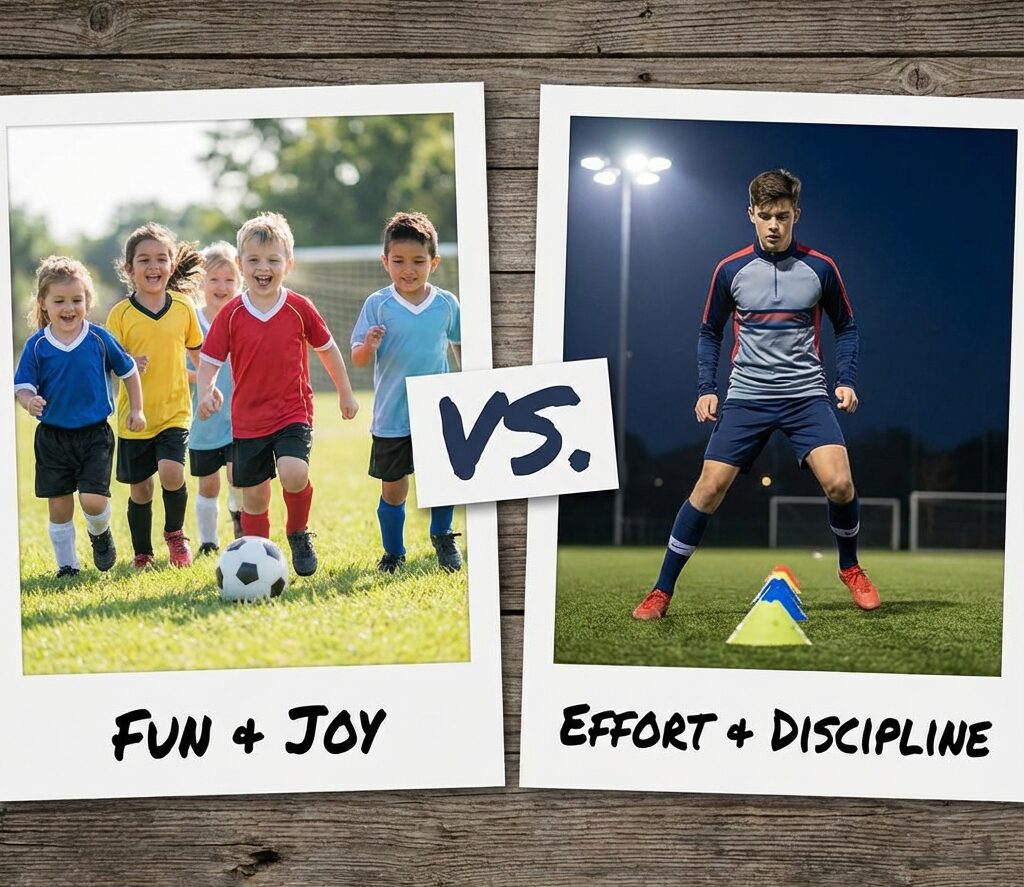
We here at USSP have become very conscious of two conflicting messages in U.S. youth soccer and parent and coaching circles: “Just let them have fun” and “It takes thousands of hours to reach an elite level.” These can seem outright contradictory, but in reality, both are true. There’s a real challenge here for families—and for the U.S. system— that I think we have to consciously address, to figuring out how joy and serious commitment can coexist instead of pulling in opposite directions.
What “fun” really means
Sometimes, for some youth players, especially the younger ones, the game really is purely for recreation and fun. But once it gets organized into teams, leagues and schedule, when parents say they want their kids to “just have fun,” they can’t really mean “never work hard” or “never be challenged.” A better way to look at it would be that their child feels excited to go to training instead of dreading it. Training sessions and games should be emotionally safe environments where mistakes are treated as part of learning, not reasons to be yelled at or benched. And, have adults involved all actively recall that relationships matter: friends, good coaches, a sense of belonging to something bigger.
Development experts consistently point out that enjoyment and intrinsic motivation are what keep kids in the sport long enough to improve. Players who feel ownership of their experience are more likely to practice on their own, experiment, and seek out challenges—all of which are prerequisites for high performance.
In other words, “fun” in youth soccer is not the opposite of development; it is the fuel for it.
What true elite development demands
At the same time, parents who dream of college, pro, or international levels are not wrong about the workload required. Studies of skill acquisition and technical training show that:
- Team training and weekend games alone rarely provide enough high-quality touches or intensity to reach a truly elite level.
- Small-sided games and individual sessions can multiply ball contacts compared to 11v11 formats, dramatically accelerating technical growth.
- Outside of formal training, top players often add regular “extra” work: wall passes, juggling, pickup games, and physical preparation.
For many families, the first step is understanding the different levels of competition and what each actually offers in terms of development.
Informal play is a big part of this picture. In many soccer cultures, kids grow up playing pickup several times a week, experimenting, taking risks, and solving problems with the ball under minimal adult control. That combination—structured coaching plus a huge diet of free play and self-driven training—is what tends to produce the world-class outliers.
The uncomfortable truth for U.S. families: reaching the very top requires a sustained commitment of time and energy that most recreational or even “select” environments do not provide on their own.
Join U.S. Soccer Parent
Free for every soccer parent.
Save articles, get the free newsletter, and find guidance tuned to your state, your kids' ages, and the pathway your family is on.
The U.S. gap: “elite” branding vs. truly elite pathways
Here is where the American system complicates the fun vs. elite conversation. At the broad population level, the U.S. still lacks a deep, coherent network of truly elite programs capable of consistently producing top international players. Many “elite” programs are primarily businesses, selling high-cost competition, travel, and branding more than a genuinely world-class development environment. The culture often pushes families toward early selection and heavy travel before kids have built a strong technical base or even decided how serious they are. Because parents fund so much of youth soccer, clubs face powerful incentives to keep as many kids “in the system” at high fees, rather than concentrating true elite work in smaller, heavily subsidized programs.
By contrast, countries that regularly produce top international talent usually combine robust community-wide participation with a smaller, clearly defined layer of heavily supported elite academies and talent centers. Joyful, accessible grassroots soccer is the foundation; intensive, carefully managed elite development is the tip of the pyramid.
The U.S. often skips that middle step, asking families to pay elite-level prices for environments that are neither particularly joyful nor truly elite.
How parents can reconcile joy and ambition
For individual families, the goal is not to choose “fun” or “elite,” but to stage them appropriately over time. A few practical principles can help.
- Protect joy early, then layer in seriousness.
- Ages 6–11 should be dominated by variety, free play, and basic technical work in environments that make kids love the ball.
- Competition and travel should expand gradually, not define the experience from day one especially with new registration and league changes that are reshaping age groups and travel demands.
- Make extra work playful, not punitive.
- Wall passes in the driveway, juggling challenges, and neighborhood pickup games can be framed as games, not chores.
- Fifteen to thirty minutes of focused, self-driven ball work on “off days” can add up to a powerful advantage without burning kids out.
- The environment is key.
- A so-called “elite” team that benches kids for mistakes and chases weekend trophies at all costs is more likely to kill joy and creativity than to produce elite players.
- Look for coaches who prioritize touches, decision-making, and development over rankings, especially before the teenage years.
Let seriousness be player-led.
When a child starts asking for more training, wants to watch games, and chooses soccer over other activities, that is a strong signal to support additional commitment. If the desire is mostly adult-driven, dial back the pressure and focus on widening their base of experiences. In the end, elite soccer can still be fun but it is a full-time commitment requiring a level of commitment and focus that goes far beyond even the highest levels of recreational soccer. When kids reach the right age and maturity level, it’s a conscious choice they have to make.
What the U.S. system needs to change
At a systemic level, the U.S. can do much more to accommodate both perspectives—mass participation and genuine elite development—without pitting them against each other. That means building a pyramid where fun and access at the base feed into, rather than compete with, serious pathways at the top:
Stronger, cheaper community and school programs.
- Local rec leagues, school-based play, and pickup initiatives should make it easy for any child to fall in love with the game and stay in it through adolescence. Some of these shifts are already visible in new trends in U.S. youth soccer, from more local options to better support for families
- Public investment and partnerships with pro clubs can reduce the financial burden on families, allowing fun to be the main driver at younger ages.
Clearer, smaller, and more honest elite layers.
- Instead of dozens of “elite” badges, each region should have a limited number of genuine elite centers—MLS Next academies, NWSL/USL-linked programs, and a few independent hubs—that are heavily subsidized and selected on merit.
- These environments must combine high training volume, sport science, and education support with a culture that still values enjoyment and creativity.
Cultural norms that celebrate both paths.
- The message to families should be: it is fully valid for a player to love soccer, play hard, and never chase an elite pathway—and also valid, later, to pursue a serious track when the player chooses it.
- Clubs and governing bodies can model this by highlighting stories of lifelong players, local coaches, and fans alongside pros and national team stars.
If the U.S. wants more truly elite players, it does not need to drain the joy out of childhood; it needs to build a system where joy is the on-ramp to serious work, not the alternative to it. For parents, that means guarding their child’s love of the game as fiercely as any college dream—and expecting their clubs and leagues to do the same.
I had a very interesting conversation recently with a youth coach who has an idea on how the U.S. could develop a true, elite tier. We’ll write more about this in an upcoming blog.