Let’s Talk About Concussions in Youth Soccer
Protecting our kids on the soccer field has never been more important. When New Jersey Youth Soccer announced its partnership with HitCheck, it marked a meaningful step forward for youth player safety—and it resonated deeply with us as parents whose son suffered a significant concussion while playing soccer.
This page is meant to be an easy, parent‑friendly guide to concussions in youth soccer: what they are, what to watch for, how the game is changing around heading, and where a tool like HitCheck fits into the picture.
At a Glance: What Parents Should Know
Concussions can happen in soccer from more than just heading the ball—collisions, falls, and whiplash‑type movements are all common causes.
Kids’ brains are still developing, so even “mild” concussions deserve serious attention and proper recovery time.
U.S. soccer organizations have introduced heading limits and concussion procedures to make the game safer, but parents still play a critical role in noticing symptoms and speaking up.
Sideline tools like HitCheck give coaches and families quick, objective information, but they never replace evaluation by a qualified healthcare professional.

Our Family’s Story
When our son’s concussion happened, we found ourselves navigating a maze of uncertainty. He was playing in Spain, where there was less awareness about diagnosing concussions in youth soccer, and he was not properly evaluated until he came back to the United States on a visit. By then, it was clear that the injury was more serious than anyone first realized.
His recovery protocol lasted almost two months and affected everything from school to social life and sleep. Like thousands of other families, our biggest questions were: How do we know if it’s safe for him to keep playing? What subtle warning signs might we be missing? How do we balance his love for soccer with his long‑term health?
That experience is the reason this topic—and tools that help parents and coaches—matter so much to us.
Concussions in Youth Soccer: The Bigger Picture
Concussions are a common concern across youth sports, and soccer is no exception. Young athletes are especially vulnerable because their brains and bodies are still maturing, and their symptoms can sometimes be subtle or delayed.
In soccer, concussions often happen through:
Player‑to‑player contact (collisions, elbows, clashes of heads).
Falls to the ground or whiplash‑style movements.
Ball‑to‑head impacts, especially on poorly timed or unexpected headers.
Undiagnosed or poorly managed concussions can contribute to longer‑term problems with concentration, school performance, mood, and overall well‑being. That’s why many leagues now emphasize “when in doubt, sit them out” and encourage parents and coaches to err on the side of caution.
Join U.S. Soccer Parent
Free for every soccer parent.
Save articles, get the free newsletter, and find guidance tuned to your state, your kids' ages, and the pathway your family is on.
Current Heading and Safety Context in Youth Soccer
Over the last several years, U.S. soccer organizations have moved toward more conservative rules around heading for younger age groups to reduce head‑impact exposure.
Key themes you’ll see across many leagues and clubs include:
No heading allowed for the youngest age groups (often through U11).
Strict limits on heading in training for early middle‑school ages.
A focus on teaching proper heading technique only when players are physically and developmentally ready.
Clear concussion procedures for tournaments and league play, including removal from play and follow‑up recommendations when a concussion is suspected.
These rules are not identical everywhere, but the trend is the same: reduce unnecessary heading and repeated head impacts in the younger years, and treat any suspected concussion with urgency and care.
Even with these policies, most concussions still happen from contact and collisions, not from controlled, well‑taught headers. That’s why awareness, communication, and careful monitoring remain just as important as the rules themselves.
Concussion Basics for Soccer Parents
You do not have to be a doctor to notice when something is “off” with your child after a hit or a fall.
Common concussion signs and symptoms in kids and teens can include:
Headache or pressure in the head.
Dizziness, balance problems, or feeling unsteady.
Confusion, appearing dazed, or having trouble following instructions.
Sensitivity to light or noise.
Nausea or vomiting.
Difficulty concentrating, remembering, or doing schoolwork.
Irritability, mood changes, or unusual emotional responses.
“Not feeling right” or “just different” compared to normal.
What parents should do if a concussion is suspected:
Remove your child from play immediately—do not let them “try to finish the game.”
Monitor them closely over the next hours and days for worsening symptoms.
Seek evaluation from a healthcare professional experienced with concussions.
Follow a step‑by‑step return‑to‑school and return‑to‑play plan, progressing only when symptoms stay stable or improve.
Avoid rushing back into full contact or heading until a medical provider clears them.
No app, checklist, or online guide can officially diagnose a concussion or clear your child to return. Those decisions belong with medical professionals. But the more informed you are as a parent, the better you can advocate for your child.
What HitCheck Brings to the Sideline
Traditional sideline checks often rely heavily on subjective observations and memory: “Does he look okay?” “Did she answer that question right?” In the stress of the moment, that can leave parents and coaches uncertain about what they’re really seeing.
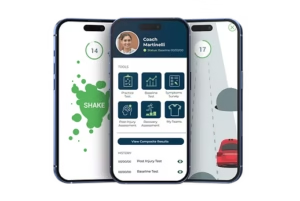
HitCheck is a mobile tool designed to make sideline assessments more objective and more consistent. In just a few minutes on a smartphone or tablet, players complete a series of interactive tasks that turn established neurocognitive tests into simple, game‑like challenges.
HitCheck is built to:
Measure key brain functions that can be affected by concussion, such as memory, attention, reaction time, balance, and problem solving.
Compare baseline scores (taken when an athlete is healthy) to post‑impact scores so that changes are easier to see and discuss.
Include a symptom checklist that helps track how a player feels over time, from the day of injury through recovery.
Give trainers and healthcare professionals quick access to structured data that can support their clinical judgment and return‑to‑play decisions.
For families, the benefit is an extra layer of objective information in a moment that otherwise feels very emotional and uncertain. It does not replace medical evaluation, but it does provide a clearer picture than “they seem okay” or “they say they feel fine.”
Why the NJ Youth Soccer–HitCheck Partnership Matters
New Jersey Youth Soccer’s partnership with HitCheck signals a commitment to bringing better tools and standardized practices to the sidelines. Instead of each team or parent doing something different, this type of partnership encourages a consistent approach to how suspected concussions are recognized, documented, and followed up.
For parents, that means:
Greater confidence that your child’s club has access to a formal sideline assessment tool.
Better communication between coaches, trainers, and medical providers when an injury happens.
A culture that values long‑term brain health over short‑term wins or playing time.
This partnership is not just about technology—it’s about raising the overall standard of care for young players and reminding everyone that safety comes first.

How This Empowers Families
For parents like us, knowing there is an official, organization‑backed tool on the sideline changes the conversation. Instead of relying only on instinct or on a quick “How many fingers am I holding up?” test, we have a process that captures how a player’s brain is actually functioning in that moment and how that compares to their normal.
That doesn’t make concussion decisions easy, but it does make them more informed. It also reinforces an important message to kids: if you speak up when something feels wrong, the adults around you have tools and support to help.
Ultimately, our children’s long‑term health is more important than any single practice, game, or season. Partnerships like NJYS and HitCheck are one part of a bigger shift in youth sports toward evidence‑based safety, transparency, and putting players first.
Original Press Release
Pioneering the Future of Brain Health in Sports with AI-Powered Screening Technology
New Jersey Youth Soccer, representing more than 120,000 players ages 5 to 19, today announced a strategic partnership with HitCheck, a leading mobile app that monitors athletes’ cognitive performance and screens for signs of concussion.
HitCheck transforms standardized neurocognitive testing into a fast, engaging seven-minute mobile assessment that can be completed on a smartphone or tablet. The test evaluates nine key brain functions commonly affected by concussions. When a head injury is suspected, athletes complete a post-injury test, which is compared against their personal baseline scores to help inform medical decisions. A 22-question symptom survey is also included to track recovery progress.
“Our vision is to create a sports landscape where brain health screening is a priority across all levels of play,” said Mike Piha, CEO and Co-Founder of HitCheck. “Partnering with New Jersey Youth Soccer, one of the largest youth soccer programs in the country, sends a powerful message about the importance of protecting young athletes from the long-term impacts of sports-related concussions.”
Through this partnership, NJ Youth Soccer and HitCheck reaffirm their shared commitment to athlete safety, equipping trainers and healthcare professionals with real-time data that supports early detection, objective decision-making and effective return-to-play protocols.
“This partnership enhances our ability to promote player safety and long-term brain health by leveraging HitCheck’s quick and easy concussion assessment app,” said Evan Dabby, CEO of NJ Youth Soccer. “We are proud to make HitCheck the Official Sideline Concussion Test of New Jersey Youth Soccer as part of our ongoing commitment to keeping athletes safe.”
To find out more information about New Jersey Youth Soccer or to contact us directly, please email communications@njyouthsoccer.com. Also make sure to follow us on social media: @NJYouthSoccer
About HitCheck
HitCheck digitizes neurocognitive testing methods using AI, delivering short mobile assessments that help detect changes in brain performance following potential concussions. Each test measures areas such as memory, reaction time, balance, and executive function. With subscribers in six countries, HitCheck partners with organizations including Stanford University, Iowa State University, Howard University, Baylor Scott & White Health, American Youth Football, and the NFL Alumni Association. Learn more at hitcheck.com/how-it-works or contact info@hitcheck.com.