
College/University Overview
College/University Soccer Overview
College soccer in the U.S. now sits at the intersection of three big realities for teen players: the dream of playing at the next level, the hard math of roster spots and scholarships, and the long‑term need for a degree and a healthy relationship with the game. For most families, the smartest approach is to treat college soccer as a planning project with multiple viable options rather than a single all‑or‑nothing bet on Division I.
What “college soccer” really means
College soccer is not one thing; it is a collection of different competitive tiers, institutional types, and academic environments that all use soccer as part of campus life.
- NCAA Division I, II, and III, plus NAIA and junior colleges (JUCO), all offer structured college soccer with different rules, scholarship models, and recruiting cultures.
- For the vast majority of teen players, the primary value of college soccer is a combination of education, daily competitive sport, and a healthy bridge into adult life, with “going pro” as a possible upside rather than the central plan.
The Division I dream: odds, reality, and fit
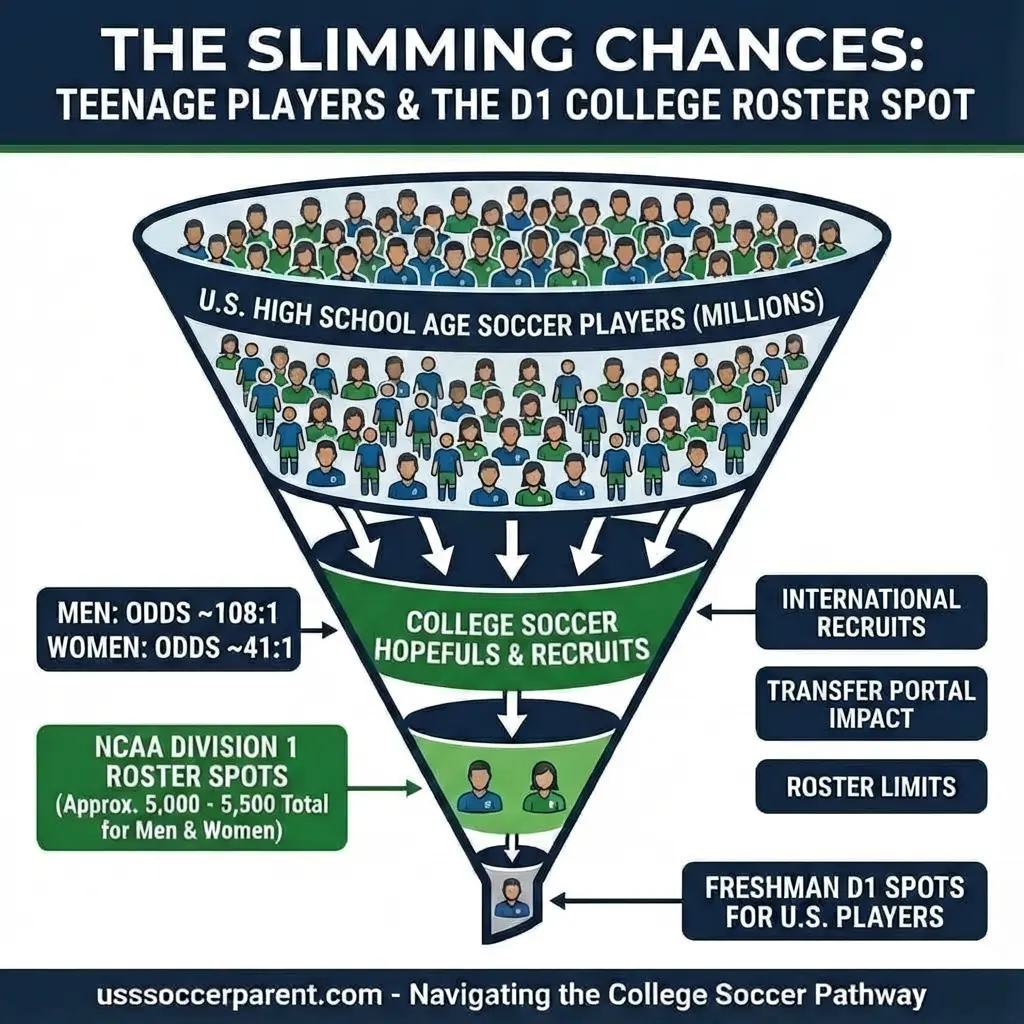
Division I is still the most visible level and carries the highest concentration of professional‑track talent, but it is also where the math is now toughest for U.S. teenagers.
- The overall number of serious teen prospects in club and high school keeps growing, while D1 roster spots at each program are effectively capped and scholarship budgets remain limited.
- Soccer is an equivalency sport: even at D1, many rostered players receive partial or no athletic aid, so the odds of “playing in college somewhere” are meaningfully higher than the odds of landing a heavily funded D1 scholarship.
- International recruiting, older gap‑year players, and the transfer portal mean a rising share of D1 rosters is filled by 19‑ to 22‑year‑old athletes who already have academy or college experience, making it harder for 17‑ and 18‑year‑old U.S. high‑school‑age players to win spots and money.
For a teen who still wants to aim at D1, the profile has shifted: impact at a high‑level club (ECNL, GA, MLS NEXT or equivalent), strong highlight video, exposure at showcases and ID events, and academic readiness are now basic expectations rather than differentiators. A growing number of serious candidates also add a structured extra year in elite club, USL pathways, or gap‑year environments to match the age and physical maturity of the players they are competing against.
Join U.S. Soccer Parent
Free for every soccer parent.
Save articles, get the free newsletter, and find guidance tuned to your state, your kids' ages, and the pathway your family is on.
Strong options beyond Division I
A key message for families is that Division II, Division III, NAIA, and JUCO are not “consolation prizes.” They are alternative routes that often offer better odds of making a roster, more playing time, and comparable or even better total financial packages once academic and need‑based aid are included.
- Division II blends serious soccer with partial athletic scholarships that can be stacked with academic money, making it attractive for “D1‑bubble” players who want a real chance to play early in their careers.
- Division III does not offer athletic scholarships but can deliver significant academic and need‑based aid; at top programs, the playing level is high, and the culture often allows more balance between soccer, academics, and broader campus life.
- NAIA programs sit in a middle ground that, on the field, frequently resembles solid D2 or upper‑tier D3 sides, with up to 12 equivalency scholarships per team and more flexible recruiting calendars that can help late‑developing or under‑recruited players.
- JUCO (NJCAA) can be a powerful two‑year launchpad, particularly for players who need to grow physically, improve grades, or reset their recruiting market; at top programs, scholarship packages can be substantial and the level of play intense, with many players using JUCO as a bridge to D1 or D2.
For most teen players, opening the search to all of these levels materially raises the chance of finding the right match on three axes that matter: playing role, academic fit, and total cost to the family.
College soccer and the path to pro
College soccer still connects to professional opportunities, but its role has changed. Be aware that the share of players who move from any college level into major professional leagues like MLS and NWSL is well under 2%, and an increasing portion of pros now come through professional academies and leagues such as MLS NEXT Pro and USL rather than college.
- Division I retains the strongest correlation with pro outcomes; many MLS and NWSL players still come from high‑end D1 programs.
- Players do move from D2, D3, NAIA, and JUCO into MLS, NWSL, USL, and overseas environments, but the probability is lower and the pathway more individual, typically built on standout college performance plus summer competition in leagues like USL League Two or NPSL.
- At any level, what really matters for professional chances is performance against strong opposition, physical and tactical readiness, and visibility in environments where professional clubs actually scout, including USL academies and MLS NEXT Pro.
For families, the practical takeaway is that each step down from D1 generally lowers the baseline odds of a pro contract but does not close the door entirely for an exceptional, driven player. The safer planning assumption, however, is that college soccer should support a long‑term life path in which the degree and overall experience remain valuable even if a pro contract never arrives.
Building a realistic plan for teen players
Because the landscape is crowded and changing, planning early and revisiting decisions regularly can relieve pressure and improve outcomes.
- In early high school, the goal is broad: develop as a well‑rounded player and student, keep options open across multiple college levels, and learn the basic recruiting rules and timelines.
- By the middle of high school, families can start to narrow targets based on updated information about level of play, academic profile, and financial reality, treating D1, D2, D3, NAIA, and JUCO as parallel tracks rather than a simple ladder.
- Throughout, club soccer, showcases, and ID camps are the central recruiting environments, with high school soccer offering social value, leadership opportunities, and additional game film but playing a secondary role in evaluation for most college staffs.
A practical planning framework for you might include:
- Clarifying priorities: how important are immediate playing time, academic prestige, campus size, and geographic preference relative to chasing the highest possible division label.
- Tracking development honestly: using feedback from trusted coaches and objective benchmarks (minutes at current level, physical data, interest from comparable programs) to calibrate which levels are realistic stretch, target, and safety options.
- Managing exposure deliberately: targeting events and communications toward schools that align with both soccer level and academic profile, instead of sending generic messages to dozens of programs that are not a fit.
When treated this way, college soccer becomes less of a one‑time verdict on a player’s worth and more of a structured, evolving family project that can adjust as the athlete and the landscape change.