
College soccer in the U.S. now sits at the intersection of three big realities for teen players: the dream of playing at the next level, the hard math of roster spots and scholarships, and the long‑term need for a degree and a healthy relationship with the game. For most families, the smartest approach is to treat college soccer as a planning project with multiple viable options rather than a single all‑or‑nothing bet on Division I.
College soccer is not one thing; it is a collection of different competitive tiers, institutional types, and academic environments that all use soccer as part of campus life.
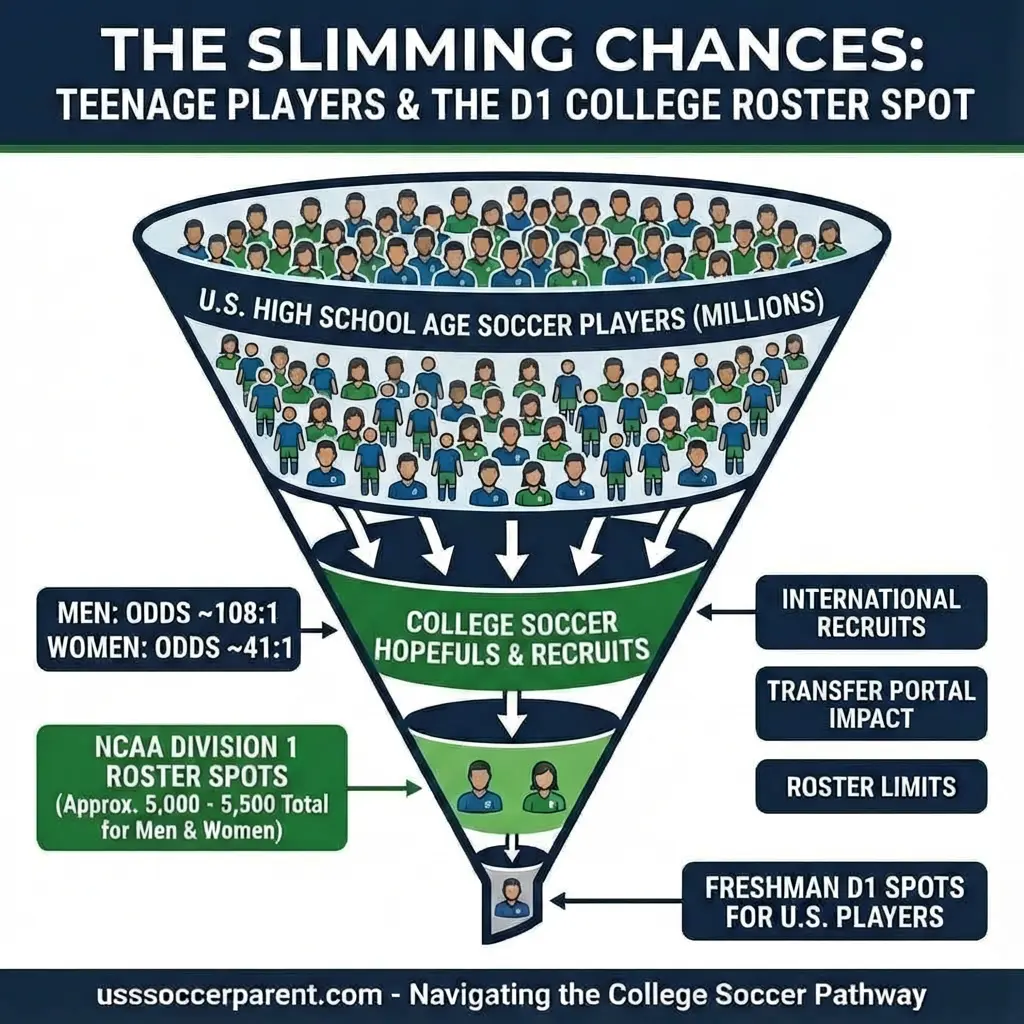
Division I is still the most visible level and carries the highest concentration of professional‑track talent, but it is also where the math is now toughest for U.S. teenagers.
For a teen who still wants to aim at D1, the profile has shifted: impact at a high‑level club (ECNL, GA, MLS NEXT or equivalent), strong highlight video, exposure at showcases and ID events, and academic readiness are now basic expectations rather than differentiators. A growing number of serious candidates also add a structured extra year in elite club, USL pathways, or gap‑year environments to match the age and physical maturity of the players they are competing against.
A key message for families is that Division II, Division III, NAIA, and JUCO are not “consolation prizes.” They are alternative routes that often offer better odds of making a roster, more playing time, and comparable or even better total financial packages once academic and need‑based aid are included.
For most teen players, opening the search to all of these levels materially raises the chance of finding the right match on three axes that matter: playing role, academic fit, and total cost to the family.
College soccer still connects to professional opportunities, but its role has changed. Be aware that the share of players who move from any college level into major professional leagues like MLS and NWSL is well under 2%, and an increasing portion of pros now come through professional academies and leagues such as MLS NEXT Pro and USL rather than college.
For families, the practical takeaway is that each step down from D1 generally lowers the baseline odds of a pro contract but does not close the door entirely for an exceptional, driven player. The safer planning assumption, however, is that college soccer should support a long‑term life path in which the degree and overall experience remain valuable even if a pro contract never arrives.
Because the landscape is crowded and changing, planning early and revisiting decisions regularly can relieve pressure and improve outcomes.
When treated this way, college soccer becomes less of a one‑time verdict on a player’s worth and more of a structured, evolving family project that can adjust as the athlete and the landscape change.
Stay up to date with the latest youth soccer news. Join our community today!