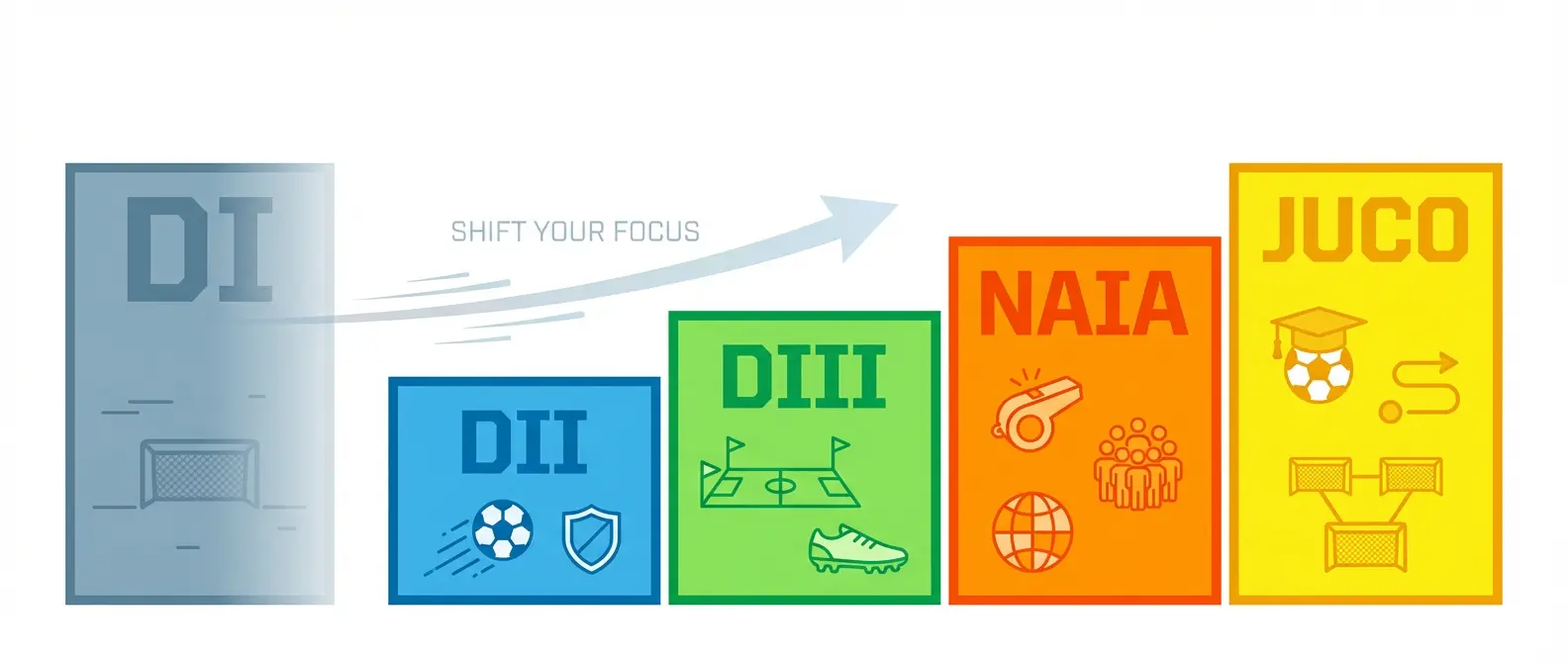
Recently, we wrote a blog about the diminishing odds for U.S. teens to land on college DI rosters. It sparked quite a lot of conversation and some parents pointed out that DII, DIII, NAIA and JUCOs all deserve consideration. Division I is not the only path to meaningful college soccer or athletic money. For many American teens, these options can offer better odds of making a roster, more playing time, and comparable overall aid once academics and need-based packages are included.
Why “DI-or-bust” hurts families
The core problem is that as we wrote in the previously referenced post, demand for DI spots massively exceeds supply, especially as rosters globalize and coaches lean on older transfers. That leaves a lot of good teenage players—club and high school—stuck chasing a shrinking pool of offers while ignoring levels where they might actually thrive.
At the same time, the scholarship model in soccer is largely equivalency across DI, DII, NAIA, and NJCAA: coaches slice limited totals into partials. The biggest “wins” often come from stacking a smaller soccer award with strong academic and need-based aid at non‑DI schools.
Division II: “Hidden DI” and real money
NCAA Division II is often closer in on‑field level to mid‑major DI than most families realize, and the scholarship rules allow meaningful aid.
- DII men’s soccer is allowed up to 9.0 equivalency scholarships, and women’s DII up to 9.9, per program.
- Coaches nearly always split those funds; a typical men’s roster of ~30–32 players might have 18–22 athletes on partial money rather than 9 full rides.
From an American teen’s standpoint, the physical and tactical bar is still high (top DIIs recruit a lot like mid‑major DIs), but the path to a roster and partial scholarship is slightly wider than DI, especially if you are an impact player in a solid regional club rather than a national‑level star. Moreover, many DIIs sit in regions with fewer internationals, so U.S. players sometimes face less head-to-head competition from 20‑year‑old foreign pros than at DI.
When DII is framed correctly—strong soccer, partial athletic money, stackable academic aid—it can be the best fit for players who are “DI bubble” in ability but want a real chance to play and contribute early.
Division III: no athletic money, but real value
NCAA Division III cannot offer athletic scholarships, which causes a lot of families to write it off too quickly. That misses the way DIII schools actually package aid.
- D3 programs offer zero athletic scholarships, but often provide generous academic and need-based aid, especially at smaller private colleges.
- There are far more DIII teams than DI teams, which mathematically increases the chances of finding a roster spot, and rosters are typically composed of a higher proportion of U.S. players than at DI.
For teen players:
If you have strong grades, test scores, or a compelling personal story, a DIII offer can end up cheaper out-of-pocket than a small partial at a DI or DII that does not stack as much academic money.
The soccer is serious at the top end (NESCAC, UAA, SCIAC, etc.), but the culture usually allows more balance between sport, academics, and campus life, which suits many student‑athletes better than a fully professionalized environment.
DIII is especially attractive for players whose soccer talent is very good but whose **academic profile is elite—you are selling a coach on the fact that you help both on the field and in the classroom and retention numbers.
NAIA: flexible rules, solid soccer
NAIA programs are often overlooked but can be excellent, particularly for late developers or players who need more flexibility in admissions or recruiting timing.
- NAIA men’s and women’s soccer are both allowed up to 12 equivalency scholarships per team, typically spread across rosters of about 25–30 players.
- NAIA schools operate under looser recruiting calendars than the NCAA, so coaches can contact prospects earlier and more frequently, which can help late bloomers or players without heavy showcase exposure.
On the field, perhaps surprisingly to a lot of people, many top NAIA teams look like strong DII or low‑major DIII sides. For U.S. teens, NAIA can be a second chance if your DI/DII recruiting started late or grades/test scores are a bit short for selective NCAA schools.
International presence is growing here too, but there are many regional programs that still recruit heavily from local and state youth clubs, which keeps the odds more manageable for domestic players.
Junior college (NJCAA/CCCAA): a strategic launchpad
Junior colleges are one of the most under‑appreciated tools American players have, especially those needing time to grow physically, repair academics, or get film against college‑age opponents.
- NJCAA DI men’s programs can offer **up to 24 equivalency scholarships**, with average rosters under 20 players, so it is one of the few environments where a “full” or near‑full soccer package is genuinely common.
- The level at top JUCOs is intense; many rosters are stacked with internationals and DI‑caliber players hoping to move up after 1–2 years, but there is more roster churn, which creates openings for driven U.S. teens.
JUCO is especially powerful for players who:
- Are a bit late physically or technically and need a 2‑year runway before DI/DII.
- Need to fix GPA or credits to meet NCAA/NAIA requirements.
- Want to use a strong JUCO season and video to re‑enter the recruiting market with proof they can compete at college speed.
A well‑chosen JUCO followed by a transfer can turn an “unrecruited” high school senior into a legitimate DII, DI, or strong NAIA prospect.
Realistic odds and how teen players should think
The big picture:
- Roughly 7–8%** of U.S. high school age players end up playing college soccer at any level (NCAA, NAIA, NJCAA).
- Only about **1–2%** reach DI, but several additional percentage points land in DII, DIII, NAIA, or JUCO, often with some form of athletic or stacked aid.
For a teenager in club and/or high school soccer, the practical takeaways are to treat DII, DIII, NAIA, and JUCO as parallel targets, not consolation prizes. The real goal is the right combination of level, playing time, academic fit, and total financial package. Your odds of making a roster and getting at least some aid are materially higher once you open the funnel beyond DI, especially if you are willing to look outside your immediate region and consider different types of schools.
Repositioning the family mindset
For your audience of parents and players, the message is that “college soccer success” should not be defined by a logo but by:
- Is the player developing, playing meaningful minutes, and enjoying the environment?
- Is the degree respected and aligned with life after soccer?
- Does the total cost (after all aid) make long‑term financial sense for the family?
When those questions lead honestly to a DII, DIII, NAIA, or JUCO locker room instead of a DI crest, that is not a failure of the pathway. That is the system working as it should for the vast majority of American teen players who love the game and want it to be part of, not all of, their college story.

Ron Stitt
Co-Founder, U.S. Soccer Parent