

It sounds like clickbait, but it is real. A small number of exceptional girls are earning spots on boys’ MLS NEXT teams, and their experiences reveal a lot about where American youth development is headed.
Most parents think of MLS NEXT as a boys-only pathway that feeds MLS academies and, eventually, MLS NEXT Pro and MLS first teams. That picture is of course mostly accurate—but it leaves out a growing group of trailblazing girls who have stepped into this environment and thrived.
MLS NEXT’s rules allow clubs to roster girls if the staff believes that is the right developmental environment for the player. In practice, that means a very small number of elite girls—usually in the younger age groups—train and compete with boys’ MLS NEXT squads while remaining part of the overall girls’ pathway through ECNL, Girls Academy (GA), and the national teams.
The Thompson sisters: MLS NEXT to the USWNT
No story has brought more attention to this pathway than that of Alyssa and Gisele Thompson. Playing for Total Futbol Academy in Los Angeles, the sisters became the first girls registered in MLS NEXT and competed on TFA’s boys teams. That experience pushed their speed of play, physicality, and decision-making to a level that quickly separated them from their peers on the girls’ side.
Alyssa’s rise was astonishingly fast. She moved from TFA’s MLS NEXT teams to the U.S. Under-20s and then made her senior USWNT debut as a teenager, while still in high school. She was drafted No. 1 overall by Angel City FC in 2023, became one of the youngest NWSL stars, and in 2025 earned a transfer to Chelsea, joining a wave of USWNT players heading to Europe.
Gisele followed a similar route, logging years of training and competition against boys at TFA before signing her own professional deal with Angel City as a teen defender. She has represented the United States at youth World Cups and Pan American Games, and is already viewed as a major USWNT prospect while extending her NWSL contract through 2028. For both sisters, MLS NEXT was not a replacement for the girls’ game but a powerful accelerator on the way to the highest levels of women’s soccer.
Loradana Paletta: breaking barriers in New York
On the East Coast, 14‑year‑old midfielder Loradana Paletta is rewriting expectations in a different MLS academy. In 2024 she became the first girl in U.S. history to make a boys’ MLS academy team, earning a place on New York City FC’s U15 boys squad—and remaining the only girl on the roster. Her technical quality and ability to ride challenges against academy boys her age have already earned her a call‑up to the USWNT U17 camp, where she is one of the youngest players in the pool.
Brands have taken notice as well. Italian sportswear company LOTTO signed Paletta to its first U.S. NIL partnership, explicitly framing her as a future face of the women’s game and highlighting her willingness to play “fearlessly against boys.” Like the Thompsons, she shows how a carefully managed stint in boys’ MLS NEXT can coexist with national‑team ambitions on the girls’ side.
Why would a girl play with boys?
For parents, the key question is “Why?” Why would a club place a top girl in a boys’ MLS NEXT environment rather than leaving her in ECNL or GA full‑time?
Coaches and technical directors consistently point to environment. At younger ages, the speed of play and physical demands in high‑level boys’ matches can challenge an exceptional girl in ways that typical girls’ competition cannot match week‑to‑week. That pressure forces quicker decisions, sharper first touches, and constant adaptation—skills that translate directly back to the girls’ game when she joins GA, ECNL, or youth national teams.
Importantly, this is not a mass‑market solution. Only a tiny percentage of girls will be physically, technically, and mentally prepared to compete with academy‑level boys, especially beyond the U14 age range. Even at the professional level, U15 boys’ teams have beaten senior women’s national teams in scrimmages, a stark reminder of how wide the physical gap becomes after puberty. For most high‑level girls, a top ECNL or GA team will remain the best competitive home by ages 15–16.
The new alliance with Girls Academy
The landscape is also changing structurally. In late 2024, MLS NEXT announced a strategic alliance with the Girls Academy. The partnership focuses on aligning technical standards, sharing resources, and integrating GA teams into MLS NEXT events, including adding a girls’ competition to the prestigious Generation adidas Cup.
For families, this matters in two ways. First, it clarifies that MLS NEXT sees the girls’ side as a parallel, not secondary, pathway, even if the competitions are branded separately. Second, it means more clubs will house both MLS NEXT boys and GA girls under one roof, making it easier for an exceptional girl to occasionally train or even play with boys while still anchoring her long‑term development and recruiting exposure on the girls’ side. In other words, the Thompson‑style hybrid path may become easier to manage, but it will remain reserved for outliers.
Other current girls in MLS NEXT
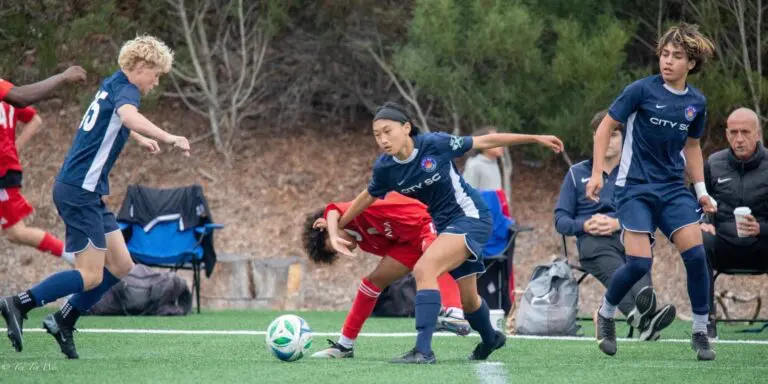
Image: Josephine Loke, City SC Carlsbad
Beyond the headline names, there is a growing list of younger girls currently competing in MLS NEXT boys’ environments. Defender Josephine Loke, listed by City SC Carlsbad in a club announcement as a 2011 player selected for the MLS NEXT program, represents a particularly rare example of a girl defender earning a spot in a boys’ MLS NEXT back line, where physical demands and aerial duels are especially intense.
Midfielder Emery Aguilar plays for Total Futbol Academy’s 2011 boys in U14 MLS NEXT while also attracting U.S. Women’s Soccer Talent ID attention. Another midfielder, Angelica Alzugaray, is highlighted by Cincinnati United SC as “competing at the U15 MLS NEXT level” for CUP 2011 while earning call‑ups to the U.S. U‑15 Girls National Team. In California, Rio Mesa’s Natalia Bautista has been profiled as a Ventura County Fusion player using the club’s MLS NEXT program as her primary development platform, illustrating another girls‑on‑boys case on the West Coast.
Parent Takeaways
For most readers, the headline “Girls in MLS Next?!” will come as a genuine surprise. The reality is nuanced: yes, girls can and do appear on MLS NEXT rosters, but only rarely, and almost always as a deliberate, individualized developmental choice for a highly advanced player. Their long‑term careers—whether Alyssa and Gisele heading to the USWNT and top professional clubs, or Loradana rising through the USYNT ranks—still flow back into the women’s game.
For parents of talented girls, the practical questions are less about chasing a boys’ MLS NEXT roster spot and more about fit:
- Is my daughter dominating her current environment technically, tactically, and physically?
- Is the club genuinely committed to both the boys’ and girls’ sides, with a clear plan and support network if she trains with boys?
- How will this choice impact her visibility for college, NWSL, or national‑team pathways that still run primarily through ECNL, GA, and youth national‑team events?
The stories of the Thompsons, Paletta, Aguilar, Alzugaray, Bautista, Loke, and others show what is possible when a club, a family, and a player align around an ambitious but thoughtful plan. Girls in MLS NEXT are not a loophole or a publicity stunt; they are a sign that the American youth soccer system is slowly learning to flex around the needs of extraordinary players—girls included.
The other broader takeaway is the value of “playing up” as a way to challenge and accelerate development. I took our son who played MLS Next before going to Spain to an ID camp at Syracuse University when he was a high school freshman. There he competed against mostly juniors and seniors and looked lost on Day 1, shell-shocked by the pace and athleticism of the older boys. On Day 2, you could see how he quickly adjusted and started to hold his own. Because his club coach was also an assistant coach at a D1 College, he also had a chance to attend a couple of training sessions with the university boys when he was 15, with the same effect – almost immediate elevation of his game.
“Playing up” with bigger, stronger, faster players may not work for every child, but it is something to at least consider for all high-level players (girls and boys).

Ron Stitt
Co-Founder, U.S. Soccer Parent