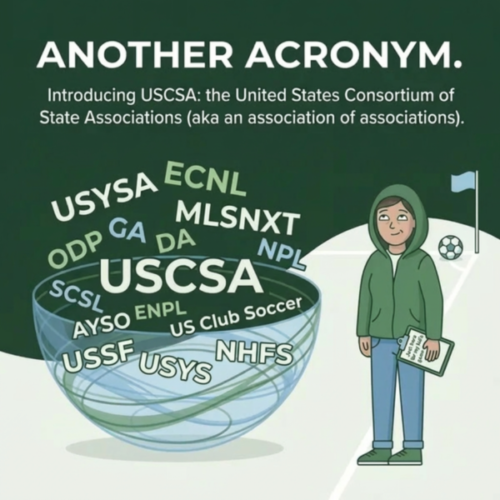
This is really an FYI for soccer parents, not anything of immediate strong relevance or concern, but when I heard about it (an announcement about the Florida state association joining)I couldn’t help but roll my eyes a bit. Every few months, American youth soccer seems to invent a new acronym. The latest entry is the United States Consortium of State Associations (USCSA), a network of US Youth Soccer state associations that have decided to formally collaborate with one another. An association of associations, LOL. 😂
Why was the USCSA created?
In theory, US Youth Soccer should be the natural place for state associations to coordinate. In practice, state associations operate with a lot of autonomy, and many of them face the same headaches including aging or inconsistent technology platforms, limited staff and marketing capacity, pressure to find new sponsorship and non‑dues revenue and a need to modernize policies and programs without a lot of in‑house expertise
So the USCSA is an attempt by a group of state associations to pool resources and share solutions. They talk about “shared services,” “efficiency,” and “modernization” because that is where their pain is: administration, technology, and finance. On that level, the logic is understandable. If ten states are going to build or buy a new registration system, or negotiate insurance, or design club‑support programs, there are obvious economies of scale in doing some of that together.
What does it actually do?
Importantly, the USCSA does not run leagues, cups, or showcases. It does not sit above state associations in a governance pyramid, and it doesn’t ask families to register with it directly.
Instead, it focuses on things like:
- Shared technology and operational tools
- Joint marketing and sponsorship efforts
- Common policy templates and standards
- A more unified voice in national discussions
In other words, this is mostly back‑office work. If it succeeds on its own terms, parents might notice better communication, smoother registration, slightly more consistent policies between states, or new sponsor‑funded programs. They are not going to be choosing between “joining USCSA” or some other league acronym.
Why I’m skeptical/bemused
That said, the very existence of the USCSA also tells a story about the system.
First, it underlines how fragmented U.S. youth soccer governance has become. The fact that state associations feel they need to “form an association of associations” suggests that the existing structures are not giving them the support or coordination they think they need. Instead of U.S. Soccer and US Youth Soccer clearly organizing the pyramid, we now have a growing web of parallel entities trying to solve pieces of the problem from different angles.
Second, every new organization comes with its own leadership, meetings, incentives, and survival instinct. Even if it starts as a pragmatic collaboration project, it will quite naturally want to justify its existence and grow its influence. Historically, that kind of institutional creep tends to protect existing arrangements more than it challenges them.
Third, the messaging around initiatives like this usually leans heavily on buzzwords—“unlocking potential,” “game‑changing collaboration,” “innovative solutions”—and lightly on specific, measurable commitments that matter to parents: lower fees, reduced travel, simpler pathways, clearer accountability.
From a parent perspective, it is fair to ask: is this really a missing piece, or is it another example of the system organizing itself to better serve organizations rather than families?
This is also happening against the backdrop of broader debates about how youth soccer should be organized in the United States.
Many parents and observers look at more centralized systems in countries like Spain and see clearer pathways, fewer overlapping platforms, and less redundant bureaucracy. In that light, a new consortium of state associations can feel like another sidestep: instead of simplifying the structure, we create a new coordination layer on top of the existing one.
At the same time, state associations are under real pressure. They compete with other sanctioning bodies and with independent leagues, and they live inside the same confusing ecosystem parents do. It’s not surprising that they are looking for ways to share tools, cut costs, and have more leverage when they sit down with vendors, sponsors, or national governing bodies.
So you can see the USCSA as both symptom and response: a symptom of a system that isn’t coordinated enough from the top, and a response from organizations trying to survive and adapt within that system.
For now, the USCSA is mainly an inside‑baseball story for administrators. Parents don’t need to add it to the long list of things they worry about, at least not for now.

Ron Stitt
Co-Founder, U.S. Soccer Parent