USL is finally committing to a vertically integrated, movement‑based system. Promotion and relegation across three professional tiers won’t instantly turn the U.S. into England, but it introduces a fundamentally more European logic.
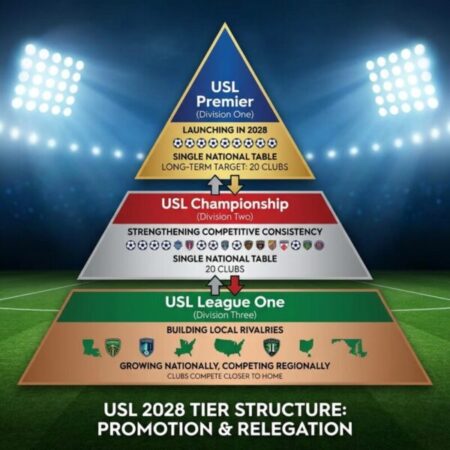
The United Soccer League’s announcement of USL Premier, a new Division I league slated to launch in 2028, is the most ambitious structural change in American pro soccer since MLS kicked off in 1996. USL Premier will sit above USL Championship and USL League One in a three-tier pyramid, with promotion and relegation planned across all three professional levels.
What USL Is Actually Proposing
USL Premier is designed as a single national league with a long‑term goal of 20 clubs. League president Paul McDonough has said the target for 2028 is 12–14 teams, with roughly eight or nine existing USL Championship clubs and five or six new or outside franchises. To be sanctioned as Division I, USL must satisfy U.S. Soccer’s Pro League Standards, which currently require (among other things) stadiums of at least 15,000 seats and substantial ownership net worth thresholds.
McDonough has been open that many strong USL clubs simply don’t fit that 15,000‑seat requirement today and that the league will push for more realistic standards that prioritize full, vibrant stadiums over arbitrary capacity numbers. At the same time, USL is in tense CBA talks with the USL Players Association, which has highlighted how many current players lack year‑round contracts, health insurance and truly professional wages—issues that must be addressed if a new “Premier” league is going to live up to the name.
What Fans And Insiders Are Saying
This story generated a surprising amount of interest from our audience. If you scroll through the early reaction on social media, a few themes jump out:
- Many expect only a small group of well‑resourced Championship clubs—especially those that own their stadiums and already behave like “big” clubs—to make the initial jump.
- Commenters repeatedly mention clubs like Louisville City as prototypes: strong crowds, club‑controlled venues, and full reserve/academy structures that look more like European setups than traditional American minor league teams.
- There is skepticism about how much true sporting merit will drive selection. A number of fans predict that early placement in USL Premier will be “mostly based on stadium agreements” and financial stability, not just league tables.
- Questions abound about what happens to USL League Two, whether it remains amateur, and how promotion will work if a club earns its way up on the field but doesn’t yet meet stadium or financial requirements. Some fans assume a European‑style approach where you simply aren’t promoted until you meet the standards, and no one is relegated above you that year.
- On the positive side, many lower‑division supporters are excited about USL League One becoming more regional, which could slash travel costs and make it easier for ambitious USL2 clubs to step up to the professional ranks while staying rooted in their communities.
In other words: enthusiasm about the vision, realism about the hurdles, and lots of practical “how will this really work?” questions.
This Is Still A Big Step In The Right Direction
From a U.S. Soccer Parent perspective, I share many of those questions—but I still see this as a net positive and an important milestone in the long evolution of American soccer.
First, USL is finally committing to a vertically integrated, movement‑based system. Promotion and relegation across three professional tiers won’t instantly turn the U.S. into England, but it introduces a fundamentally more European logic: performance matters, clubs can climb, and poor performance carries consequences. That alone changes how owners, coaches, and fans think about investment, development, and ambition.
Second, this structure doesn’t stop at the first team. As USL clubs plan for possible promotion or fight to avoid relegation, the incentive to build genuine academies, reserve teams, and local scouting networks grows dramatically. Over a decade, that mindset can pull more resources, coaching expertise, and long‑term planning down into the youth space—especially in markets outside the traditional MLS footprint.
Third, I view this as the beginning of a ten‑year project, not a 2028 switch‑flip. It is almost inevitable that some initial timelines will slip, some stadium projects will get delayed, and some ownership groups will discover the financial reality is harsher than the PowerPoint pitch. That’s normal. If, by the mid‑2030s, the U.S. has a functioning pro‑rel ladder from USL Premier down through League One, with real local rivalries and packed mid‑sized stadiums in 30–40 markets, that will be a huge win—especially for young players and their families.
USL, MLS And The Long‑Term Landscape
A lot of people are already speculating that the USL pathway will eventually “slot in” under MLS—that USL Premier is really just a de facto second division to MLS’s closed top tier. I don’t think that is the most likely outcome.
USL is clearly aiming for its new league to be sanctioned at the same Division I level as MLS, not below it. Early reporting explicitly frames USL Premier as a potential challenger at the top of the pyramid, not a feeder. Long term, there are a few possible destinations:
- Two co‑existing Division I leagues, differentiated by geography, style, or business model.
- A future merger once both sides see strategic value in combining their pyramids.
- Some hybrid arrangement where MLS continues as a closed league and USL operates an open system alongside it, with both drawing from overlapping but distinct fan bases and talent pools.
The American sports market is big enough—and fragmented enough—that more than one top‑tier soccer league is not unthinkable. Over time, the marketplace will answer whether fans, broadcasters, sponsors and players are willing to support two rival Division I ecosystems. For now, I’m rooting for USL to be ambitious, independent and successful rather than assuming it must inevitably become “MLS2.”
What It Could Mean For Families And Young Players
For parents of youth players, this is where the story gets interesting. A healthy, ambitious USL structure can create more professional environments closer to home, especially in mid‑sized and smaller markets. It can also offer clearer, multi‑step pathways from local amateur or academy teams into professional setups—not just via a handful of MLS academies. All this should increase demand for quality coaching, sports science, and player care at every rung of the ladder, because promotions and relegations will expose weak programs quickly.
None of that arrives overnight with a press release. It will be built, club by club, academy by academy, over years. But the direction of travel—toward an open, competitive, community‑rooted system—matches what many American families say they want from the game.
USL Premier is not a finished product; it’s a declaration of intent. There are legitimate concerns about labor standards, financial safeguards, and how much of the dream can be realized by 2028. Yet if we zoom out to a decade‑long horizon, this announcement looks like the start of something genuinely important: a more European‑style professional ecosystem that reaches down into youth development and gives American players, coaches and communities more ways to climb.
I’m choosing to be patient, ask tough questions—and root for it to succeed.

Ron Stitt
Co-Founder, U.S. Soccer Parent