
The Youth Player Pathway to MLS Academies
How Players Get Noticed by MLS Academies: A Parent’s Guide
For families interested in an MLS academy, the practical questions are straightforward: How do players get noticed? Which opportunities are legitimate? And what should parents consider before changing clubs or accepting an invitation?
Approach academy interest as a possible outcome of a player’s development, not a guaranteed sequence of steps. Focus first on an environment where your child receives good coaching, meaningful playing opportunities, and appropriate challenges rather than choosing a club solely for its promised connections.
This guide explains the routes through which players may be evaluated, the distinction between an MLS academy and an MLS NEXT team, and the questions to ask about trials, roster offers, and the commitment involved. The goal is to help your family evaluate opportunities with realistic expectations while keeping your child’s development, education, and enjoyment central to the decision.
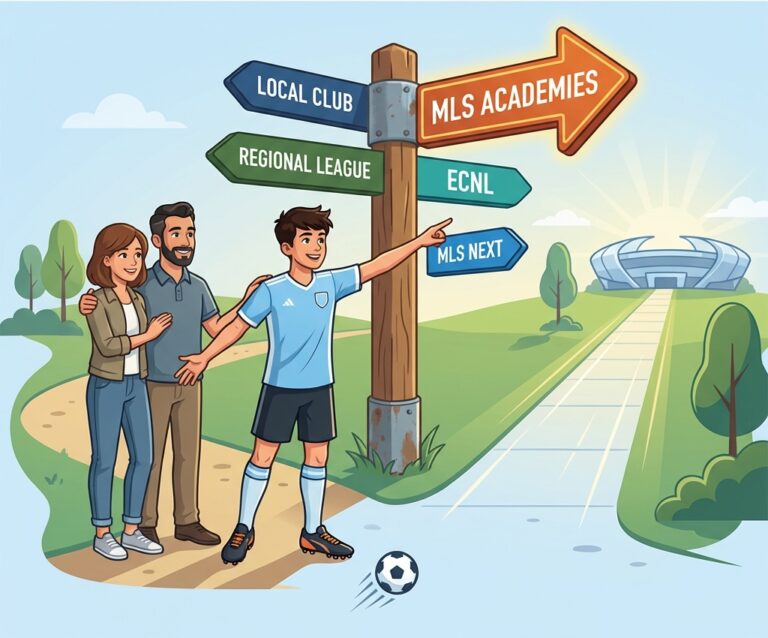
Understand the Difference Between MLS Academies and MLS NEXT
An MLS club academy and an MLS NEXT team are not interchangeable terms. MLS NEXT’s Homegrown Division includes both MLS club academies and non-MLS academies, so playing in that division does not necessarily mean a player has joined the youth academy of an MLS professional club.
MLS NEXT also operates an Academy Division, which includes additional teams from existing MLS NEXT clubs and newly admitted clubs. The word “Academy” in that division’s name should not be taken to mean every participating team belongs to an MLS professional club.
Before evaluating an opportunity, ask which organization runs the team, which competition and division it plays in, and whether any advertised connection to an MLS club is a formal affiliation. Ask what that relationship actually provides rather than treating it as a promise of selection or future promotion.
For a broader explanation of the league structure, read our MLS NEXT guide. Here, the focus is how players may be identified and evaluated for an MLS club’s own academy.
Join U.S. Soccer Parent
Free for every soccer parent.
Save articles, get the free newsletter, and find guidance tuned to your state, your kids' ages, and the pathway your family is on.
How MLS Academies Identify and Evaluate Players
Recruitment procedures vary by academy, so start with the individual club’s official guidance rather than assuming every academy holds open tryouts. For example, FC Dallas Academy accepts player information for review but states that trials are by invitation, while Inter Miami CF Academy reviews submitted profiles and contacts selected players according to its criteria and needs.
Players may also be evaluated at competitions and scouting events. MLS NEXT events provide opportunities for professional, national-team, and college scouts to watch players, but families should treat participation as an opportunity to be evaluated, not a promise of academy interest.
If an academy accepts player submissions, follow its instructions and provide the information it requests. Ask your child’s current coach for an honest assessment of readiness and whether they can provide a useful reference; avoid paying for extra exposure without understanding who will evaluate players and what the opportunity involves.
Before registering for an event or responding to an invitation, confirm it directly with the academy through its official website or published contact details. Clarify whether it is a camp, identification session, training invitation, or roster trial, and ask about eligibility, costs, supervision, and next steps.
What Academies Look For
Look beyond goals, speed, or physical size when discussing your child’s readiness. MLS NEXT emphasizes technical quality, decision-making, tactical awareness, and long-term growth in its development environment.
Ask your child’s coach for specific feedback: Can your player receive and use the ball under pressure, recognize passing options, move effectively without the ball, and adapt when the game changes? Use that feedback to identify development priorities rather than treating any one strength as proof that an academy move is the next step.
Readiness also deserves a conversation beyond soccer ability. Consider how your child responds to feedback, handles setbacks, and feels about a more demanding training schedule alongside school and family life. Before accepting an opportunity, ask the academy what it expects and how it supports players in meeting those expectations.
What an Academy Offer Means
Evaluate an academy offer as a specific development opportunity, not a promise of a professional career. Clarify which team your child would join, who would coach it, what the training and match schedule involves, and how the academy reviews player progress and future roster decisions.
Ask how opportunities to train or play with older teams are considered, but separate those possibilities from what is actually being offered now. Your decision should rest on the quality of the current environment, the support available, and whether the commitment works for your child and family.
Before Accepting a Trial or Academy Offer
Before committing, ask the academy to clarify the following:
The exact opportunity: Is this a camp, identification session, training invitation, roster trial, or confirmed team place? Which club, team, and competition does it involve?
Official confirmation: Can the academy verify the invitation through its published contact details? Confirm the organizer and purpose before paying fees or arranging travel.
The full cost: What is covered, and what remains your responsibility? Ask about registration, equipment, travel, accommodation, meals, and any relocation expenses.
Education and daily life: How will training, travel, and school fit together? If living away from home is involved, who is responsible for accommodation, supervision, and player welfare?
Development and communication: How will your child receive feedback? Ask about playing-time expectations, progress reviews, parent communication, and support if the placement is not working.
Written terms and next steps: Request the relevant offer, fee, refund, registration, and release information in writing. For a trial, ask when and how the academy will communicate its decision.
Include your child in these conversations. A worthwhile opportunity should offer an appropriate challenge and clear support, not depend on pressure to commit or promises about where your child will eventually play.
Keep Going
Additional Resources
Explore related guides and the official recruitment information for the academy examples discussed above.
Related Guides
- Understanding MLS NEXT Explore MLS NEXT’s structure and the distinctions families should understand when comparing programs.
- Youth Soccer Levels of Competition See where different leagues fit and what to consider when evaluating your child’s competition options.
- MLS NEXT Academy Division Read the parent guide to the Academy Division, often referred to as MLS NEXT 2.
- Balancing Fun & Elite Soccer Goals Consider how enjoyment and long-term development fit alongside competitive ambitions.
Official Academy Recruitment
- FC Dallas Academy Scouting Review the academy’s player-submission process and guidance on invitation-only trials.
- Inter Miami Academy Scouting & Tryouts Find the academy’s official player-interest form and scouting contact information.