Blog
The U.S. Way, Eight Months Later: Is It Reaching Your Kid's Club?
October 14, 20269 min read
In February, we covered U.S. Soccer's push for clubs to put player development ahead of weekend wins. Then-sporting director Matt Crocker's message was simple: national teams should be the "cherry on top," while 95% of a player's development happens at the local club. He had also acknowledged that putting this vision into practice across thousands of clubs the federation does not control was "an astronomical ask."
At the time, much of the "U.S. Way" was a direction of travel, not a finished plan. Eight months later, the U.S. Way has a new test: Crocker, one of its leading champions, is gone. Even so, some of those pieces are now real. Others are still in progress. Here's what has changed, what hasn't, and what it means for your family.
What has changed since February
The leadership changed, and the job was redesigned
In April, U.S. Soccer announced that Crocker was leaving "to pursue another opportunity in international soccer," widely reported to be a similar role with Saudi Arabia's federation. Chief Operating Officer Dan Helfrich took over executive oversight of sporting operations.
Rather than simply replace him, U.S. Soccer is restructuring its sporting department. In place of one sporting director over every national team, the federation plans to hire a director of men's and boys' soccer and a director of women's and girls' soccer. Both will oversee the pathways to the national teams, with work spanning amateur clubs, youth national teams and professional leagues. The men's and boys' job posting says the role will "oversee the implementation of our comprehensive youth development and pathway strategy." We have not seen either hire announced yet.
For parents, this matters in two ways. The U.S. Way did not leave with Crocker: most of the developments below happened after his departure. And under the new structure, youth development is set to have two senior leaders focused on it, rather than one executive who also managed the senior national teams.
The USYS vote removed a major structural barrier
In February, one of the clearest obstacles was scale. Crocker had compared coordinating American youth soccer to aligning all of UEFA under one philosophy, noting that US Youth Soccer alone had 54 state associations, each with its own calendars and politics.
That changed on August 29. At their annual general meeting in Dallas, US Youth Soccer's state associations voted to make U.S. Soccer the sole voting member of USYS, handing governance of the 52-year-old organization to the federation. U.S. Soccer announced a two-year integration process beginning September 1, with full integration targeted for 2028. USYS registers nearly 2.7 million players a year through those 54 state associations, which serve about 10,000 clubs and leagues.
This is the clearest tie between the vote and the U.S. Way. U.S. Soccer's own announcement lists the U.S. Way among the initiatives it is building on, and it says the integration aims to "create clearer opportunities for players to develop and reach their potential." Instead of trying to persuade dozens of separate organizations, the federation will now work directly with the state associations as local partners.
Two pieces of the integration could matter for player development down the road, though neither has been decided:
- ODP. U.S. Soccer could rebuild the Olympic Development Program as a local talent-identification hub, or redirect it entirely.
- Registration. A single centralized registration system could eventually give the federation direct visibility into who is playing, where and at what level.
For families, nothing changes this season. Registration and league play continue as normal.
Join U.S. Soccer Parent
Free for every soccer parent.
Save articles, get the free newsletter, and find guidance tuned to your state, your kids' ages, and the pathway your family is on.
A new league wrote coach education into its rules
The National 1 League launched this fall as the top team-based competition for US Club Soccer and US Youth Soccer, replacing NPL and the USYS National League.
One detail ties directly to the February story. Under the National 1 handbook, every coach must complete five hours of annual development through an approved method, which can include a U.S. Soccer D License or higher earned in the past five years. It is not a high bar, but it turns "qualified coaches" into a written league requirement. Our coaching licenses guide compares how different leagues handle this.
A pathway for late bloomers
Five days after our February article, U.S. Soccer launched the U-15 and U-16 Boys' National Team Futures program. U.S. Soccer said the program was developed through the U.S. Way to identify, support and develop high-potential players ages 14 to 16 who physically mature later than their peers.
This addresses one of youth soccer's long-running problems: early-maturing players often get the attention, while smaller, later-developing players get overlooked. One note: 41 of the 48 players named to the first Futures camp came from MLS club development setups, so the program is not yet a broad open door.
More transparency about how scouting works
In August, U.S. Soccer published a detailed look at how its talent identification system works. From August 1, 2025, through July 31, 2026, U.S. Soccer reported that:
- Scouts tracked nearly 8,000 unique players.
- 1,276 players were called into a youth national team camp, and 40% of them were first-timers.
- U.S. Soccer hosted 188 Talent ID Centers across 42 locations.
U.S. Soccer also listed the six qualities its scouts look for: physical execution, game understanding and decision-making, technical execution, responsibility and initiative, growth mindset and winning mentality, and learning ability.
Notice what is not on that list: a club's win-loss record. These are individual qualities built over years of good training, which is exactly the point the U.S. Way makes about clubs.
U.S. Soccer is also widening who does the scouting. Its Talent Reporters Program, part of the U.S. Way, trains licensed coaches to help identify high-potential players ages U-13 to U-20, so players can be seen regardless of geography or club. After a pilot that ran from September 2025 through June 2026, applications for 2026–27 closed in August. Our youth soccer visibility guide explains the other ways players get seen.
A central home for coaching education
U.S. Soccer opened the Arthur M. Blank U.S. Soccer National Training Center in Fayetteville, Georgia, in May. It is home to all 27 national teams, and U.S. Soccer describes it as centralizing "high performance training, coaching education, officiating development, and youth pathway support under one roof."
It is one national center, not the coaching-education hub in every state that Crocker had described as a long-term goal. But it is a real piece of infrastructure.
Clearer language about the stages of the game
U.S. Soccer's Pathways Strategy says that, as part of the U.S. Way, the federation is working to define each stage of a player's journey ("recreational, competitive, pre-professional, and beyond") so families "can make informed choices and feel confident that your player is in the right environment." Its stated goals include lowering the cost of running soccer programs and expanding access. We looked at whether that promise holds up in U.S. Soccer's Pay-to-Play Plan: Real or Still Just Talk?
What hasn't changed yet
Some of what we described in February is still not visible to most families:
- Shared development plans for clubs and families. U.S. Soccer says it will test its U.S. Way digital platform, which includes player profiles and individual development plans, with a pre-professional working group before an initial rollout to pre-professional and professional environments. It has not published a date for broader club access. (MLS NEXT separately says it is giving its clubs Taka video-based development plans this season, but that is a league program, not U.S. Soccer's platform.)
- State coaching hubs. We have not seen an announced network of coaching-education centers in every state.
- A unified national calendar. Work with MLS NEXT and other leagues has been discussed, but we have not seen a published shared national calendar.
- Club-level consistency. The system is still uneven. Some clubs are investing in coach education and player-first training. Others still chase wins, tournament results and constant travel.
That last point matters most for your family, and it is the one you can evaluate yourself.
How to tell if your club is player-first
U.S. Soccer can set direction, but your child experiences the U.S. Way (or doesn't) at practice on a Tuesday night. A few questions to ask:
- Does playing time reflect development or just results? At younger ages, are all players getting meaningful minutes, or only the strongest ones?
- What training do the coaches have? Ask what licenses or annual education the club requires. National 1 now requires five hours of annual development.
- Does the club talk about long-term growth? Do coaches give feedback on decision-making, technique and mindset, not just the score?
- Is the travel schedule reasonable for the age? More tournaments do not automatically mean better development.
- How does the club handle late bloomers? Are smaller or younger players treated fairly, or are teams built around early physical size?
- Does the club have a written development philosophy? If it does, does what you see on the field match it?
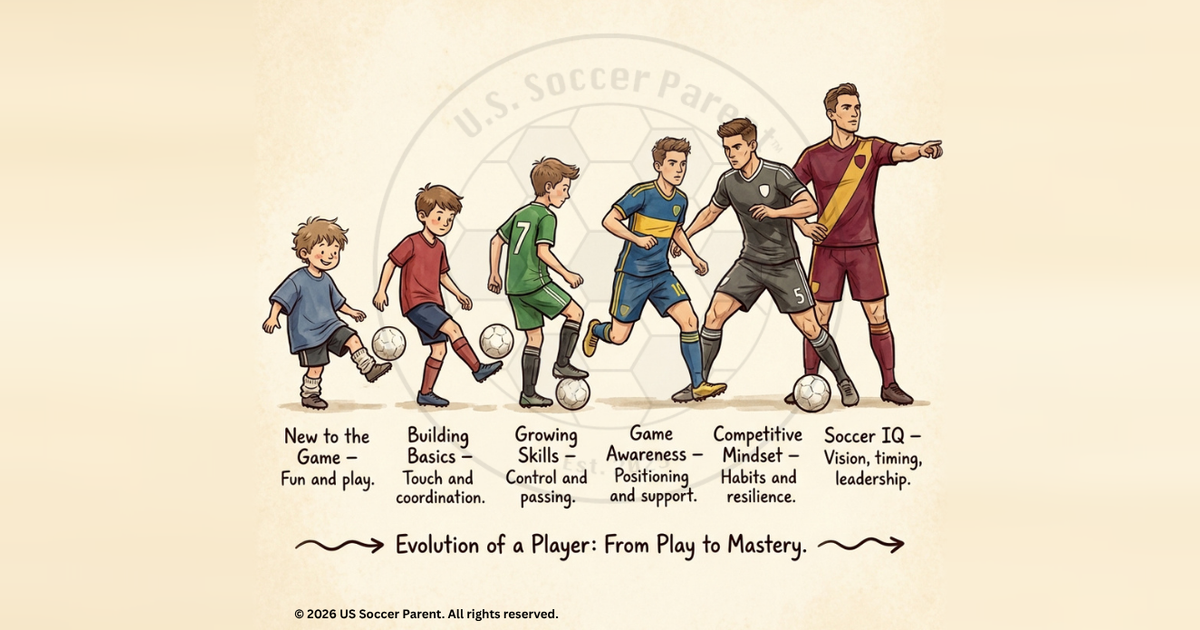
Use the six stages in the illustration at the top of this article as a simple reference point. A player-first club should be able to explain how it moves your child from one stage to the next.
The bottom line
In February, we said the U.S. Way was a direction of travel, not a destination. That is still true, even with new leadership. But the direction is clearer now. The federation is absorbing US Youth Soccer, a major league has written coach education into its rules, scouting is more transparent, and new programs are aimed at players the system used to miss.
What hasn't changed is where development happens. It is still your local club. The best thing parents can do is ask good questions and support the clubs that are actually putting players first.
The U.S. Way Update: Frequently Asked Questions
Quick answers about U.S. Soccer's player-development push, the USYS vote, and how to tell if your club puts players first.
What is the U.S. Way?
The U.S. Way is U.S. Soccer's player-development philosophy. It aims to create shared standards, age-appropriate training and clearer pathways from recreational soccer to the national teams, without forcing one playing style on every club.
How does the USYS vote connect to the U.S. Way?
On August 29, 2026, US Youth Soccer's state associations voted to make U.S. Soccer the sole voting member of USYS. That puts the federation in a direct relationship with the 54 state associations, one of the biggest coordination challenges for the U.S. Way. U.S. Soccer's integration announcement names the U.S. Way among the initiatives it builds on.
Has the U.S. Way changed anything for youth players yet?
Some things have. U.S. Soccer launched a Futures program for later-maturing boys, published talent-identification data, expanded its Talent Reporters scouting network and opened its National Training Center. Most day-to-day changes still depend on individual clubs.
Does the U.S. Soccer and US Youth Soccer integration affect my child this season?
Not yet. The two-year integration began September 1, 2026, with full integration targeted for 2028. Registration and league play continue as normal for now.
What does U.S. Soccer look for when scouting youth players?
U.S. Soccer lists six key qualities: physical execution, game understanding and decision-making, technical execution, responsibility and initiative, growth mindset and winning mentality, and learning ability.
How can I tell if my child's club prioritizes development over winning?
Look at playing time, coach education, the type of feedback players get, travel load and how the club treats later-developing players. A player-first club should be able to explain its development philosophy and show it on the field.