
NewsNews
5-for-5: NCAA Finalizes Shift to Five-Year Age-Based Eligibility Model
June 26, 20269 min read
Updated: August 3, 2026
As expected, the NCAA is now officially moving to a five‑year, age‑based eligibility model. It is a significant shift that will tighten roster openings for incoming freshmen and raise the bar for “day‑one ready” college soccer players. For American youth players and parents, it accelerates the timeline: more development must be done before matriculation, and alternative pathways (gap year, JUCO, post‑grad or overseas) will matter more, but they need to be used carefully so they do not burn eligibility under the new rules.
What the NCAA just changed
- Division I athletes now get up to five years of competition, not four, as long as they enroll no later than the academic year after their 19th birthday.
- The model is age-based, and the trigger is not high school graduation. The five-year window opens at whichever of these comes first: the term the player first enrolls full time and attends class at any college — domestic, international or two-year — or the age-based trigger. The age trigger is the start of the academic year right after the player’s 19th birthday if they turn 19 before September 1. If they turn 19 on or after September 1, the clock instead starts the following academic year, unless they enroll full time before then.
- Traditional redshirts and most waivers (including medical hardship and clock extensions) are eliminated, with narrow exceptions for pregnancy, active‑duty military service and official religious missions if no organized competition is played.
- The new model becomes the only option for prospects first enrolling full‑time in fall 2027 or later; the 2026‑27 class and current athletes can use either the old or new rules, whichever is more favorable.
Update — September 2, 2026: The injunction is paused
On August 21, the Tenth Circuit Court of Appeals granted the NCAA a stay of the class-wide injunction in Wisne v. NCAA, on a 2–1 vote. The panel found the NCAA had met its burden on all four stay factors, including a strong showing that it is likely to win on the merits.
Read that carefully, because the distinction matters: the injunction is paused, not overturned. The court did not rule on the merits, and it did not disturb the class certification. An expedited appeal has been set.
The practical effect was immediate. The NCAA’s age-based eligibility rules went back into force. Class of 2022 athletes whose only protection was membership in the certified class are ineligible again. Schools will not be charged with violations for players who competed while the injunction was in effect, and the NCAA said it would continue processing hardship and season-of-competition waiver requests submitted by the July 31 deadline.
One important exception: the federal stay does not reach athletes who won their own separate court orders. A group of Louisiana football players and the Ohio state-court basketball plaintiffs hold individual injunctions and are unaffected.
What this means for your family: if your player is in middle school or high school, none of this litigation is about them. The certified class covers athletes who started college in 2022-23 and finished four seasons in spring 2026 — young adults now 22 and 23 years old. What governs your player is the enrollment-year table below, and that table has not changed once through any of this.
(The earlier ruling, for context)
Update — August 3, 2026
On August 1, NCAA chief legal officer Scott Bearby called the Colorado ruling “egregiously wrong” in a letter to member schools and said the NCAA would appeal on an expedited basis (Yahoo Sports). The appeal went to the Tenth Circuit Court of Appeals.
On August 2, the NCAA filed an emergency motion asking Judge Sweeney to clarify exactly what her order enjoined. She ruled the same day — granting the motion while leaving the injunction itself untouched. Class of 2022 athletes cannot be barred from a fifth season. But she made three limits explicit: the order does not enjoin NCAA transfer rules, does not override the House settlement’s roster limits or revenue-sharing cap, and does not stop individual schools from making their own eligibility decisions (Las Vegas Sun, Yahoo Sports).
A transfer portal window for these athletes ran August 3–10 (SwimSwam) and has since closed.
What this means for your family: the roster-limit clarification is the part that matters most for soccer families. Because House roster limits stay in effect, a returning fifth-year player doesn’t create an extra spot — they occupy one of the existing capped spots. If a roster is already full, a class of 2022 player can’t simply join it. For 2027 and 2028 families, the practical effect is unchanged from our earlier update: more competition for the same number of places, and no certainty until the appeal resolves. Treat any individual eligibility question as unsettled and confirm with the NCAA Eligibility Center or the compliance office at the school recruiting your player.
Join U.S. Soccer Parent
Free for every soccer parent.
Save articles, get the free newsletter, and find guidance tuned to your state, your kids' ages, and the pathway your family is on.
Which rules apply to your player
This is the part to bookmark. It comes straight from the NCAA Eligibility Center, and unlike the court news, it has stayed put.
Used their final season of competition under the previous rules during 2025-26 — no additional eligibility.
Currently in college with eligibility remaining after 2025-26 — reviewed under the previous rules or the new age-based rule, whichever is most beneficial to the athlete.
First enrolls full time during 2026-27 — reviewed under the previous rules or the new age-based rule, whichever is most beneficial to the athlete.
First enrolls full time in fall 2027 or later — the age-based rule only.
If you are reading this as the parent of a youth player, you are almost certainly in that last group. The age-based rule is the only rule that will ever apply to your child, and no court ruling to date has changed that. Everything in the litigation updates above concerns athletes who are already in college.
In practical terms, the NCAA traded a messy, loophole‑filled system of waivers and redshirts for a simple five‑year window that almost every athlete can understand at a glance.
This decision formalizes a direction that had been telegraphed for months, as Division I leaders discussed an age‑based “5‑for‑5” proposal to cap careers and reduce legal exposure around eligibility disputes. College sports had drifted toward older rosters, with sixth‑ and even seventh‑year players using waivers and medical redshirts to stay in school well into their mid‑20s, which in turn squeezed out younger recruits. The Cabinet and NCAA leadership have said they wanted a model that is easier to administer and more predictable for roster management, which this rule clearly delivers.
From a soccer perspective, this rule is more about stabilizing rosters across all sports than it is about soccer specifically, but the ripple effects will be felt acutely in a non‑revenue sport where scholarship money is already fragmented and coaches tend to lean on experienced players.
Impact on youth soccer players and families
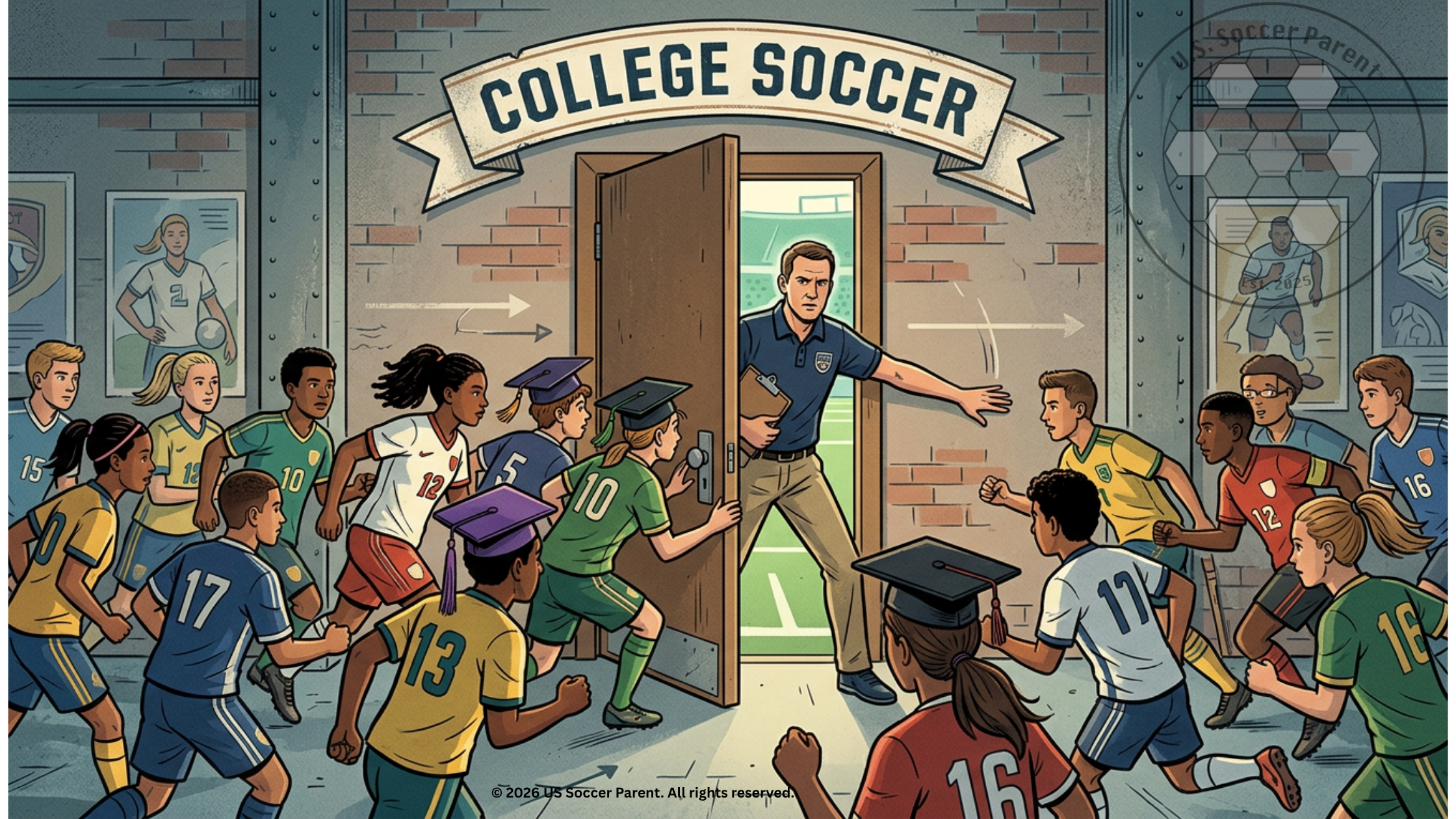
For U.S. youth soccer families, the headline is straightforward and it’s not good news, especially for kids in 2027/28 classes who are seeing the ground shift beneath them. There will likely be fewer true openings for 18‑year‑old freshmen, and coaches will have both the incentive and the mechanism to keep a core group together for five full seasons. A five‑year window with no redshirts means:
- More fifth‑year players on rosters, especially in the spine (center backs, central mids, goalkeepers) where experience and physical maturity are most valued.
- Less turnover year‑to‑year, making it harder for marginal high school seniors to win one of a limited number of roster spots.
- A stronger bias toward recruits who arrive physically mature and tactically polished enough to help right away, rather than projects who might have previously been stashed on a redshirt.
Programs now get to spread the same number (or in some cases fewer) scholarships across potentially older, more stable rosters, so the risk profile of each scholarship offer changes. Expect larger classes of impact‑ready transfers (from JUCO, lower‑division NCAA or NAIA) who have already proven they can handle the college game. At the same time, smaller, more selective freshman classes at many programs, with fewer “developmental” players taken on speculation.
This amplifies existing pressures in the system; it does not create them from scratch. U.S. youth pathways already reward early physical developers and those in high‑visibility environments (MLS NEXT, GA, ECNL), and this model makes that bias even sharper.
Do families now “need” a gap year?
The new rules of course do not automatically dictate a gap year, but they do make your pre‑college development strategy more consequential. A gap year or post-grad step can help a player close the physical and tactical gap before entering college. Here is the part that changed, and it is good news: the NCAA eliminated the old delayed-enrollment and organized-competition rules, so where and how a player competes during a gap year no longer starts or burns eligibility on its own. Only two things move the clock now — enrolling full time, and the age trigger. That makes the calculation much simpler. If your player turns 19 well before they plan to enroll, the clock is going to start without them whether they play, train, or sit on the couch. If it starts before they get to campus, they will not have five seasons available. That is the whole question.
Well‑structured options that can support a later entry include:
- Domestic post‑grad academies and “U19/U20” style programs that deliver high‑level training, match play and showcases without triggering NCAA enrollment.
- Overseas gap‑year programs designed to preserve NCAA eligibility while providing daily training and competition in Europe or elsewhere; some providers explicitly market this model to American players.
- Junior college (JUCO) routes for players needing academic recovery, more film or a second shot at recruiting; these still consume eligibility years, but can position an athlete as a proven college player when they arrive at a four‑year school.
Because the NCAA is now tying eligibility to age and enrollment instead of “seasons of competition,” the key is not just whether you are playing, but when you start full‑time college and whether your path includes any exceptions (military, pregnancy, religious missions) that legally pause the clock. For most families, the smarter adjustment is not “everyone take a gap year,” but “be much more intentional about whether an extra year before college will actually change your recruiting profile enough to justify burning calendar time.”
What youth players should do differently now
Given this shift, the practical guidance for U.S. Soccer Parent readers and American youth families looks like this.
- Accelerate readiness by age 17–18: Priority one is arriving on campus with college‑level physicality (strength, speed, resilience), not hoping to “grow into it” via a redshirt year that now largely does not exist.
- Upgrade the recruiting story: Coaches facing tighter roster churn will look for players who can contribute in the first 12–18 months; highlight reels, data (GPS, match metrics) and references all need to scream “ready to play now.”
- Segment pathways by profile, not emotion:
- Early‑maturing, high‑level prospects should still aim for direct entry to strong Division I or II programs, possibly leveraging the new fifth season to maximize development and exposure.
- Late‑bloomers and players from less‑visible clubs may be better served by a deliberate two‑step path — JUCO, NAIA or D3 first, then transfer — to arrive at their “final” school as battle‑tested sophomores or juniors.
- Families considering gap‑year academies or overseas options should vet programs for NCAA compliance and realistic placement results, not just branding.
The underlying message is that the margin for error shrinks: the college window is still five years long, but it is now clearly defined and less forgiving of delays, missteps and “try it and see” decisions. U.S. youth players and parents do not need to panic, but they do need to plan; the era of assuming a redshirt or waiver can fix things later is over.